Zero Tax Up to ₹12.75 Lakhs – Reality Explained
Introduction
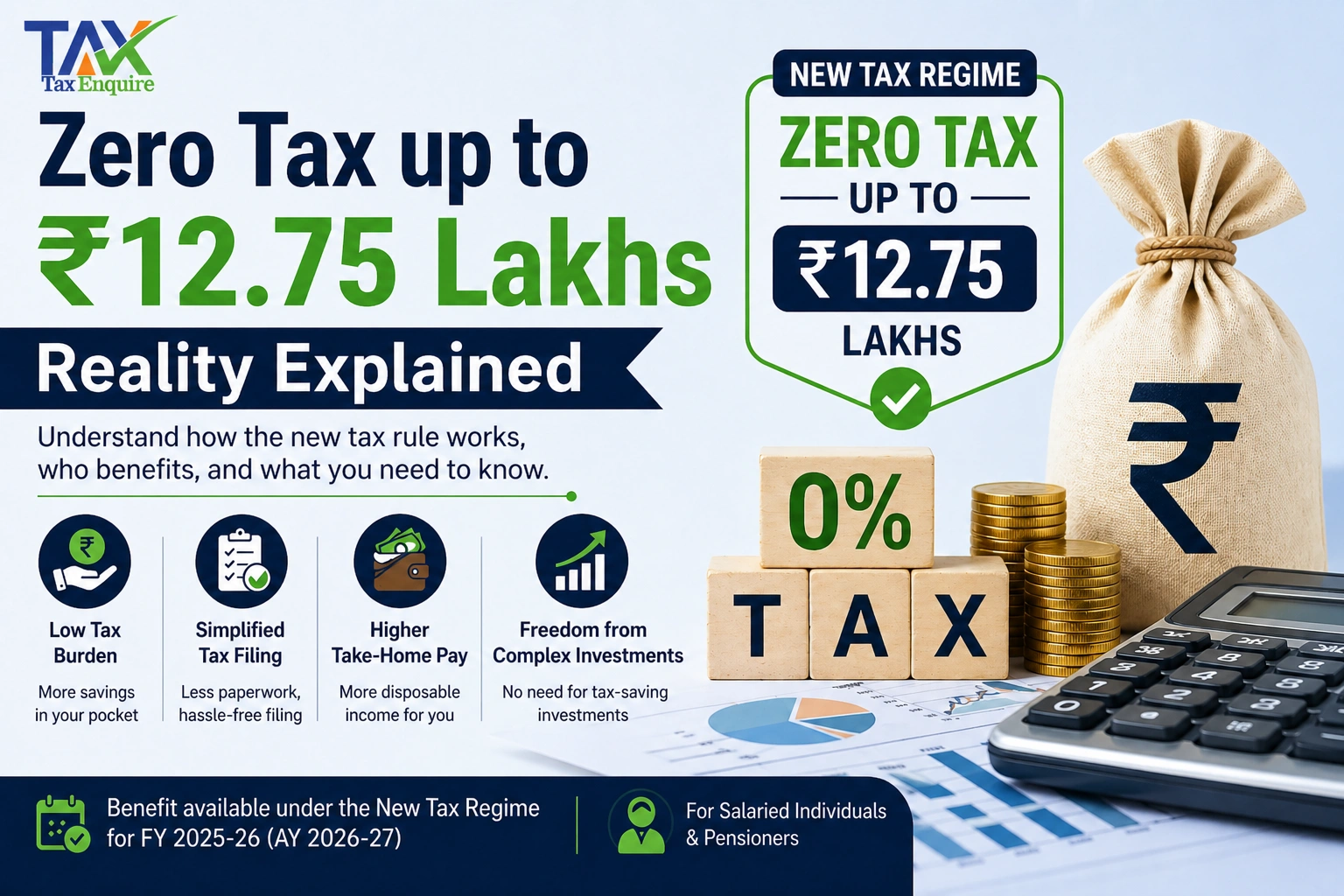
The announcement of zero tax up to ₹12.75 lakhs has created excitement among taxpayer’s, especially salaried individuals. At face value, it appears that anyone earning up to this amount does not need to pay any income tax. However, this interpretation is not entirely accurate.
In reality, this benefit is the result of a combination of provisions under the new tax regime, including the standard deduction and rebate under Section 87A. It is not a blanket exemption like basic exemption limits in earlier system’s.
Understanding how this work’s is crucial because many taxpayers assume they are fully exempt, which may lead to incorrect tax planning or compliance issues. This article breaks down the concept in detail and explains the actual mechanics behind achieving zero tax liability at ₹12.75 lakhs.
What Does “Zero Tax up to ₹12.75 Lakhs” Mean?
The phrase does not mean that income up to ₹12.75 lakhs is completely tax-free. Instead, it means that after applying deductions and rebate’s, the final tax payable becomes zero.
Here’s the key distinction:
Income is still taxable under slab rates
Tax is calculated as per applicable slab’s
A rebate is applied to reduce the tax liability
Final tax payable becomes zero
Another important aspect is the difference between gross income and taxable income. While your gross salary may be ₹12.75 lakhs, the taxable income becomes lower after deducting the standard deduction. This reduced taxable income is what qualifies for rebate eligibility.
So, the benefit is more of a tax relief mechanism rather than a direct exemption.
Key Components Behind Zero Tax Benefit
1. Section 87A Rebate
Section 87A is one of the most important provisions for individual taxpayers. It provide’s a rebate that directly reduces the amount of tax payable.
Under the new tax regime, if your taxable income fall’s within the specified limit, you can claim this rebate. The rebate amount is equal to the tax liability or a specified cap, whichever is lower.
In simple terms, even if tax is calculated based on slab rate’s, the rebate cancels it out, resulting in zero tax payable.
However, this benefit is strictly conditional:
It is available only to resident individuals
It depends on taxable income, not gross income
Once income crosses the threshold, the rebate benefit reduces or disappears
This makes Section 87A the backbone of the zero-tax concept.
2. Standard Deduction of ₹75,000
The standard deduction is another key factor that helps increase the zero-tax limit. Under the new tax regime, salaried individuals and pensioners are allowed to claim a flat deduction of ₹75,000.
This deduction reduces the total taxable income without requiring any proof or investment.
For example:
Gross Income: ₹12.75 lakh
Less Standard Deduction: ₹75,000
Taxable Income: ₹12 lakh
This reduced taxable income becomes eligible for rebate under Section 87A.
Without this deduction, the taxable income would exceed the rebate limit, and zero tax would not be possible. Therefore, the standard deduction effectively extend’s the zero-tax threshold.
New Tax Regime Slabs (FY 2025–26 / AY 2026–27)
The new tax regime is designed to simplify taxation by offering lower tax rates with minimal deductions. It replaces the complex system of exemptions and deductions available in the old regime.
The slab structure is progressive, meaning tax rates increase as income rises. Typically, it includes:
Lower income taxed at minimal or zero rate
Middle-income taxed at moderate rate’s
Higher income taxed at higher rates
These slabs are applied to taxable income to compute the total tax liability. Unlike the old regime, most deductions are not allowed here, except a few like the standard deduction.
The simplicity of this regime is what makes it easier to calculate tax and understand how the rebate applies.
Income Tax Slabs Comparison (New Tax Regime)
Let’s understand the process in detail with a practical example: Step 1: Calculate Gross Income: Assume a salaried individual earn’s ₹12,75,000 annually. Step 2: Apply Standard Deduction: Deduct ₹75,000 → Remaining income = ₹12,00,000 Step 3: Compute Tax as per Slab’s: Tax is calculated on ₹12,00,000 based on slab rates. Step 4: Apply Section 87A Rebate: Since taxable income is within the eligible limit, rebate is applied. Step 5: Final Tax Payable: Tax liability becomes zero after rebate adjustment. This step-by-step approach show’s that zero tax is achieved only after proper calculation and application of provisions. This is a critical area where many taxpayers make mistakes. If your taxable income exceeds ₹12 lakh even by a small amount: You may lose eligibility for the full rebate Tax liability will arise The increase in tax may feel sudden For example: Income: ₹12,00,000 → Zero tax Income: ₹12,10,000 → Tax becomes payable This sharp transition happens because rebate eligibility is tied to a specific threshold. Once crossed, the benefit reduces significantly. Therefore, careful income planning is essential to stay within the limit if the goal is zero tax. Marginal relief is introduced to reduce the burden when income slightly exceeds the rebate threshold. Without marginal relief, a small increase in income could lead to a disproportionately high tax liability. This would be unfair to taxpayers. Marginal relief ensures that: The additional tax payable does not exceed the additional income earned The transition from zero tax to taxable income is smoother This provision acts as a safety net, especially for those whose income is just above the rebate limit. While the zero-tax benefit is attractive, it comes with certain conditions: Applicable only under the new tax regime Available only to individual taxpayers Not applicable to certain types of income like capital gains or lottery income Based on taxable income, not gross income Additionally, if a taxpayer opts for the old tax regime, this benefit may not be available in the same manner. Understanding these limitations is essential to avoid incorrect assumptions. The old tax regime allows multiple deductions and exemptions, such as investments under Section 80C, HRA, and medical insurance. However, achieving zero tax at ₹12.75 lakh income under the old regime is difficult unless the taxpayer has significant deductions. The new tax regime, on the other hand: Offers simplicity Requires minimal documentation Provides predictable outcomes Choosing between the two depends on individual financial situations. Taxpayers with high deductions may still benefit from the old regime, while others may find the new regime more advantageous. Case 1: Salaried Individual Case 2: Slightly Higher Income Case 3: Pensioner These scenarios highlight how small differences in income can impact tax outcomes. This provision is designed to make taxation simpler and more beneficial, especially for salaried and middle-income taxpayers. Let’s understand each advantage in detail: One of the biggest advantage’s of this rule is the significant reduction in tax liability for individuals earning in the middle-income range. Earlier, taxpayers with income around ₹10–₹15 leaks had to pay a noticeable amount of tax even after deductions. With the combined benefit of standard deduction and rebate, individuals earning up to ₹12.75 lakhs can now legally bring their tax liability down to zero. This directly reduce’s financial pressure and allows taxpayers to retain more of their earnings. It is especially beneficial for salaried professionals, pensioners, and small taxpayers who do not have access to multiple tax-saving instrument’s. The new rule works under the new tax regime, which is known for its simplicity. Unlike the old regime, where taxpayers had to maintain proofs for investments, rent receipts, insurance policies, and multiple deductions, this system minimizes such requirements. Since the zero-tax benefit is achieved through fixed deduction and rebate, the need for documentation and calculation complexity is reduced. This makes tax filing: Faster Less prone to errors Easier even for non-experts As a result, taxpayers can file returns with greater confidence and less dependency on extensive paperwork. When tax liability is reduced or eliminated, the immediate impact is an increase in take-home income. For example, a taxpayer who previously paid ₹20,000–₹40,000 as tax can now retain that amount. This extra income can be used for: Daily expenses Savings and investments Loan repayments Lifestyle improvements Higher disposable income also improves overall financial stability and boosts spending capacity, which can indirectly support economic growth. Under the old tax regime, taxpayers often invested in instruments like LIC policies, PPF, ELSS, or fixed deposits mainly to save tax, not always because those investments suited their financial goals. This new rule reduces that dependency. Since zero tax can be achieved without multiple deductions, taxpayers are no longer forced to: Lock money in long-term schemes Make last-minute tax-saving investments Choose products only for tax benefit’s Instead, individuals can now focus on goal-based financial planning rather than tax-driven decisions. This lead’s to more flexible and efficient money management. It aligns with the government’s objective of making taxation simpler and more transparent. Misconception 1: ₹12.75 lakh is fully tax-free Misconception 2: No need to file tax return Misconception 3: Crossing ₹12 lakh leads to huge tax Clarifying these misconception’s helps taxpayer’s make better decisions. To make the most of this benefit: Keep track of total income, including bonuses and incentives Plan salary structure carefully Compare both tax regimes before choosing Avoid exceeding the rebate threshold unnecessarily Effective planning can help maintain zero tax liability without complications. The concept of zero tax up to ₹12.75 lakhs is beneficial but often misunderstood. It is not a direct exemption but a calculated outcome achieved through deductions and rebate. Taxpayers should focus on understanding the mechanism rather than relying on assumption’s. Proper planning, awareness of condition’s, and choosing the right tax regime are key to maximizing this benefit. In the end, informed decision’s lead to better financial outcomes and stress-free compliance.Step-by-Step Calculation of Zero Tax
What Happens If Income Exceeds ₹12 Lakhs?
Marginal Relief Explained
Important Conditions & Limitations
Zero Tax vs Old Tax Regime
Practical Scenarios & Case Studies
Income: ₹12.75 lakh
After deduction and rebate → Zero tax payable
Income: ₹13 lakh
Rebate not fully applicable → Tax liability arises
Receives standard deduction → Eligible for rebate → Zero tax possibleBenefits of This New Tax Rule
1. Reduces Tax Burden for Middle-Income Earners
2. Encourages Simplified Tax Filing
3. Increases Disposable Income
4. Eliminates the Need for Complex Tax-Saving Investments
Common Misconceptions
Reality: Tax is calculated and then reduced
Reality: Filing may still be required
Reality: Marginal relief may reduce the impactTax Planning Tips Under New Regime
Conclusion
© 2026 Tax Esquire | Expert CA Services in Greater Noida, Uttar Pradesh
8810380146 | info.taxesquire@gmail.com | taxesquire.in
This document is for informational purposes only. For personalised tax advice, consult our chartered accountants.