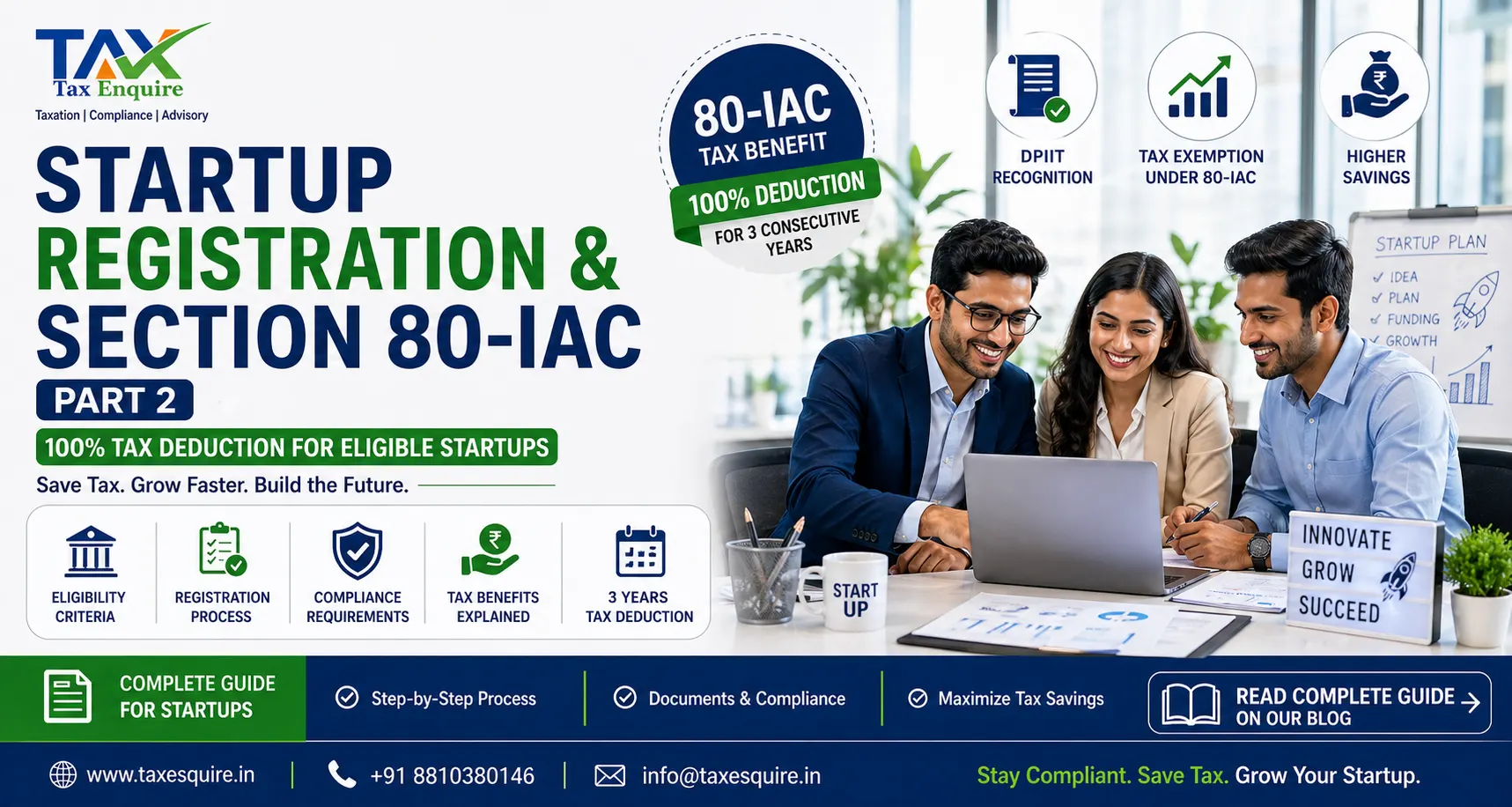
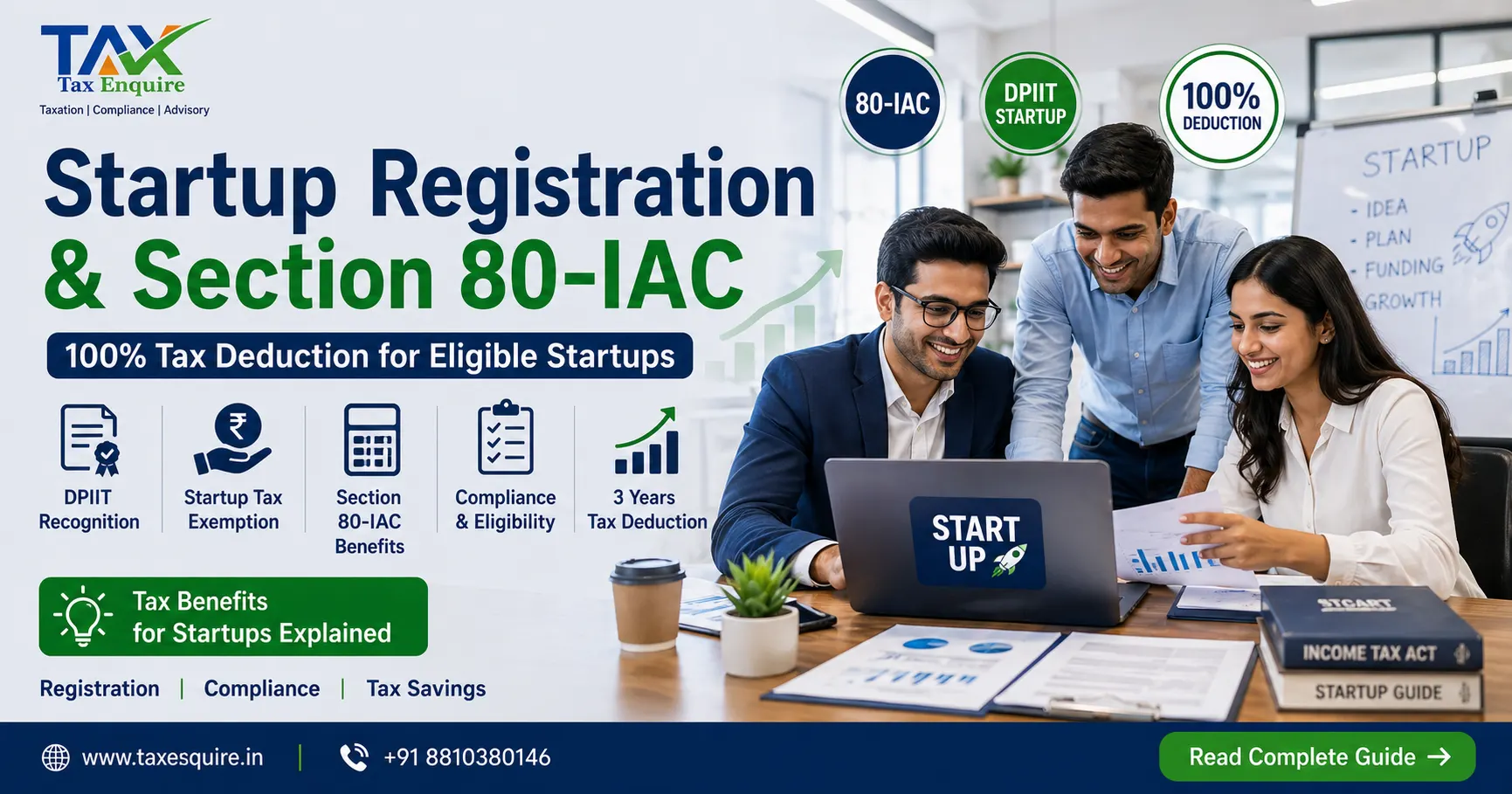
Startup Registration & Section 80-IAC
Introduction
India’s startup ecosystem has seen exponential growth due to digital transformation, investor interest, and proactive government policie’s. To support entrepreneur’s, the government introduced the Startup India initiative, which provide’s recognition, tax exemption’s, and compliance benefits.
Two major pillars of this support system are:
Startup Registration (DPIIT Recognition)
Tax exemption under Section 80-IAC
These benefits are not automatic; they require proper planning, eligibility, and compliance. This guide helps founder’s understand the entire lifecycle from incorporation to tax saving’s so they can make informed decisions.
What is a Startup (As per Government of India)?
A startup is defined by the Department for Promotion of Industry and Internal Trade based on specific criteria.
1. Incorporation Period
The entity must be incorporated within the last 10 years. Beyond this period, it loses startup status even if it meets other condition’s.
2. Turnover Limit
Annual turnover must not exceed ₹100 crore in any financial year since incorporation.
3. Innovation & Value Addition
The business must:
Develop new products/services
Improve existing ones
Use technology or unique processes
Traditional businesses (e.g., trading shops) usually do not qualify unless they bring innovation.
4. Scalability
The startup should demonstrate:
Growth potential
Ability to generate employment
Market expansion possibilities
Not Eligible:
Businesses formed by splitting or reconstructing existing companies
What is Startup Registration (DPIIT Recognition)?
Startup Registration is the process of getting official recognition under the Startup India scheme.
Objective:
Identify innovative businesses
Offer tax and compliance benefits
Promote entrepreneurship
Why It Matters:
Mandatory for claiming 80-IAC tax exemption
Builds credibility with investors
Enables participation in government schemes
Without DPIIT recognition, startups cannot access most government benefits.
Types of Business Structures for Startups
Choosing the right structure affects funding, taxation, and compliance.
1. Private Limited Company
Separate legal entity
Easy fundraising (VCs prefer this)
Limited liability
Best for scalability
2. Limited Liability Partnership (LLP)
Lower compliance than companies
Suitable for professional startups
Limited liability protection
3. Partnership Firm
Easy to start
Fewer compliance requirements
Not preferred for startups seeking investment
Best Choice: Private Limited Company
Step-by-Step Process
Getting recognition from the Department for Promotion of Industry and Internal Trade involves 4 simple steps:
Step 1: Incorporation
Register your startup through the Ministry of Corporate Affair’s.
You’ll get:
Certificate of Incorporation
PAN & TAN
Choose Pvt Ltd or LLP for better eligibility and growth.
Step 2: Startup India Portal Registration Create an account on the Startup India portal Fill basic details like: Startup name Industry Founder details This creates your official startup profile. Step 3: DPIIT Application Apply for recognition by submitting: Business details Innovation description (very important) Supporting documents (COI, pitch deck, website, etc.) Clearly explain what makes your startup unique and scalable. Step 4: Review & Approval DPIIT reviews your application If everything is correct, approval comes in 2–7 days You’ll receive: Startup Recognition Certificate This makes you eligible for benefits like Section 80-IAC of Income Tax Act. Certificate of Incorporation PAN of entity Aadhaar of directors/partners Business description (clear & detailed) Website or pitch deck Proof of innovation (important for approval) A strong innovation description significantly increases approval chances. Getting recognized under the Department for Promotion of Industry and Internal Trade is not just a formality it unlocks a powerful ecosystem of tax saving’s, compliance relief, funding access, and legal advantages. Let’s break down each benefit in detail and understand how it directly impacts a startup’s growth. One of the biggest advantage’s of startup registration is eligibility for tax exemption under Section 80-IAC of Income Tax Act. Startup’s usually struggle with cash flow in early stages Saving tax means more money for growth More funds for hiring employees Increased budget for marketing & expansion Faster product development This benefit alone can save lakhs or even crores depending on profitability. DPIIT-recognized startups are allowed to self-certify compliance under certain labor and environmental laws. Provident Fund (PF) Employee State Insurance (ESI) Contract labor laws Other labor regulations No frequent government inspections Reduced compliance burden Less paperwork and legal hassle This creates a stress-free regulatory environment. Startups can wind up their business quickly under the Insolvency and Bankruptcy Code. Quick closure reduces financial losses Avoids long legal procedures Allows founders to restart new ventures faster This promotes a fail-fast, innovate-fast culture. DPIIT-recognized startup’s get access to various government scheme’s and funding support. Fund of Funds for Startups (FFS) Startup India Seed Fund Scheme (SISFS) Grants, subsidies, and incentive’s Easier access to capital Lower dependency on private investors Support in early-stage funding Better credibility in front of investors Increased chances of VC/angel funding Funding becomes more accessible and affordable. Startup’s receive strong support in protecting intellectual property (IP). Fast-track patent examination Up to 80% rebate on patent filing fee’s 50% rebate on trademark registration Government-facilitated legal support Protects innovation from competitors Builds long-term business value Enhances brand credibility A tech startup can: This encourages innovation and R&D investment. Documents Required for Startup Registration
Key Benefits of Startup Registration
1. Tax Benefits (80-IAC Eligibility)
What You Get: 100% tax exemption on profits and Available for 3 consecutive year’s out of 10 years
Why It Matters:
Practical Impact:
2. Self-Certification Under Labor Laws
Key Laws Covered:
What This Means:
Why It’s Important:
Focus on business instead of legal complexity
Save costs on compliance professionals
Avoid unnecessary penalties due to minor errors3. Easy Company Closure (Within 90 Days under IBC)
Key Advantage: Fast-track exit within 90 days
Why This is Crucial: Not all startups succeed—and that’s okay.
Benefits:
4. Government Funding Access
Key Opportunitie’s:
How It Helps:
Additional Advantage:
5. IPR Benefits
Key Benefits:
Why This Matters:
Example:
File patents faster
Save significant legal costs
Secure its innovation early