RCM On Rent : Complete Practical Guide FY 2026–27
Introduction
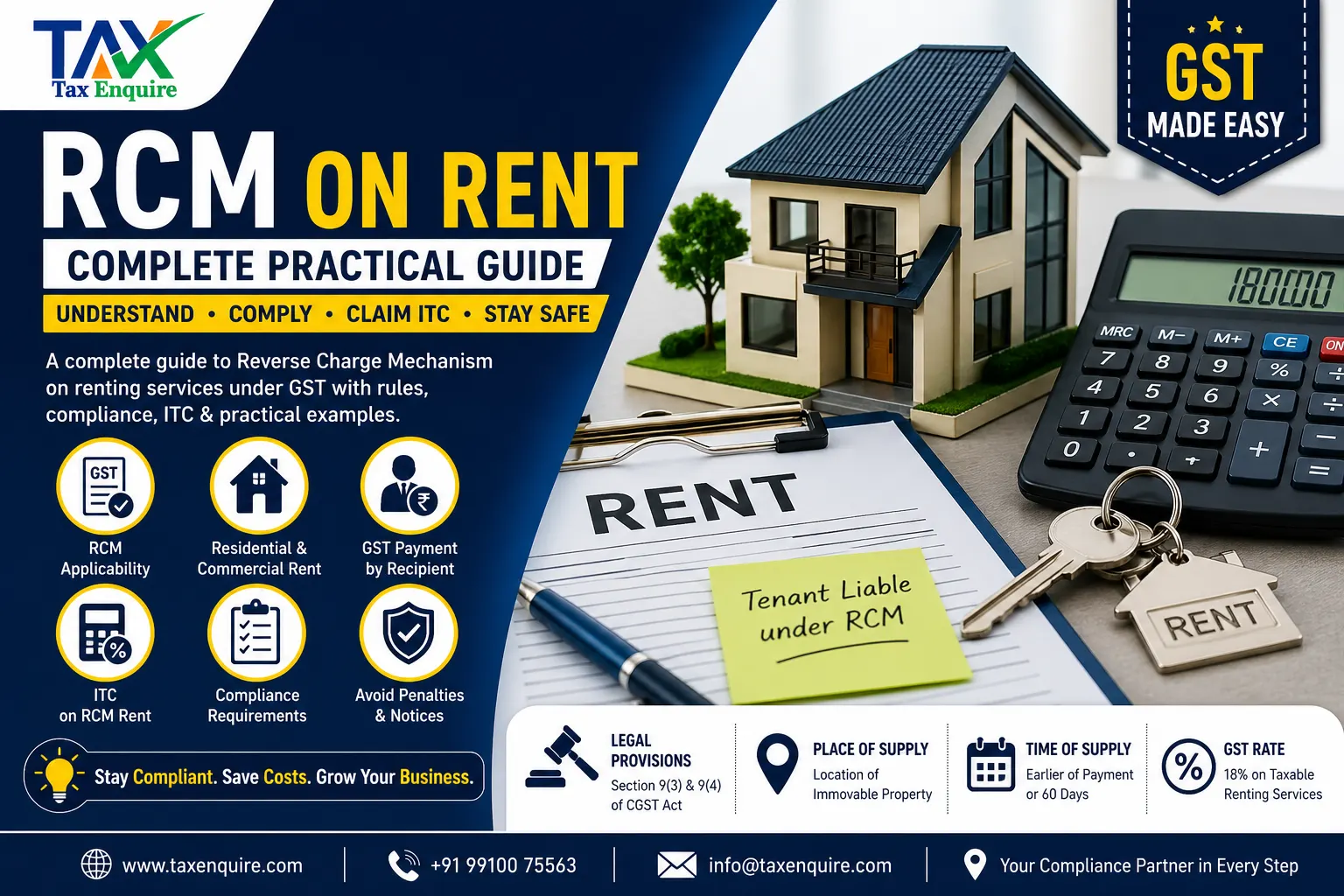
The taxation of renting transactions under GST has undergone a major transformation, especially after the introduction of Reverse Charge Mechanism (RCM) on certain renting services. What was earlier considered a simple exempt supply (in case of residential property) has now become a high-risk compliance area for businesses.
Today, many registered taxpayers unknowingly:
Fail to pay GST under RCM
Misclassify rent transactions
Incorrectly claim Input Tax Credit (ITC)
This guide provides a complete practical understanding of RCM on rent with real-life scenarios, legal provisions, and compliance steps.
Understanding GST on Renting Services
Under GST law, renting of immovable property is treated as a supply of service as per Schedule II of the CGST Act.
Types of Renting:
(A) Residential Property
Used for living purposes
Generally exempt
Exception: When used for business purposes
(B) Commercial Property
Shops, offices, warehouses, etc.
Always taxable
Continuous Supply: Renting is considered a continuous supply of service, meaning:
GST liability arises periodically (monthly/quarterly)
Even without invoice in some cases
What is Reverse Charge Mechanism (RCM)? RCM is a system where tax liability shifts from supplier (landlord) to recipient (tenant). Section 9(3) – Notified services Section 9(4) – Supplies from unregistered persons Core Concept: “Recipient pays GST instead of supplier” To bring unregistered suppliers into tax net To reduce tax evasion To ensure compliance from organized sector Applicability of RCM on Rent RCM is not applicable to all rent transactions—it applies only under specific conditions. Tenant must be registered under GST Property must be used for business purposes Transaction falls under notified category Personal rent = No GST RCM on Renting of Residential Property This is the most critical and frequently misunderstood provision. General Rule: Residential property rented for personal use → Exempt Exception (Major Amendment): If Property is rented to a registered person and Used for business/professional purposes Then GST is payable under RCM by tenant Key Insight: Even if the property is “residential”, usage determines taxability. RCM on Commercial Property Rent General Rule: Commercial property rent is taxable under forward charge Landlord charges GST and pays to government RCM Applicability: When landlord is unregistered (Section 9(4)) Tenant is registered RCM on Rent from Unregistered Landlord This provision is highly important for compliance. Legal Basis: Section 9(4) of CGST Act Applicability: If Supplier (landlord) is unregistered and Recipient (tenant) is registered Tenant must pay GST under RCM Time of supply determines when GST liability arises. Earliest of date of payment and 60 days from invoice date. Input Tax Credit (ITC) on RCM Rent ITC is one of the biggest advantages under RCM. Rent used for business GST paid under RCM Proper invoice/self-invoice available Personal use Blocked credits (Section 17(5)) Important Rule: ITC can be claimed only after GST payment in cash Compliance Requirements under RCM RCM increases compliance responsibility on tenants. Self-Invoicing: Required when supplier is unregistered Payment in Cash: Cannot use ITC to pay RCM GST Returns: GSTR-3B → Tax payment GSTR-1 → Reporting Treating all residential rent as exempt RCM introduced on residential rent for registered persons Increased GST audits on rent transactions Clarifications issued for business usage This area is under strict departmental scrutiny Benefits of Proper RCM Compliance Reverse Charge Mechanism (RCM) on rent is not just a legal requirement—it directly impacts a business’s financial health, compliance status, and risk exposure. Proper handling of RCM can save businesses from serious consequences while improving overall efficiency. 1. Avoidance of Penalties & Notices One of the biggest advantages of proper RCM compliance is protection from GST notices and penalties. RCM is a department-sensitive area, and GST authorities actively track: Transactions with unregistered suppliers Cases where GST is not paid under RCM Mismatch in returns (GSTR-3B vs books) 2. Smooth Input Tax Credit (ITC) RCM, when handled correctly, allows businesses to claim Input Tax Credit (ITC) efficiently. GST paid under RCM must be paid in cash Once paid, it becomes eligible for ITC Rent = ₹1,00,000 GST (18%) under RCM = ₹18,000 ₹18,000 can be claimed as ITC Reduces overall tax liability Improves working capital efficiency Avoids ITC blockage 3. Better Financial Planning RCM compliance brings clarity and predictability to tax liabilities. Rent is a fixed recurring expense, and GST on rent (under RCM) becomes a known monthly liability. Helps in accurate budgeting Improves cash flow management Enables correct pricing of goods/services 4. Strong Compliance Rating GST compliance is increasingly becoming data-driven, and every taxpayer has a compliance profile. Improves GST compliance score Reduces chances of: scrutiny, audit, and investigation. Easier loan approvals Better credibility with clients/vendors Smooth departmental interactions A compliant taxpayer is always treated as low-risk by authorities RCM on rent is now a critical compliance area under GST, especially after recent amendments. Businesses must: Understand applicability clearly Identify RCM transactions correctly Pay GST on time Maintain proper documentation A proactive approach ensures: Zero penalties Smooth ITC Strong compliance Legal Provisions:
Why RCM is Applied:
Key Conditions:
Important Clarification:
Business rent (in some cases) = RCM applicable Practical Scenarios:
Comparison:
Time of Supply under RCM for Rent
Under RCM:
GST Rate on Renting Services
ITC Available If:
ITC Not Available If:
Mandatory Requirements:
Common Mistakes & Risks
Ignoring RCM for business use
Not issuing self-invoice
Claiming ITC wrongly
Missing monthly liabilityLatest Updates & Notifications
Key Developments:
Why this matters:
How it works:
Example:
Benefits:
Why it matters:
Advantages:
Impact of Proper RCM Compliance:
Long-Term Benefits:
Conclusion
© 2026 Tax Esquire | Expert CA Services in Greater Noida, Uttar Pradesh
8810380146 | info.taxesquire@gmail.com | taxesquire.in
This document is for informational purposes only. For personalised tax advice, consult our chartered accountants.