MCA’s 2026 Amnesty Scheme–One time 90% Penalty waiver–MCA Companies Compliance Facilitation Scheme-CCFS 2026

Introduction
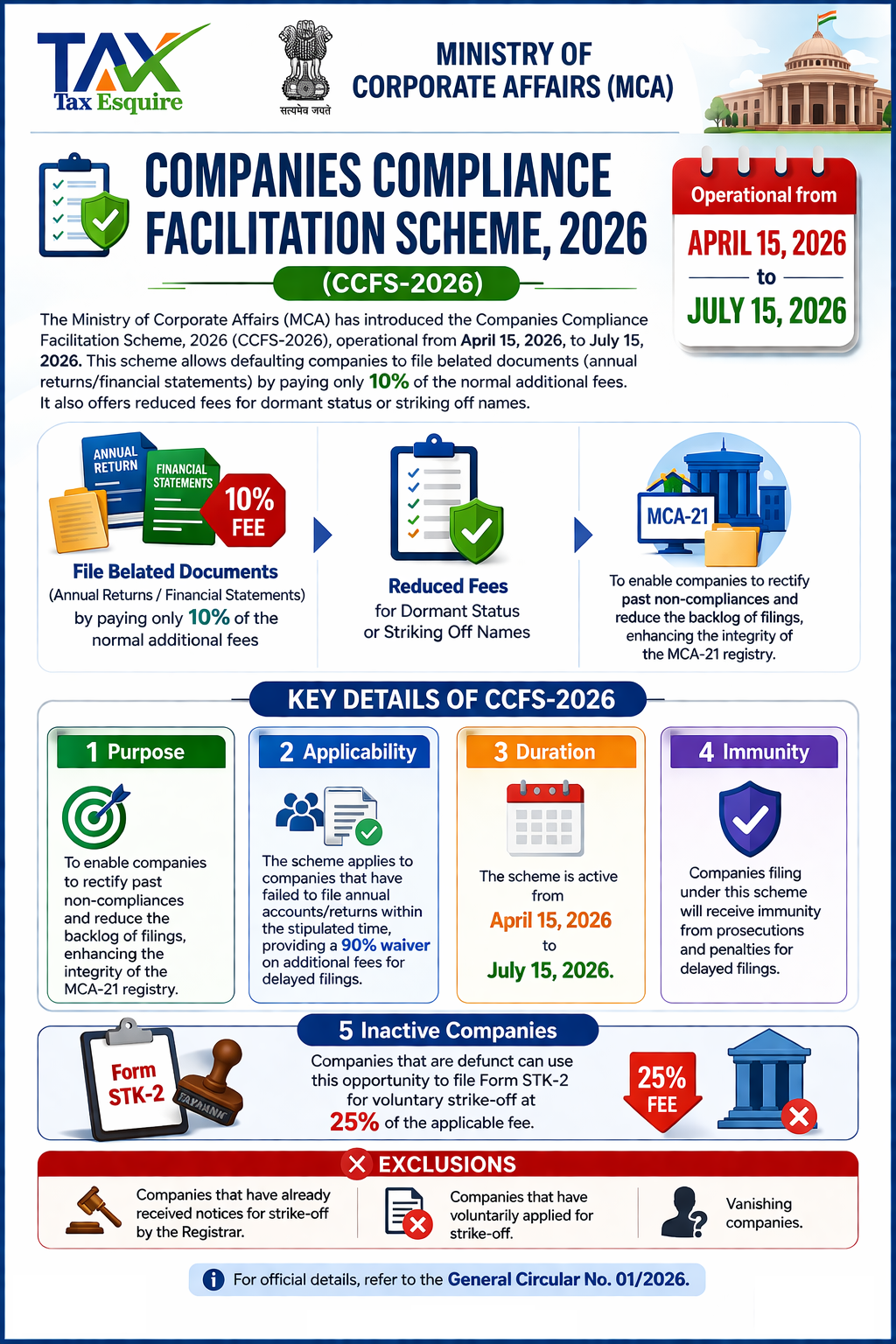
In a significant move to enhance corporate compliance and reduce the burden of accumulated penalties, the Ministry of Corporate Affairs (MCA) has introduced the Companies Compliance Facilitation Scheme, 2026 (CCFS-2026). This one-time amnesty scheme provides companies with an opportunity to regularise long-pending statutory filings at substantially reduced costs.
The scheme is particularly relevant for companies that have defaulted in filing annual returns, financial statements, or other mandatory forms under the Companies Act, 2013.
Scheme Overview
The CCFS-2026 is designed as a time-bound compliance window, enabling defaulting companies to complete overdue filings by paying significantly reduced additional fees.
Key Highlights:
• 90% waiver on additional (late) filing fees
• Applicable to a wide range of ROC forms
• Opportunity to avoid prosecution for delayed filings
• Additional options for dormant status or strike-off
Duration of the Scheme
The scheme is available for a limited period:
• Commencement Date: 15 April 2026
• Closure Date: 15 July 2026
Companies must complete all pending filings within this window to avail the benefits. No extension has been indicated, making timely action critical.
Scope and Forms Covered
One of the most notable features of CCFS-2026 is its broad applicability across various statutory filings. The scheme covers most e-forms under both the Companies Act, 2013 and certain legacy filings under the Companies Act, 1956.
Key Forms Included:
Annual Filings
• AOC-4, AOC-4 XBRL, AOC-4 CFS – Filing of financial statements
• MGT-7 and MGT-7A – Annual returns
Auditor-Related Filings
• ADT-1 – Appointment of auditor
• ADT-3 – Resignation of auditor
Director and KYC Compliance
• DIR-12 – Appointment and resignation of directors
• DIR-3 KYC – Director identification compliance
Charges and Borrowings
• CHG-1 – Creation or modification of charge
• CHG-4 – Satisfaction of charge
Event-Based Filings
• MGT-14 – Filing of resolutions
• PAS-3 – Return of allotment
Foreign Company Filings
• FC-1, FC-3, FC-4
Special Applications
• MSC-1 – Application for dormant company status
• STK-2 – Application for strike-off
This extensive coverage allows companies to address nearly all categories of non-compliance within a single framework.
Financial Relief Under the Scheme
The central benefit of the scheme lies in the substantial reduction of additional fees:
• Companies are required to pay:
o Normal filing fees, plus
o Only 10% of the applicable additional fees
Given that additional fees typically accrue at ₹100 per day without an upper limit, this waiver represents a significant financial advantage.
Additional Compliance Options
Beyond regular filings, the scheme offers strategic alternatives for companies with limited or no operations:
Dormant Company Status
Companies may apply for dormant status by filing the prescribed form and paying reduced fees. This option is suitable for entities intending to retain their legal existence without active operations.
Strike-Off of Company
Defunct companies may opt for voluntary removal from the register by filing Form STK-2 at concessional fees, providing a cost-effective exit route.
Immunity and Legal Relief
The scheme provides conditional immunity from prosecution and penalty proceedings for delays in filings, provided that compliance is completed within the stipulated timeline.
However, immunity may not be available in cases where adjudication orders have already been passed and compliance timelines have lapsed.
Consequences of Non-Compliance
Companies that do not avail the benefits of the scheme within the specified timeframe are likely to face stringent consequences under the Companies Act, 2013. Once the scheme concludes, the regulatory authorities are expected to resume strict enforcement actions against defaulting entities.
Financial Consequences
Upon expiry of the scheme, the relaxation in additional fees will no longer be available. Companies will be required to pay full additional fees, which continue to accrue at prescribed rates (generally ₹100 per day) without any maximum limit, significantly increasing the financial burden.
Legal and Regulatory Exposure
Non-compliant companies may become subject to adjudication proceedings initiated by the Registrar of Companies. Further, persistent defaults can lead to penal action and prosecution, depending on the nature and duration of non-compliance.
Impact on Directors
Continuous non-compliance may also have consequences for directors, including the risk of disqualification under applicable provisions of the Act. In certain cases, there may also be implications relating to the status of Director Identification Number (DIN) due to non-fulfilment of statutory obligations.
Business and Operational Impact
From a practical standpoint, non-compliant status may adversely affect the company’s credibility. This could create hurdles in raising funds, entering into contractual arrangements, or maintaining banking relationships, thereby impacting overall business operations.
Practical Implications
The scheme presents a cost-effective opportunity for companies to reassess and rectify their compliance status. Businesses with long-pending filings can significantly reduce financial liabilities while avoiding future legal complications.
A proactive approach—comprising identification of pending filings, evaluation of liabilities, and timely submission—will be critical to fully benefit from the scheme.
Conclusion
The MCA Amnesty Scheme 2026 (CCFS-2026) represents a pragmatic regulatory initiative aimed at encouraging voluntary compliance and easing the financial burden on companies.
With its limited validity and substantial benefits, the scheme offers a rare opportunity for businesses to reset their compliance position and align with statutory requirements at minimal cost.
Companies are strongly advised to act promptly and leverage this window to avoid stricter enforcement measures in the future.