GST Compliance for Small Businesses in 2026: A Complete Practical Guide
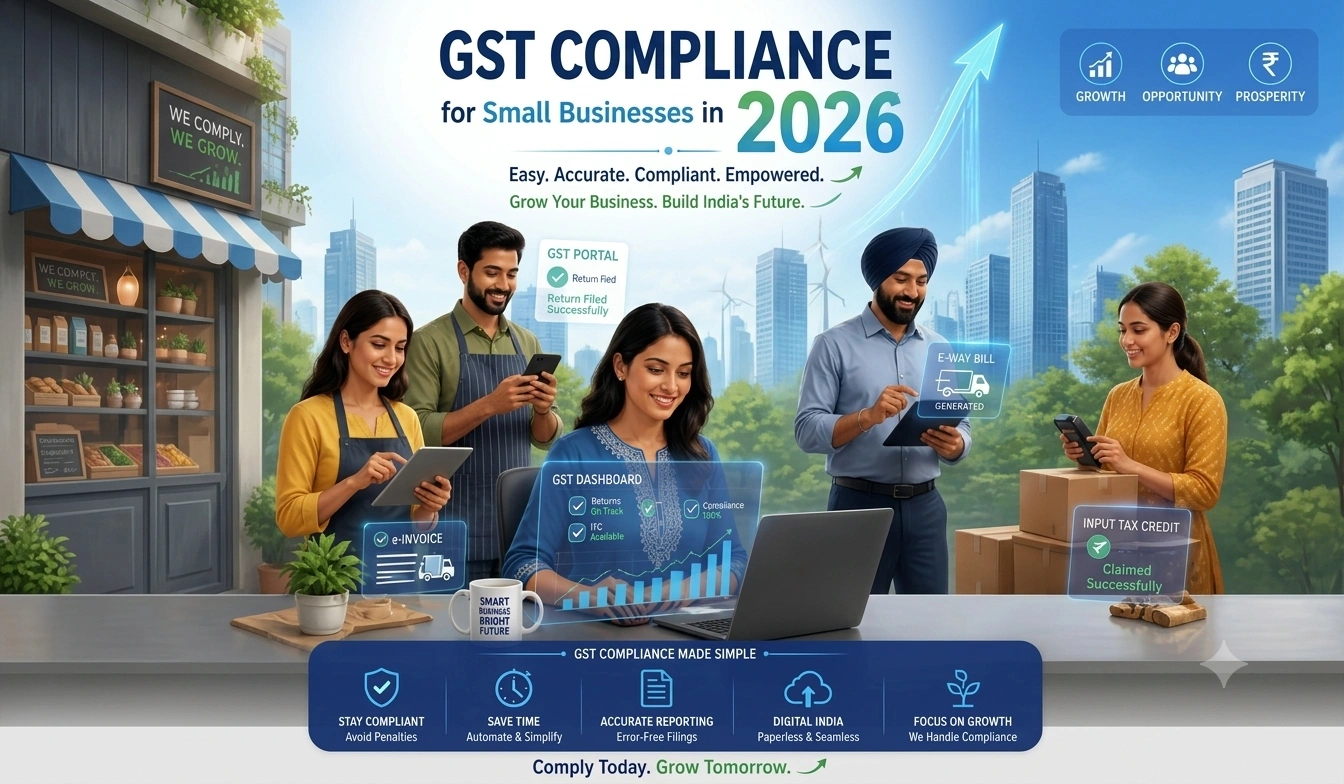
GST Compliance for Small Businesses in 2026
Everything you need to know about staying compliant with GST rules, meeting deadlines, and avoiding costly penalties
What's Changed in GST Compliance for 2026?
Look, GST rules keep evolving. In 2026, the compliance landscape has tightened. The tax authorities are now focusing heavily on real-time data validation and cross-checking of invoices across the supply chain. If you're running a small business, this means you can't afford to be casual about your GST filing anymore.
The thing is, most small business owners don't realize that GST compliance isn't just about paying taxes on time. It's about maintaining proper records, issuing correct invoices, and making sure your input tax credit claims match your supplier's output tax declarations. Get this wrong, and you're looking at penalties that can hurt your cash flow.
So what does this mean for you? You need a system. Not something complicated, but something that works consistently every single day.
Staying compliant in 2026 protects your business from surprise audits, penalties, and the stress of dealing with tax authorities. Plus, it builds trust with your customers and suppliers.
Do You Really Need to Register for GST?
The short answer? It depends on your turnover. But here's what I see most often: people either rush to register when they don't need to, or they delay registration when they should've done it months ago.
GST registration becomes compulsory if your annual turnover exceeds 20 lakh rupees. But and this is really important, there's a catch. If you're supplying goods or services to registered businesses, or if you're in certain sectors like e-commerce or restaurants, you might need to register even below this threshold.
- Businesses with turnover above 20 lakhs must register
- Certain sectors need registration below the threshold (food delivery, restaurants, e-commerce)
- Casual taxable persons must register even if turnover is lower
- Voluntary registration is allowed if turnover is below 20 lakhs
- Non-resident taxable persons must register immediately
- Input service distributors need to register separately
Honestly, the safest approach is to register if you're anywhere near the 20 lakh mark. The registration process is straightforward now, and it takes about 3-5 days to get approved.
Delaying GST registration when you should've registered can result in penalties up to 10% of the tax amount, plus interest. The tax department can also demand back taxes from the date you should've registered.
The Registration Process: What Actually Happens
In 2026, the registration process is mostly online. You'll go to the GST portal, fill out Form REG-01, and submit your documents. But here's where most people stumble: they don't prepare their paperwork properly beforehand.
What I mean is, you need to have your PAN, Aadhaar, business registration documents, and bank account details ready before you start. If you're a proprietor, you'll need your PAN and Aadhaar. If you're a partnership or company, you'll need your registration certificate and partner/director details.
| Document Type | Required For | Format |
|---|---|---|
| PAN Certificate | All registrations | PDF or JPG |
| Aadhaar | Proprietors and partners | PDF or JPG |
| Shop Act License | Retailers and traders | PDF or JPG |
| Rent Agreement | If premises are rented | PDF or JPG |
| MOA and AOA | Companies only | PDF or JPG |
Once you submit, the GST officer will verify your application. Most of the time, they'll approve it without any issues. Sometimes they'll ask for additional documents or clarification. But here's the thing: even if they ask for something, respond within 7 days. Missing that deadline can delay your registration by weeks.
GST Filing: The Monthly and Annual Returns You Can't Skip
And here's where compliance gets real. Once you're registered, you're filing GST returns. In 2026, there are two main returns you need to worry about: GSTR-1 and GSTR-3B.
GSTR-1 is your outward supply return. You report all the sales you've made. GSTR-3B is where you claim your input tax credit and pay the net GST amount. Put simply, GSTR-1 is what you sold, GSTR-3B is what you owe.
The filing deadline for GSTR-1 is the 11th of the next month. GSTR-3B is due by the 20th. Miss these deadlines, and you're automatically blocked from filing for the next period. Plus, you'll face late fees.
- GSTR-1 (Sales): Due by 11th of next month
- GSTR-3B (Tax Payment): Due by 20th of next month
- GSTR-9 (Annual Return): Due by December 31st
- GSTR-9C (Audit Report): Due if turnover exceeds 2 crores
- Late fees apply immediately after deadline
So what does this mean for you? You need a filing system. Mark these dates on your calendar. Better yet, set reminders two days before each deadline.
Filing on time keeps your GST account clean, prevents penalties, and makes sure you get your input tax credit without delays. It also protects you if the tax department decides to audit your business.
Invoicing Rules You Need to Follow Right Now
Here's something I see go wrong constantly: bad invoices. And I don't mean invoices that look ugly. I mean invoices that don't have the right information on them.
In 2026, every invoice you issue must have specific details. Your GST number, the buyer's GST number (if they're registered), the HSN or SAC code for the product or service, and the tax amount broken down by tax rate. Miss any of these, and your invoice isn't valid for input tax credit purposes.
The thing is, your supplier will be reporting this invoice in their GSTR-1. When you file your GSTR-2A, the system automatically matches their invoice with your purchase record. If there's a mismatch, you won't get input tax credit. And then you're paying tax twice on the same transaction.
| Invoice Detail | Requirement | Why It Matters |
|---|---|---|
| Invoice Number | Sequential, unique | Prevents duplicate claims |
| GST Numbers | Seller and buyer GSTIN | System matching and validation |
| HSN/SAC Code | Correct code for item | Determines correct tax rate |
| Tax Breakup | CGST, SGST, IGST separate | Enables input tax credit claim |
| Invoice Date | Actual date of supply | Determines tax period for filing |
Honestly, the easiest way to handle this is to use accounting software that's GST-compliant. Tools like Tally, Zoho Books, or even GST-specific software will auto-populate most of this information for you. Your job is just to make sure the HSN codes are correct.
Issuing invoices without proper GST details can result in the buyer not being able to claim input tax credit. This creates disputes and can damage your business relationships. The tax department also penalizes businesses that issue incorrect invoices.
Input Tax Credit: Getting Your Money Back
So you've paid GST on your purchases. Now you want to claim it back. That's called input tax credit, and it's one of the biggest benefits of GST registration.
Here's how it works: every time you buy something for your business, you get an invoice with GST. You can claim that GST as a credit against the GST you collect from your customers. So if you collected 10,000 rupees in GST but paid 7,000 rupees on your purchases, you only pay 3,000 rupees to the government.
But and this is where people mess up, you can't claim credit on everything. You can't claim credit on personal expenses, food, entertainment, or fuel (unless it's for your vehicle and you're in specific sectors). You also can't claim credit if the invoice isn't in the right format or if the supplier isn't registered.
What I mean is, keep your receipts organized. Separate business expenses from personal ones. And always ask your suppliers for GST invoices, not plain receipts.
- You can claim credit on all business purchases with valid GST invoices
- Credit on personal expenses, food, and entertainment isn't allowed
- Supplier must be GST-registered for credit eligibility
- Invoice must have your GSTIN to claim credit
- You have 2 years to claim credit from invoice date
- Capital goods purchases are also eligible for credit
Common Compliance Mistakes and How to Avoid Them
Let me be honest: I see the same mistakes over and over. And they're preventable.
The biggest one? Mismatch between what you report in GSTR-1 and what your customers report in GSTR-2A. This happens because you're reporting an invoice, but the customer isn't receiving it, or they're reporting it at a different amount. The system flags this, and suddenly you're in a compliance mess.
Second mistake: filing returns late. You miss the deadline by a day, and the system blocks you from filing for that month. Now you're scrambling to file the next month's return, and you're already behind.
Third mistake: not maintaining proper records. You're filing returns, but you don't have supporting documents. If the tax department audits you, you can't back up your claims. That's a huge problem.
Fourth mistake: wrong HSN codes. You're selling a product but using the wrong HSN code. This puts you in the wrong tax bracket, and you're either paying too much or too little tax. Either way, it's a compliance issue.
- Reconcile GSTR-1 with customer GSTR-2A monthly
- Set calendar reminders for filing deadlines
- Keep all invoices and supporting documents for 5 years
- Verify HSN codes before issuing invoices
- Match purchase invoices with your GSTR-2A
- Maintain a separate record of exempt supplies
Avoiding these mistakes means smooth audits, no penalties, and better cash flow. You'll also build a reputation as a compliant business, which helps with loans and partnerships.
Penalties: What Happens When You Don't Comply
Look, penalties are real. And they add up fast.
If you file late, you'll pay a penalty of 100 rupees per day, capped at 5,000 rupees per return. Miss a filing deadline by even one day, and you're already paying 100 rupees. Wait a month, and you've hit the 5,000 cap.
If you file incorrect returns, the penalty can be up to 10% of the tax amount. So if you underpaid by 10,000 rupees, you're paying 1,000 rupees as a penalty, plus interest on the unpaid tax.
If you don't maintain proper records, the penalty can be up to 25,000 rupees. And if the tax department finds deliberate evasion, they can prosecute you criminally.
| Violation Type | Penalty Amount | Additional Consequences |
|---|---|---|
| Late Filing | 100 per day (max 5000) | Interest on unpaid tax |
| Incorrect Return | Up to 10% of tax | Demand notice issued |
| No Records | Up to 25,000 | Assessment at higher rate |
| Fake Invoices | Up to 50% of tax | Criminal prosecution possible |
So what does this mean? Don't cut corners. The cost of compliance is way less than the cost of penalties.
Penalties compound quickly. A late filing penalty of 5,000 rupees plus interest on unpaid tax can easily become 8,000 to 10,000 rupees. Multiple violations in a year can cost you tens of thousands.
Tools and Software to Make Compliance Easier
You don't need to do all this manually. There's software that can help you stay compliant without spending hours every month.
Tally is the most popular choice in India for small businesses. It's designed for Indian tax compliance and handles GST filing automatically. Zoho Books is good if you want something cloud-based that you can access from anywhere. For very small businesses, even Google Sheets with proper structure can work, but it's risky.
The thing is, the software isn't the expensive part. The expensive part is messing up and having to deal with penalties. So invest in decent software. It'll pay for itself.
- Tally ERP: Best for Indian compliance, handles invoicing and GST filing
- Zoho Books: Cloud-based, good for remote teams
- Busy: Affordable option for small businesses
- GST Suite: Dedicated GST filing software
- Quicko: Good for tax planning and compliance
- ClearTax: Integrates with accounting software
FAQ: Your GST Compliance Questions Answered
Q1: Can I claim GST on a purchase if I didn't get a proper invoice?
No, you can't. The invoice must have your GSTIN and the supplier's GSTIN, along with the HSN code and tax breakup. If it doesn't, you won't be able to claim credit, and you'll have to bear the GST cost yourself. So always ask for proper invoices from your suppliers.
Q2: What happens if I file my GSTR-1 but my customer doesn't file GSTR-2A?
The system will flag this as a mismatch. Your customer won't get credit, and they might chase you for a corrected invoice. To avoid this, follow up with your customers about their GST filing. It's in your interest that they claim credit properly.
Q3: I'm registered but haven't made any sales this month. Do I still file returns?
Yes, you still file. You'll file a nil return showing zero sales and zero tax. This keeps your account active and prevents the tax department from thinking you've abandoned your registration.
Q4: What's the difference between CGST, SGST, and IGST?
CGST is Central GST (goes to the central government). SGST is State GST (goes to your state government). IGST is Integrated GST (used for interstate and international transactions). For a sale within your state, you collect CGST and SGST. For interstate sales, you collect IGST. The rate depends on the product or service.
Q5: Can I deregister from GST if my turnover drops below 20 lakhs?
You can apply for deregistration if your turnover is below 20 lakhs for a continuous period of 12 months. But honestly, you should think carefully before deregistering. Once you deregister, you lose input tax credit benefits. If your business picks up again, you'll have to register again and start from scratch.
Your 2026 GST Compliance Checklist
Here's what you should do right now to stay compliant in 2026:
- Check if you need to register based on your turnover and sector
- If you need to register, apply immediately through the GST portal
- Set up accounting software that handles GST
- Create a system for issuing invoices with correct HSN codes
- Mark filing deadlines on your calendar (11th and 20th of every month)
- Keep all invoices and supporting documents organized
- Reconcile your sales with customer purchases monthly
- File returns on time, even if they're nil returns
- Review your input tax credit claims before filing
- Keep a backup of all digital records
Wrapping Up: GST Compliance Doesn't Have to Be Hard
Look, GST compliance feels complicated when you're starting out. But once you set up a system and stick to it, it becomes routine.
The key is to start early, use the right tools, and don't procrastinate on filing deadlines. A few hours of work every month saves you from huge headaches later. And honestly, the peace of mind that comes with knowing you're compliant is worth it.
If you're unsure about anything, get help from a CA or tax consultant. The cost of getting advice is way less than the cost of fixing compliance problems after the fact. In 2026, there's no excuse for not staying compliant. The tools are there. The information is there. It's just about taking action.
" } ```
© 2026 Tax Esquire | Expert CA Services in Greater Noida, Uttar Pradesh
8810380146 | info.taxesquire@gmail.com | taxesquire.in
This document is for informational purposes only. For personalised tax advice, consult our chartered accountants.