How GST Affects Small Businesses in India: Complete Guide for 2026-2027
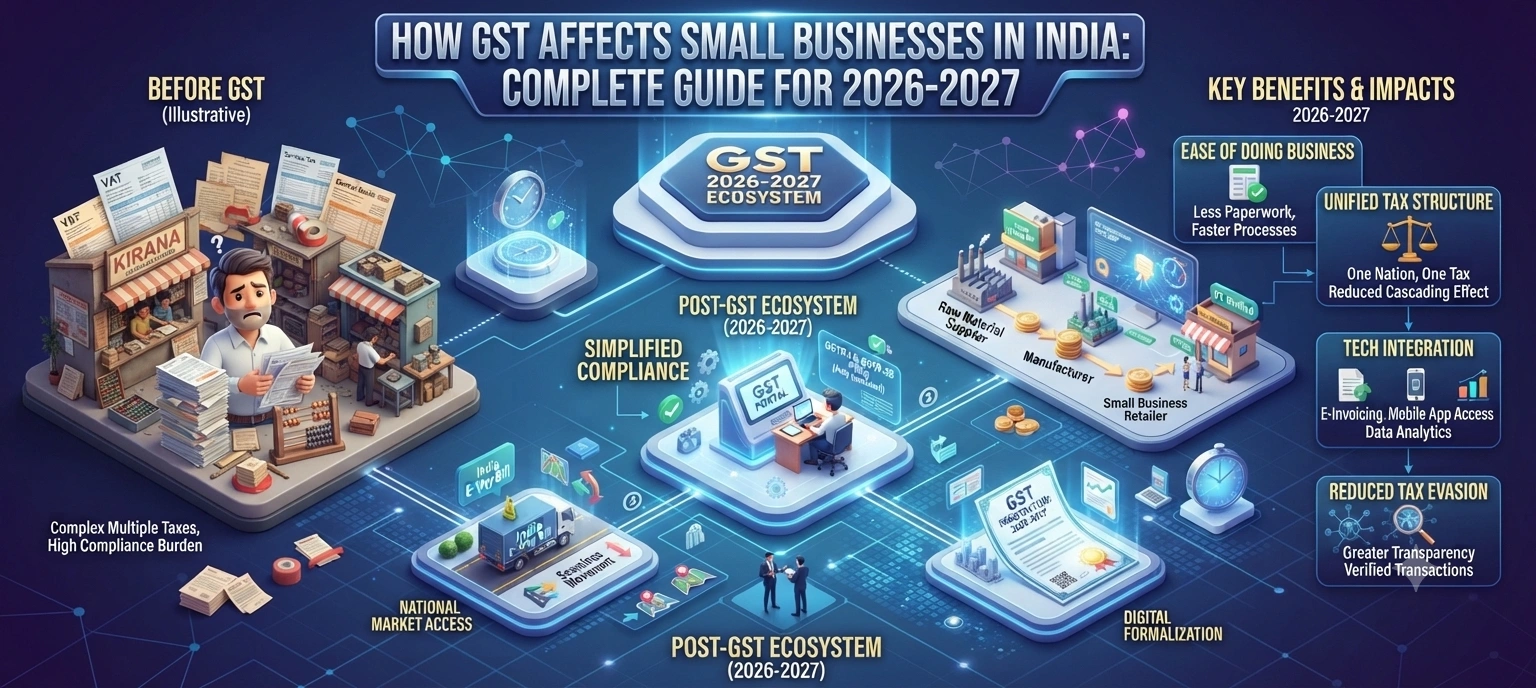
How GST Affects Small Businesses in India
A practical breakdown of GST's real impact on your small business and what you need to do about it
What is GST and Why Should You Care?
Look, if you're running a small business in India right now, GST isn't something you can ignore. The Goods and Services Tax replaced multiple indirect taxes back in 2017, and it's still reshaping how small businesses work. The thing is, most small business owners I talk to don't fully understand how it affects them—and that's costing them money.
GST is a single tax on the supply of goods and services. But here's what matters to you: if you're selling anything—whether it's products, services, or both—you probably need to know about GST. And if you don't handle it right, you're looking at penalties, blocked payments, and serious compliance headaches.
So what does this mean for your business? Let me walk you through it.
Who Needs to Register for GST?
Not every small business needs GST registration. But the rules changed, and they keep changing. As of 2026-2027, here's where you stand.
- If your annual turnover is above ₹40 lakhs (₹20 lakhs for services), you must register for GST
- If you're below that threshold but you want to register voluntarily, you can—and sometimes it helps
- If you're in specific sectors like alcohol, tobacco, or petroleum, you need GST even below the threshold
- If you're selling online across state lines, you need to register regardless of turnover
- If you're buying goods for resale and your annual purchase is above ₹40 lakhs, registration is compulsory
And that's the basic framework. But honestly, the real issue isn't knowing the rules—it's keeping up when they change. I've seen businesses miss registration deadlines and face penalties that could've been avoided.
If you cross the threshold and don't register within 30 days, you'll face a penalty of ₹10,000 or 10% of the tax due, whichever is higher. Late registration also means you can't claim input tax credit for goods and services bought before registration.
How GST Actually Changes Your Pricing and Costs
Here's where most small business owners feel the real pinch. GST affects your prices, your costs, and your profit margins. And if you don't understand it, you'll either lose money or lose customers.
Let me give you a real example. Say you're selling shoes. Before GST, you charged ₹1,000 per pair. Now, with 5% GST (the rate for shoes), you need to charge ₹1,050 to the customer. But here's the thing—your customer sees that as a price increase. Some will push back. Some will go to your competitor.
But you also get something back. If you bought the shoes from a manufacturer and paid GST on them, you can claim that as input tax credit. So if you paid ₹500 GST on your purchase, you only pay ₹50 GST to the government (₹50 collected minus ₹500 credit). In many cases, you get a refund.
The problem? You need to file your returns correctly to get that credit. If you mess up your documentation or filing, you lose that benefit. And that's expensive.
| Business Scenario | GST Rate | Impact on Small Business |
|---|---|---|
| Retail goods (clothing, electronics) | 5% | Lower rate helps with price competitiveness |
| Most services (consulting, repairs) | 18% | Higher cost, need strong input credit claims |
| Luxury goods, high-end services | 28% | Significantly impacts pricing power |
| Food items, basic necessities | 0% or 5% | Minimal GST burden, good for margins |
Input Tax Credit: Your Secret Weapon
Basically, input tax credit (ITC) is the most important benefit of GST for small businesses. And if you're not using it properly, you're leaving money on the table.
Here's how it works. You buy raw materials or services for your business and pay GST on them. When you sell your finished product or service, you charge GST to your customer. The government lets you reduce what you owe by the amount of GST you already paid. That's ITC.
But—and this is important—you can only claim ITC if you have valid invoices. And you need to file your returns on time. If you're buying things in cash without invoices, or if you're not keeping proper records, you lose this benefit completely.
And that's not all. Some expenses don't qualify for ITC. Personal items, entertainment expenses, and certain other costs are blocked. So you need to know what you can and can't claim.
A small manufacturing business buying ₹10 lakhs of raw materials at 12% GST pays ₹1.2 lakhs in GST. When they sell finished goods, they charge GST to customers. By claiming ITC on ₹1.2 lakhs, they reduce their GST liability significantly. Over a year, this can mean ₹2-3 lakhs in cash flow improvement.
GST Compliance: What You Actually Need to Do
The thing is, GST compliance isn't just about paying taxes. It's about maintaining records, filing returns, and making sure your paperwork is right. And if you get it wrong, the penalties are real.
Here's what you need to do:
- Maintain proper invoices with all required details (GSTIN, HSN code, tax amount)
- File GSTR-1 (sales return) every month by the 11th of next month
- File GSTR-2A (auto-populated purchases) to verify your ITC
- File GSTR-3B (summary return) every month by the 20th of next month
- Keep all invoices and supporting documents for at least 6 years
- Report any amendments or corrections immediately
And honestly, this is where most small business owners struggle. They don't have a system. They're doing invoices in a notebook. They're not filing on time. Then they panic when they get a notice from the tax department.
Late filing of GST returns attracts a penalty of ₹100 per day (up to ₹5,000). Issuing wrong invoices or making false claims can lead to penalties up to 10% of tax plus interest. In cases of fraud, criminal prosecution is possible.
GST Exemptions and Special Cases for Small Businesses
Not all small businesses are treated the same under GST. Some get exemptions or special treatment. And if you qualify, it can save you a lot of hassle.
Composition scheme is one big one. If your annual turnover is below ₹1.5 crores (for goods) or ₹50 lakhs (for services), you can opt for composition. What does that mean? You pay a fixed percentage of turnover as GST instead of calculating it on every transaction. You don't file monthly returns. You don't claim ITC. But your compliance burden drops dramatically.
Is it right for you? That depends. If you're doing small transactions with mostly end consumers, composition is great. If you're selling to other businesses that need invoices and ITC, it might not be worth it.
Some goods are also GST-exempt. Basic food items, medicines, books, newspapers, and certain other essentials don't have GST. If you're selling these, you don't charge GST to customers. But you still can't claim ITC on your purchases, which is a catch.
Real Impact: How GST Changes Your Bottom Line
So what does this actually mean for your profits? Let me break it down with real numbers.
Scenario 1: You're a retail trader selling goods. Before GST, you bought at ₹100 and sold at ₹150, making ₹50 profit. Now, you buy at 100 + 18% GST = ₹118. You sell at ₹150 + 18% GST = ₹177. You pay 18% GST on ₹150 (₹27) but claim ITC on ₹18 (GST on your purchase). Net GST payment: ₹9. Your profit is still ₹50, but you're paying ₹9 in GST. That's a 18% reduction in actual cash profit.
Scenario 2: You're a service provider. You charge ₹10,000 for your service. With 18% GST, you charge ₹11,800. But your costs—office rent, internet, software—don't all have GST. Your rent might be exempt. Your internet might be 18%. So your ITC is lower. You end up paying more GST than you can claim back. Your profit margin gets squeezed.
The key insight? GST's impact depends on your business model. If you buy a lot of taxed inputs and sell taxed outputs, the system works well. If you have mixed inputs or exempt supplies, you'll feel the pain.
Digital Tools and Systems You Need
Look, you can't do GST compliance manually anymore. Well, you can, but you'll waste so much time and make mistakes. In 2026-2027, you need digital tools.
The GST portal (gst.gov.in) is where you file all returns. It's not the easiest system, but it's free. You can generate invoices on it, track your ITC, and file returns. If you're comfortable with technology, you can manage it yourself.
But most small businesses use accounting software. Tally, Zoho Books, Busy, and others have built-in GST modules. They auto-calculate GST, generate compliant invoices, and prepare your returns for filing. The cost is usually ₹5,000-20,000 per year. It's worth every penny because it saves you from penalties and mistakes.
Some businesses also hire GST consultants or chartered accountants. If your business is complex or your turnover is high, this is smart. A good CA will cost you ₹5,000-15,000 per month but will save you way more in penalties and tax optimization.
Using GST-compliant accounting software reduces filing errors by 95%. It also gives you real-time visibility into your tax liability, helps you plan cash flow better, and makes audits much easier. The time saved alone is worth the investment.
Common Mistakes Small Businesses Make (and How to Avoid Them)
I've seen hundreds of small business owners make the same GST mistakes. And most of them are preventable.
- Not maintaining proper invoices: Always issue invoices with complete details. Don't accept cash payments without invoices. This kills your ITC claims.
- Filing returns late: Set calendar reminders. File by the 11th for sales returns and 20th for summary returns. Late filing means penalties and interest.
- Claiming ITC on non-qualifying expenses: Entertainment, personal items, and certain other costs don't give ITC. Know the rules before claiming.
- Not reconciling GSTR-2A: The GST portal auto-populates your purchases from your suppliers' filings. If there's a mismatch, sort it out immediately. Don't ignore it.
- Mixing personal and business expenses: Keep them separate. GST is only on business supplies. Personal spending doesn't qualify.
- Not updating GST registration when details change: If you add a new place of business, change your business type, or add partners, inform the tax department. Penalties apply for non-disclosure.
The pattern here is simple. Most mistakes come from not maintaining records or not filing on time. Solve those two things, and you're 80% of the way to GST compliance.
GST Audits and Notices: What to Expect
And that's really it when it comes to the biggest fear: GST audits. Most small business owners panic when they get a notice. But honestly, it's not always as bad as it seems.
The tax department can ask for an audit if your returns look suspicious. They might find discrepancies in your ITC claims, mismatches between your sales and your suppliers' filings, or just random checks. In 2026-2027, they're using data analytics to spot patterns, so you can't hide.
If you get a notice, don't panic. Most issues can be resolved by producing proper documentation. If you have invoices and receipts, you're fine. If you don't, you'll face penalties. And if the department suspects fraud, it gets serious—penalties up to 10% of tax plus criminal charges.
The best defense? Keep everything. Invoices, receipts, bank statements, delivery proofs—keep them all for 6 years. If you can show a clear paper trail, you'll win any audit.
GST and E-commerce: Special Rules for Online Sellers
If you're selling on Amazon, Flipkart, or your own website, there are special GST rules you need to know. And they're different from regular offline businesses.
First, if you're selling across state lines (which you are if you're on e-commerce), you need to register for GST even if your turnover is below ₹40 lakhs. That's rule number one.
Second, e-commerce platforms have to collect GST on your behalf in certain cases. If you're selling goods through an e-commerce operator, they might deduct GST before paying you. You need to track this carefully to avoid double taxation.
Third, e-commerce returns and refunds have special rules. If a customer returns an item, the GST treatment is complex. You need to issue a credit note with proper details. If you mess this up, the tax department will catch it.
And fourth, e-commerce platforms are now required to report your sales data to the GST department. So the tax department knows exactly how much you're selling. You can't underreport.
E-commerce sellers who don't register for GST face immediate account suspension on platforms. Plus, they face penalties and liability for unpaid taxes. If you're selling online, GST registration is non-negotiable.
Future Changes: What's Coming in 2026-2027
GST rules keep changing. The government is constantly tweaking rates, thresholds, and compliance requirements. So what should you expect in 2026-2027?
There's talk of lowering the composition scheme threshold. There's also discussion about simplifying return filing for small businesses. Some states are pushing for better integration between GST and state taxes. And the government is investing heavily in data analytics to catch evasion.
The real trend? More automation, more data sharing, and less room for errors. If you're still doing things manually, you're going to struggle. You need digital systems now.
Also, there's movement toward standardizing invoice formats and possibly mandating e-invoicing for all businesses. This would make compliance easier but also more rigid. If you're not ready for it, you'll face problems.
Strategies to Minimize Your GST Burden
So here's the practical stuff: how do you actually reduce what you pay in GST?
- Maximize your ITC: Buy from GST-registered suppliers. Keep all invoices. File returns on time. This is the biggest lever you have.
- Consider the composition scheme: If you're below ₹1.5 crores (goods) or ₹50 lakhs (services) and your customers are mostly consumers, composition can save you money and time.
- Separate taxable and exempt supplies: If you're selling both taxed and exempt items, track them separately. This helps you claim the right ITC.
- Plan your purchases: Buy before the month-end if possible. This ensures your ITC is claimed in the same period, improving cash flow.
- Negotiate with suppliers: Ask for GST-registered suppliers. Ask for proper invoices. This is critical for your compliance.
And that's really the core strategy: proper documentation, timely filing, and maximizing ITC. Everything else is just execution.
Frequently Asked Questions
Q: Do I need to register for GST if my turnover is below ₹40 lakhs?
A: Not compulsory. But you might want to register voluntarily if you're buying from GST-registered suppliers or if your customers need invoices. Voluntary registration helps you claim ITC even below the threshold.
Q: What happens if I file my GST return late?
A: You'll face a penalty of ₹100 per day (up to ₹5,000). Plus, you'll pay interest on the unpaid tax. If it's more than 3 months late, the tax department might suspend your registration.
Q: Can I claim ITC on all my business expenses?
A: No. Personal expenses, entertainment, and certain other costs don't qualify. Also, if you're in the composition scheme, you can't claim any ITC. You need to know which expenses qualify before claiming.
Q: What's the difference between composition scheme and regular GST?
A: In composition, you pay a fixed percentage of turnover (1-5% depending on your business) instead of calculating GST on each transaction. You don't file monthly returns. You don't claim ITC. It's simpler but you lose the benefit of input credit. Regular GST requires monthly returns but lets you claim ITC.
Q: How long do I need to keep GST records?
A: Keep all invoices, receipts, and supporting documents for at least 6 years. The tax department can ask for records from any year within this period. If you delete or destroy records, you face penalties.
Q: What happens if I'm audited by the GST department?
A: Don't panic. If you have proper documentation, you'll be fine. The department will ask for invoices, receipts, and explanations for any discrepancies. If you can show everything, the audit will be closed. If you can't, you'll face penalties. In cases of fraud, criminal charges are possible.
Final Thoughts: Managing GST as a Small Business Owner
Look, GST isn't going away. And complaining about it won't help. What will help is understanding how it works and building systems to manage it.
The businesses that struggle with GST are the ones that treat it as an afterthought. They don't maintain invoices. They don't file on time. They don't keep records. And then they panic when they get a notice.
The businesses that thrive are the ones that build GST compliance into their operations. They use accounting software. They file on time. They keep records. And they optimize their ITC claims. These businesses actually save money with GST because they understand the system.
So here's my advice: If you haven't already, invest in a good accounting system. Hire a CA if your business is complex. Set up calendar reminders for filing deadlines. Keep all your documents organized. And educate yourself on the rules relevant to your business.
GST is a tool. Like any tool, it can hurt you if you don't know how to use it. But if you master it, it can actually help your business grow.
" } ```
© 2026 Tax Esquire | Expert CA Services in Greater Noida, Uttar Pradesh
8810380146 | info.taxesquire@gmail.com | taxesquire.in
This document is for informational purposes only. For personalised tax advice, consult our chartered accountants.