The Complete 2026 Guide to MSME Classification Criteria: Micro, Small & Medium Enterprises
The Complete 2026 Guide to MSME Classification Criteria
Everything you need to know about enterprise classification, investment thresholds, and compliance requirements for 2026
What Are MSMEs? The Basics
So here's the thing—MSME stands for Micro, Small, and Medium Enterprises. These are the backbone of the Indian economy. They employ millions of people and contribute significantly to GDP. But what exactly makes a business an MSME? That's where classification comes in.
The government has set clear criteria to define each category. And honestly, getting this right matters. Why? Because your classification determines your access to government schemes, tax benefits, compliance requirements, and financing options. Get it wrong, and you miss out on real money and support.
In 2026, the classification rules are based on two main factors: investment in plant and machinery (or equipment), and annual turnover. These numbers changed in recent years, so if you haven't checked since 2020, you need to read this carefully.
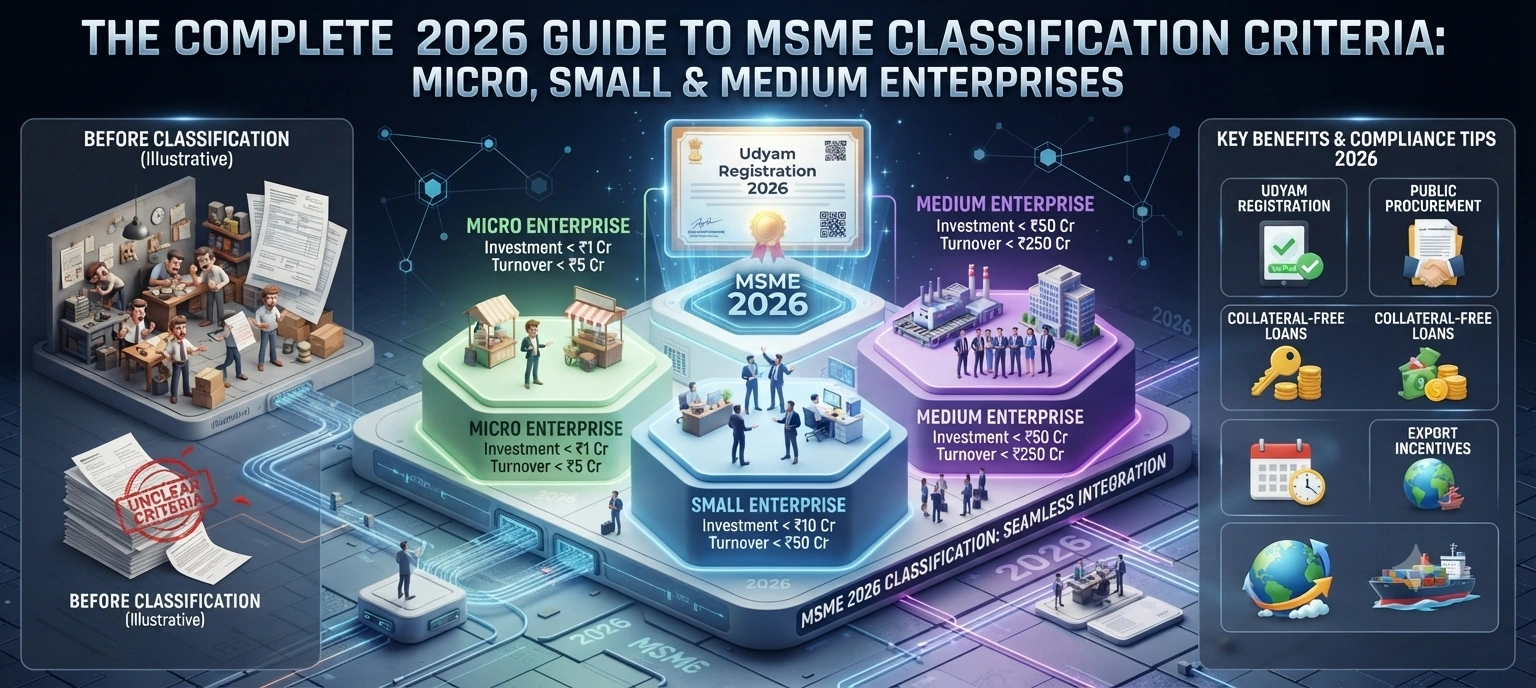
The 2026 MSME Classification Framework
The current classification framework came into effect on June 1, 2020, and it's still the standard in 2026. The government updated these criteria to make them more inclusive and business-friendly. Let me break down the exact numbers for you.
| Enterprise Type | Investment in Plant & Machinery | Annual Turnover (Whichever is Higher) |
|---|---|---|
| Micro | Up to ₹1 crore | Up to ₹5 crore |
| Small | ₹1 crore to ₹10 crore | ₹5 crore to ₹50 crore |
| Medium | ₹10 crore to ₹50 crore | ₹50 crore to ₹250 crore |
Notice something important? Your classification is based on BOTH investment and turnover. Your business falls into the category where it meets the criteria for that category in either parameter. Put simply, if your investment is ₹50 lakhs but your turnover is ₹8 crore, you're a small enterprise because your turnover exceeds the micro threshold.
Understanding these thresholds helps you plan your growth strategically. You can make informed decisions about scaling up and accessing the right government schemes.
Micro Enterprises: The Foundation
Micro enterprises are the smallest category, but don't mistake size for insignificance. These businesses are everywhere—the local shop owner, the freelancer with a small office, the manufacturing unit in an industrial area. They're the real heartbeat of our economy.
To qualify as micro in 2026, your business needs:
- Investment in plant and machinery not exceeding ₹1 crore
- Annual turnover not exceeding ₹5 crore
- At least 25% of investment should be in plant and machinery (for manufacturing)
- For service sector, at least 10% of investment should be in equipment
- Must be registered under the MSME database
Let me give you a real example. Suppose you run a small textile manufacturing unit. You've invested ₹80 lakhs in machinery and your annual turnover is ₹3.5 crore. You're clearly micro. You get access to priority sector lending, government subsidies, and tax exemptions.
But here's what people often miss—if your turnover crosses ₹5 crore even by a small margin, you automatically become small. There's no grace period. So track your numbers carefully throughout the financial year.
Don't assume you're micro just because your investment is low. Your turnover matters equally. Many businesses get reclassified mid-year and lose their benefits.
Small Enterprises: The Growth Stage
Small enterprises are the next tier. These are businesses that have grown beyond micro but aren't yet medium-sized. Think of established retail chains, mid-sized manufacturing units, or growing service companies.
To be classified as small in 2026, you need:
- Investment in plant and machinery between ₹1 crore and ₹10 crore
- Annual turnover between ₹5 crore and ₹50 crore
- Both parameters are evaluated together—you fall into small if either threshold is met
- Must maintain proper accounting records and file returns
- Eligible for MSME benefits but with different terms than micro
- Access to credit guarantee schemes and government contracts
Here's a practical scenario. You own a food processing business. Your investment in machinery is ₹7 crore and your turnover is ₹12 crore. You're small because both figures fall within the small enterprise range.
Small enterprises get some fantastic benefits. You can access government contracts reserved for MSMEs, get subsidized loans through various schemes, and enjoy tax benefits. But you also face stricter compliance requirements than micro enterprises. You'll need proper accounting, GST registration (if applicable), and regular filing with ROC.
And that's really it when it comes to the basic definition. The key is tracking both metrics accurately because reclassification can happen quickly as you grow.
Medium Enterprises: The Big Players
Medium enterprises are the larger MSME category. These are substantial businesses with significant turnover and investment. They're still considered small and medium by government standards, but they're major players in their sectors.
To qualify as medium in 2026:
- Investment in plant and machinery between ₹10 crore and ₹50 crore
- Annual turnover between ₹50 crore and ₹250 crore
- Must meet either the investment or turnover criteria
- Mandatory GST registration and compliance
- Full statutory audit requirements
- Eligible for specific government schemes and export benefits
Let me give you an example. You run a pharmaceutical manufacturing company with ₹30 crore invested in plant and machinery and ₹80 crore annual turnover. You're classified as medium. You get access to export credit schemes, technology upgradation funds, and government procurement preferences.
But here's the catch—medium enterprises face the most stringent compliance and audit requirements. You need statutory auditors, proper internal controls, and regular filing with multiple government bodies. The benefits are real, but so is the responsibility.
Medium enterprises get priority in government contracts, export promotion schemes, and technology development funds. They're also eligible for concessional financing from development banks.
Key Criteria: Investment vs. Turnover
Here's where most people get confused. Both investment and turnover matter, but they're evaluated independently. Your classification is determined by whichever parameter puts you in a higher category.
What counts as investment? Plant and machinery used for production, processing, or manufacturing. For service enterprises, it's the equipment used in delivering services. But here's what doesn't count—land, buildings, furniture, or working capital. These are excluded.
Turnover is your gross revenue from all sources during the financial year. It includes sales, service income, and any other business revenue. But it excludes taxes, duties, and discounts.
So what does this mean for you? If you're on the borderline, you need to be strategic. If your investment is ₹95 lakhs but your turnover is ₹4.8 crore, you're micro. But if your turnover hits ₹5.1 crore, you become small instantly. This reclassification affects your tax status, compliance requirements, and access to benefits.
- Track both metrics from day one
- Update your classification annually
- Inform relevant authorities of any changes
- Plan your growth considering these thresholds
- Consult a CA before crossing thresholds
Manufacturing vs. Service Sector Definitions
There's an important distinction here. The investment criteria differ slightly between manufacturing and service enterprises. This is because their asset structures are fundamentally different.
For manufacturing enterprises, investment means the cost of plant and machinery. For service enterprises, it means the cost of equipment. The turnover thresholds remain the same across both sectors.
Let me clarify with examples. A textile manufacturing unit counts spindles and looms as plant and machinery. A software company counts computers and servers as equipment. A logistics company counts vehicles and handling equipment. The principle is the same—production or service delivery assets.
But here's the tricky part. What if your business is hybrid? You do some manufacturing and some service? You classify based on whichever activity generates the majority of your revenue. If you're 60% manufacturing and 40% service, you use manufacturing criteria.
Misclassifying your business type can lead to wrong MSME registration. This affects your eligibility for schemes and can result in penalties if discovered during audits.
Registration and Compliance Requirements
Just knowing your classification isn't enough. You need to register and maintain compliance. In 2026, the registration process is streamlined and mostly digital.
All MSMEs must register on the Udyam portal (udyamregistration.gov.in). This is free and mandatory. You'll need your Aadhar number, PAN, and basic business details. The registration certificate is issued instantly online.
After registration, your compliance depends on your classification:
- Micro enterprises: Basic GST compliance if applicable, annual Udyam renewal
- Small enterprises: GST registration, income tax filing, annual accounts
- Medium enterprises: Statutory audit, full compliance, ROC filing if registered as company
- All categories: Update Udyam registration if classification changes
- Maintain records of investment and turnover for proof
Here's what I see most businesses miss—they register but don't update their information. If your turnover crosses a threshold, you must update your Udyam registration. Failing to do so can disqualify you from benefits and create compliance issues.
Government Benefits and Schemes
So why does classification matter so much? Because of the benefits. The government offers real, tangible support to MSMEs.
Micro enterprises get:
- Priority sector lending with lower interest rates
- Credit guarantee coverage up to 85%
- Exemption from statutory audit
- Simplified compliance
- Access to government procurement schemes
- Training and skill development subsidies
Small enterprises get:
- Technology upgradation funds
- Export credit guarantees
- Government contract preferences
- Cluster development schemes
- Working capital assistance
- Subsidized consulting services
Medium enterprises get:
- Export promotion schemes
- Technology development funds
- Government contract opportunities
- Concessional financing from development banks
- International quality certification support
These aren't small benefits. We're talking about actual money—subsidized loans, free training, and government contracts. That's why getting your classification right is crucial.
Common Classification Mistakes
After years of working with businesses, I've seen the same mistakes repeatedly. Let me save you from making them.
Mistake #1: Including land and buildings in investment. Many people think their factory building counts as investment. It doesn't. Only plant and machinery count. Your factory building, office space, and parking lot are excluded.
Mistake #2: Ignoring depreciation. When you calculate investment, you use the original cost, not the depreciated value. If you bought machinery for ₹1 crore five years ago, it still counts as ₹1 crore for classification, even if it's worth ₹50 lakhs now.
Mistake #3: Not updating classification when thresholds change. Your business grows, turnover increases, but you don't update your registration. This creates compliance issues and you lose eligibility for benefits.
Mistake #4: Misclassifying business type. If you're primarily manufacturing but register as service, you get the wrong criteria applied.
Mistake #5: Including working capital as investment. Your inventory, cash, and receivables don't count. Only productive assets count.
Getting your classification wrong can trigger GST audits, income tax scrutiny, and disqualification from government schemes. Always verify with a qualified CA before registering.
Reclassification: What Happens When You Grow
Your business grows. That's fantastic. But it also means your classification might change. And that has real consequences.
When you cross a threshold—say, your turnover goes from ₹4.9 crore to ₹5.2 crore—you automatically become a small enterprise. You don't get to stay micro. This happens the moment your turnover exceeds the limit, even if it's mid-financial year.
What changes when you reclassify?
- Your tax compliance requirements increase
- You may need statutory audit
- Some benefits become unavailable
- Other benefits become available
- Your loan eligibility changes
- Your Udyam registration must be updated
Here's the thing—reclassification isn't punishment. It's just a change in your status. You update your registration, adjust your compliance, and move forward. But you must do it promptly. Don't hide your growth to stay in a lower category. That's fraud.
And honestly, growing out of micro to small is a good problem to have. It means your business is succeeding. Just manage the transition properly.
Special Cases and Sector-Specific Rules
Some businesses don't fit neatly into standard categories. Let me address the special cases.
E-commerce and digital businesses: These typically have low investment in plant and machinery. They classify based on turnover alone. A digital marketing agency with ₹2 crore turnover is small, regardless of its office setup.
Retail and wholesale: Investment criteria don't apply to pure retail businesses. They classify based on turnover only. A retail chain with ₹30 crore turnover is small.
Hospitality and tourism: These also classify by turnover. A hotel with ₹60 crore revenue is medium.
Trading and distribution: Pure trading businesses use turnover criteria. A distributor with ₹40 crore annual sales is small.
The key principle is this—if your business model doesn't involve significant plant and machinery investment, you classify by turnover alone. This is actually favorable because you can grow larger while staying in a lower category.
Documentation You'll Need
When you register or update your MSME classification, you need proper documentation. Here's what to keep ready:
- Aadhar card and PAN of proprietor/partners/directors
- Business registration (GST certificate, shop license, etc.)
- Bank statements showing business transactions
- Investment proof—machinery purchase invoices, bills, photographs
- Financial statements or income tax returns showing turnover
- Property documents if you own the premises
- Employee records if you have staff
The Udyam portal doesn't ask for all this during registration, but you must keep these documents. Why? Because if you're ever audited or your registration is questioned, you need proof. I've seen businesses lose their MSME status because they couldn't prove their investment or turnover figures.
Tax Implications of Your Classification
Your MSME classification affects your taxes significantly. Let me break this down.
Micro enterprises: If your turnover is below ₹40 lakhs (₹20 lakhs for service), you can opt for composition scheme under GST. You pay a flat 1% or 2% tax instead of normal rates. You also get exemption from statutory audit.
Small enterprises: You must file regular income tax returns and maintain proper books. You need statutory audit if your turnover exceeds ₹50 lakhs (in some cases). Your GST compliance is standard.
Medium enterprises: Full compliance is mandatory. Statutory audit is compulsory. You must file audited financial statements with your income tax return.
Here's what's important—your classification determines your audit obligation. Get it wrong, and you might face penalties for non-compliance. Or you might do unnecessary audits and waste money.
Micro enterprises with turnover below ₹2 crore get income tax exemption under section 80JJAA if they employ new workers. This can save substantial taxes.
Frequently Asked Questions
Q1: Can I choose my classification, or is it automatic?
Your classification is determined by your investment and turnover. You don't choose. It's objective based on actual figures. What you do choose is whether to register on Udyum portal, but once you do, your classification is fixed based on your business metrics.
Q2: What if my turnover and investment put me in different categories?
You fall into the higher category. If your investment makes you small but your turnover makes you medium, you're medium. The classification goes with whichever metric is higher.
Q3: Do I need to register if my turnover is very low?
Registration is not mandatory, but it's highly recommended. It takes five minutes online and gives you access to government schemes, easier financing, and credibility. There's no downside to registering.
Q4: Can I downgrade my classification to stay micro?
No. Your classification is based on actual business metrics. You can't artificially keep it low. If your turnover grows, you graduate to the next category automatically. Trying to hide growth is fraud.
Q5: How often should I update my MSME classification?
You should review it annually, especially after your financial year ends. If your figures cross a threshold, update immediately. Don't wait for the next year. The sooner you update, the sooner you're compliant and eligible for the right benefits.
Conclusion: Getting Your Classification Right
Your MSME classification isn't just a label. It determines your access to capital, government support, tax benefits, and compliance requirements. Getting it right is genuinely important for your business.
Here's what you should do right now:
- Calculate your investment in plant and machinery accurately
- Determine your annual turnover for the last financial year
- Compare both figures against the 2026 thresholds
- Register on the Udyam portal with correct information
- Consult a CA if you're unsure about any classification
- Set a reminder to review your classification annually
In 2026, the classification framework remains the same as it's been since 2020. But that doesn't mean you can ignore it. Your business changes, grows, and evolves. Your classification must evolve with it.
And honestly, if you're growing fast enough that you're moving between categories, that's excellent news. It means your business is thriving. Just stay compliant and you'll continue to get the support you deserve.
" } ```
© 2026 Tax Esquire | Expert CA Services in Greater Noida, Uttar Pradesh
8810380146 | info.taxesquire@gmail.com | taxesquire.in
This document is for informational purposes only. For personalised tax advice, consult our chartered accountants.