The Complete 2026 Guide to Advance Tax Payment Due Dates
The Complete 2026 Guide to Advance Tax Payment Due Dates
Everything you need to know about advance tax deadlines, calculations, and compliance in 2026
What Is Advance Tax and Why Does It Matter?
Advance tax isn't some fancy concept. It's simply the income tax you pay upfront during the financial year instead of waiting until you file your return. Put simply, the government wants its money before the year ends, not after.
And here's the thing: if your expected tax liability for the year 2026-2027 exceeds Rs. 10,000, you're legally bound to pay advance tax. This applies to individuals, Hindu Undivided Families (HUFs), partnerships, and companies. So what does this mean for you? You need to plan ahead.
The advance tax system works in quarterly installments. You don't pay everything at once. Instead, you spread payments across four quarters, which makes cash flow management easier for most people.
The Exact Due Dates for Advance Tax in 2026
Let me give you the dates straight up. These are the deadlines you need to mark in your calendar right now:
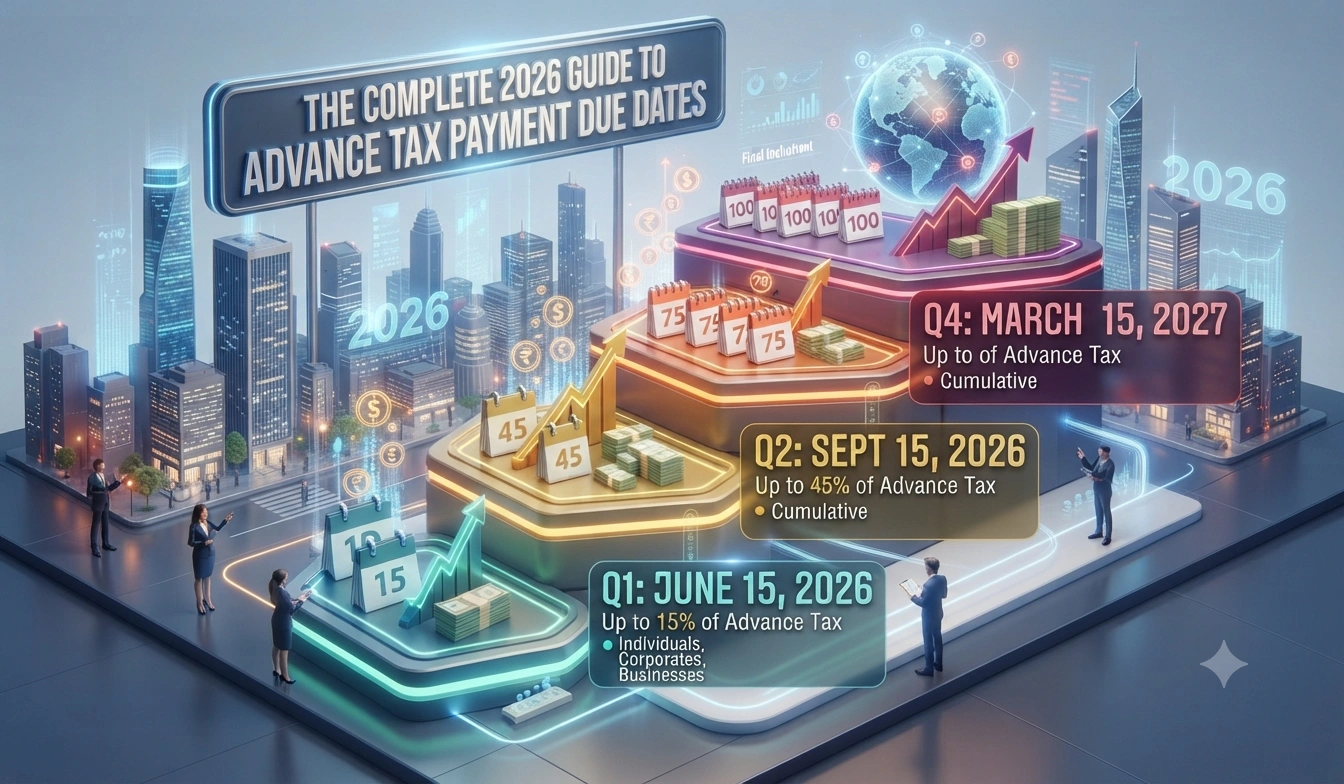
| Installment | Due Date in 2026 | Percentage of Tax |
|---|---|---|
| 1st Installment | 15 June 2026 | 15% |
| 2nd Installment | 15 September 2026 | 45% |
| 3rd Installment | 15 December 2026 | 75% |
| 4th Installment | 15 March 2027 | 100% |
Notice something? The percentages don't split evenly. You're paying more in the later quarters. This is intentional. The government assumes your income builds up as the year progresses, so they ask for more in the second half.
But here's what matters: if any due date falls on a weekend or public holiday, the deadline automatically shifts to the next working day. So if June 15, 2026 happens to be a Sunday, you've got until Monday to pay without penalty.
Spreading your tax payments across four quarters helps you manage cash flow better and avoids a big shock when filing your return. Plus, if you pay on time, you stay compliant and avoid interest charges.
How to Calculate Your Advance Tax for 2026
Calculating advance tax isn't rocket science, but you need to be accurate. Here's the basic formula:
- Estimate your total income for the year 2026-2027
- Calculate your expected tax liability based on current tax slabs
- Apply any eligible deductions and exemptions
- Divide the final amount into quarterly installments
- Pay each installment by the due date
Let me walk you through a real example. Say you're a freelance consultant expecting Rs. 50 lakhs in income for 2026-2027. After deductions under Section 80C and 80D, your taxable income comes to Rs. 40 lakhs. At the current slab rates, your tax liability would be about Rs. 8,50,000.
Now you split this: First quarter gets 15% (Rs. 1,27,500), second quarter gets 45% (Rs. 3,82,500), third quarter gets 75% (Rs. 6,37,500), and the final quarter gets 100% (Rs. 8,50,000). That's what you pay on each due date.
But honestly, most people get this wrong. They underestimate income or overestimate deductions. The result? They pay less advance tax than they should, and then face interest and penalties later. So be conservative. It's better to pay a bit extra now than scramble later.
If your actual tax liability is higher than the advance tax you paid, you'll owe interest at 1% per month on the shortfall. If it's lower, you get a refund, but that takes time. So estimate carefully.
Who Must Pay Advance Tax in 2026?
Not everyone needs to pay advance tax. The rules are specific. You're compulsory if:
- Your expected tax liability for 2026-2027 exceeds Rs. 10,000
- You're an individual, HUF, company, or partnership
- You've had income in the past and expect it to continue
- You're a business owner with turnover above certain thresholds
- You're a professional earning fees or commissions
- You have capital gains expected during the year
The thing is, even if you're not compulsory, paying advance tax is smart. Why? Because it shows the tax department you're serious about compliance, and it reduces your final tax burden when you file your return.
Methods to Pay Your Advance Tax
You've got several ways to pay. The government's made it pretty flexible:
- Online through the Income Tax e-payment portal using your PAN
- Using internet banking from your bank account
- Through authorized banks using challan forms
- Using mobile apps like BHIM or your bank's app
- At post offices in select locations
My recommendation? Use the online portal or your bank's internet banking. It's instant, you get immediate confirmation, and there's no room for clerical errors. Plus, you can pay from anywhere.
When you pay, you'll get a challan receipt with a unique identification number. Save this. You'll need it when filing your income tax return to claim credit for the advance tax paid.
What Happens If You Miss the Due Date?
Look, life happens. Sometimes you miss a deadline. But missing advance tax payments isn't consequence-free.
If you pay late, you'll owe interest at 1% per month (or part of a month) on the shortfall. So if you were supposed to pay Rs. 1,27,500 by June 15, 2026 but paid it in August, you're looking at interest for two months on that amount. It adds up quickly.
And that's not all. The tax department might issue a notice asking you to explain why you didn't pay on time. In extreme cases, they can impose penalties under Section 221 of the Income Tax Act. These penalties are separate from interest and can be substantial.
But here's the good news: if you can show that you had a genuine reason for the delay (medical emergency, natural disaster, etc.), you might get relief. The tax department does consider such cases.
Repeated failures to pay advance tax on time can trigger an assessment notice. The department may then conduct a detailed scrutiny of your entire tax position, which is time-consuming and stressful. Don't let it get to that point.
Special Cases and Exceptions in 2026
Certain situations have different rules. And that's really it when it comes to exceptions, but they matter:
Senior Citizens: If you're above 60 and your income is below Rs. 5 lakhs, you might not need to pay advance tax. But you still need to file a return.
New Startups: Companies incorporated in 2026 get some relief. You only pay advance tax from the quarter following the quarter in which you earn income. So if your startup starts earning in July 2026, your first advance tax payment is due in September 2026.
Agricultural Income: If your income is entirely from agriculture, you're exempt from advance tax. But if you mix agricultural and non-agricultural income, the rules change.
Non-Resident Indians (NRIs): If you're an NRI with income in India, you still need to pay advance tax on that income. The due dates remain the same.
Practical Compliance Checklist for 2026
Here's what I tell my clients: create a simple checklist and stick to it. It takes 10 minutes but saves hours of headaches:
- Estimate your income by April 2026 and calculate tax liability
- Mark all four due dates on your calendar: June 15, September 15, December 15, 2026 and March 15, 2027
- Set a reminder 3 days before each due date
- Prepare funds in advance so you're not scrambling at the last minute
- Pay through official channels only (e-payment portal or authorized banks)
- Keep all challan receipts in a safe folder
- Update your income estimate if it changes significantly during the year
- Review your payments before filing your return in July 2027
How Advance Tax Affects Your Final Return Filing
When you file your income tax return in 2027, all the advance tax you paid gets credited against your final liability. So if you paid Rs. 8,50,000 in advance and your actual liability is Rs. 8,40,000, you get a refund of Rs. 10,000.
But if your actual liability is Rs. 9,00,000, you still owe Rs. 50,000. You can pay this when you file your return, and the department usually gives you a few days grace.
The key is accuracy. If you overestimate income, you pay more advance tax than needed. If you underestimate, you face interest. The sweet spot is to estimate as accurately as possible based on your income trends and business performance.
Paying advance tax reduces your cash crunch when filing returns. Instead of owing a large amount, you might get a refund. Plus, it keeps you in good standing with the tax department.
Common Mistakes to Avoid
After 15 years in practice, I've seen people make the same errors repeatedly. Here's what to avoid:
- Confusing advance tax with TDS (Tax Deducted at Source). They're different. TDS is deducted by payers; advance tax is what you pay directly.
- Paying the same amount every quarter instead of following the 15-45-75-100 pattern. This causes shortfalls.
- Not keeping challan receipts. You need these to claim credit in your return.
- Paying through unofficial channels or to fraudsters. Always use the official portal or authorized banks.
- Ignoring changes in income during the year. If your income jumps significantly, recalculate and adjust future payments.
- Assuming that paying advance tax means you don't need to file a return. You still must file, even if you've paid advance tax.
Frequently Asked Questions
Q1: Is advance tax the same as self-assessment tax?
No, they're different. Advance tax is paid in installments throughout the year. Self-assessment tax is a lump sum paid when you file your return if you owe additional tax. You might pay both in the same year.
Q2: What if my income drops significantly in 2026? Can I adjust my advance tax?
Yes, you can. You don't have to stick to your original estimate. If your income drops, you can pay less in the later quarters. But don't go below what you'll actually owe, or you'll face interest charges.
Q3: Can I claim advance tax paid as a deduction in my return?
No, you can't deduct it. But you get credit for it. Meaning, the amount you paid is adjusted against your final tax liability. It's better than a deduction because it directly reduces what you owe.
Q4: What happens if I pay advance tax but then have no income in 2026?
You'll get a refund when you file your return. The refund includes the advance tax you paid plus any TDS. The process takes a few weeks, but you'll get your money back.
Q5: Do I need to pay advance tax if I'm a salaried employee?
Not usually. Your employer deducts TDS from your salary, which covers your tax liability. You only need to pay advance tax if you have additional income (freelance work, rental income, capital gains) that takes your total tax liability above Rs. 10,000.
Q6: Can I pay all four quarters' advance tax upfront in June 2026?
Yes, you can. There's no rule against paying the entire year's advance tax in one go. But most people don't because it ties up cash. The quarterly system gives you flexibility.
Final Thoughts: Getting Ahead of the Game
Advance tax isn't complicated, but it does need attention. The biggest mistake people make is ignoring it until the last minute. By then, it's too late to plan properly.
So here's what I suggest: sit down now, estimate your 2026-2027 income realistically, calculate your tax liability, and mark the due dates. Set up reminders on your phone. Keep your challan receipts organized. And if your situation changes during the year, update your calculations.
Paying advance tax on time does three things: it keeps you compliant, it saves you interest and penalties, and it gives you peace of mind. That's worth the effort.
And if you're unsure about your calculations, don't guess. Talk to a CA. A 30-minute consultation now can save you thousands in interest and headaches later. Trust me on this one.
" } ```
© 2026 Tax Esquire | Expert CA Services in Greater Noida, Uttar Pradesh
8810380146 | info.taxesquire@gmail.com | taxesquire.in
This document is for informational purposes only. For personalised tax advice, consult our chartered accountants.