Tax Audit Applicability for FY 2025-26 (AY 2026-27): Complete Guide with Limits & Rules
Introduction to Tax Audit
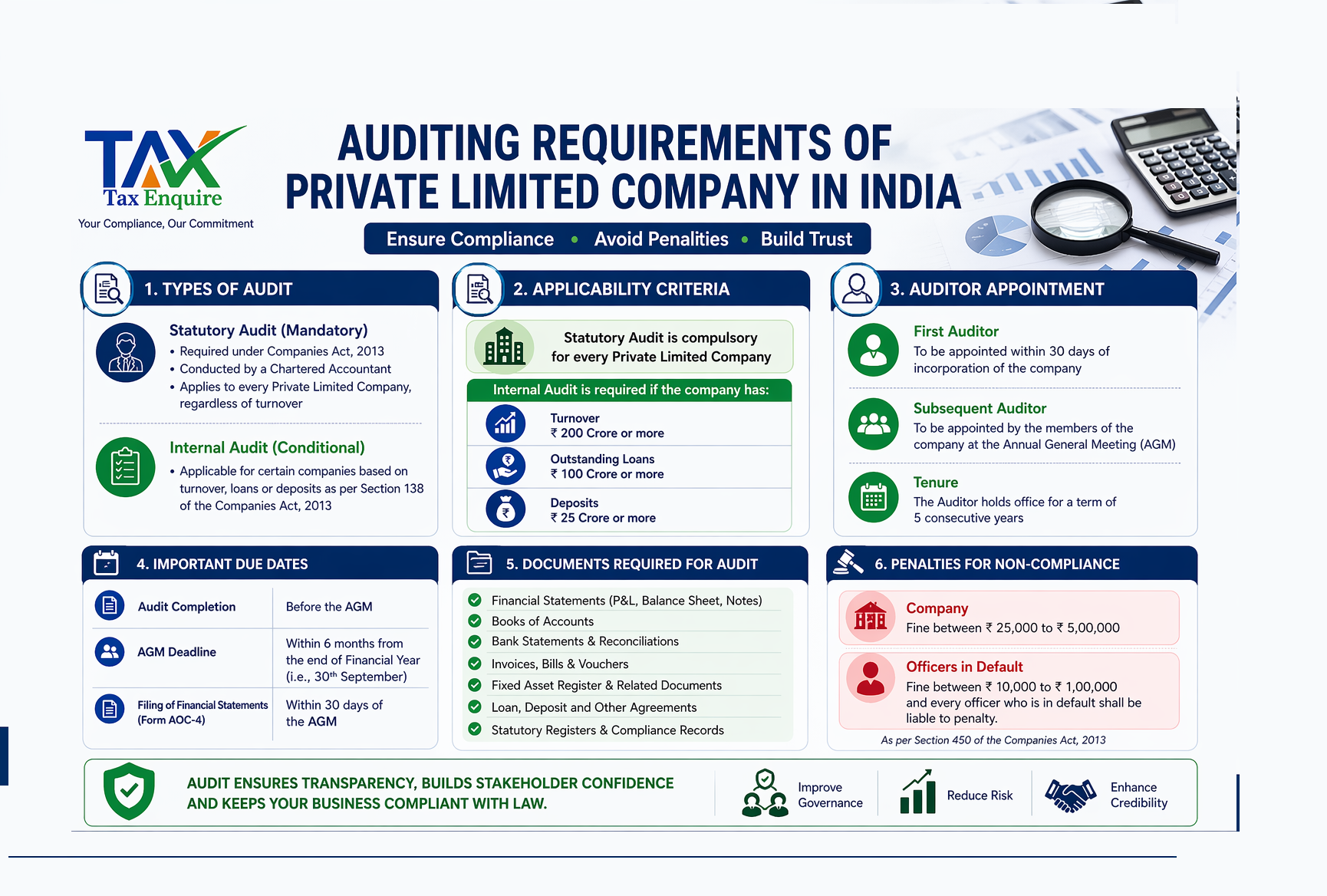
The tax audit is a process where a taxpayer's financial records are checked to make sure that income, expenses and deductions are reported correctly according to the Income Tax Act. This process is done by a Chartered Accountant to check if tax laws are being followed and to keep reporting transparent.
A tax audit is conducted not just to verify that financial records are correct, but also to ensure that income is reported honestly and mistakes or tax avoidance practices are minimized. For businesses and professionals, understanding whether a tax audit is applicable is crucial to avoid penalties and legal complications.
Section 44AB – Legal Framework
Tax audit provisions are governed by Section 44AB of the Income Tax Act, 1961. This section specifies the categories of taxpayers who must get their accounts audited.
Under this section, a taxpayer is required to get a tax audit done if their turnover, gross receipts, or income exceeds prescribed limits. The audit must be conducted by a practicing Chartered Accountant, and the report must be submitted in the specified forms. Over the years, amendments have been introduced to simplify compliance, especially for small taxpayers and those opting for digital transactions.
Tax Audit Limits for FY 2025-26
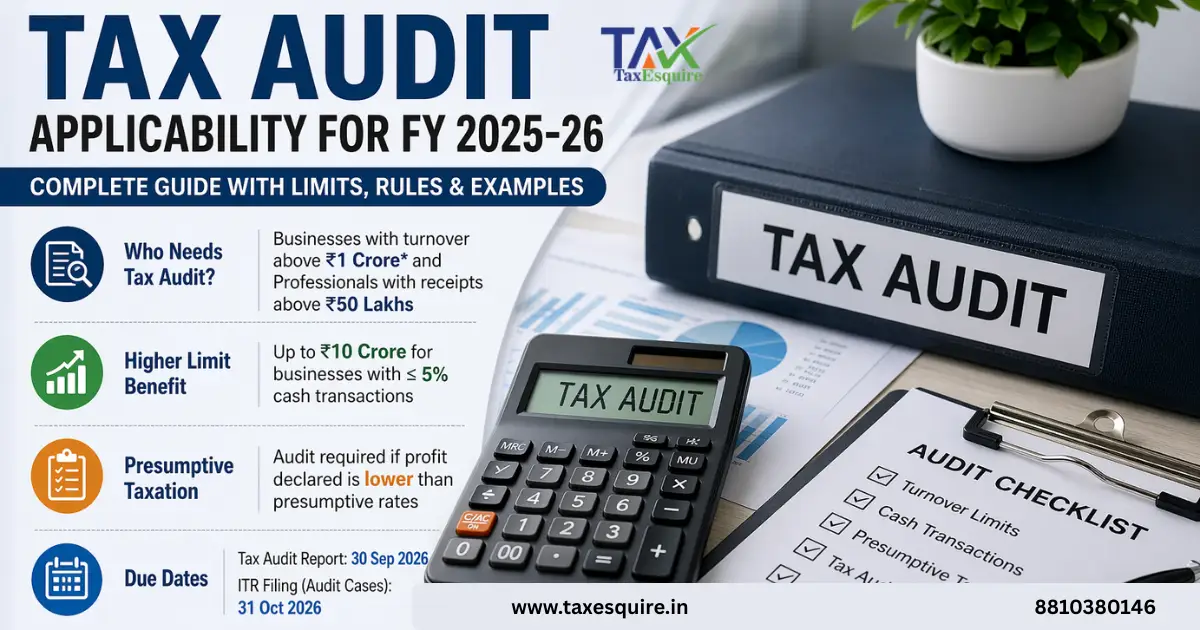
For Financial Year 2025-26, the applicability of tax audit depends mainly on turnover or gross receipts:
1. For Businesses
₹1 Crore: Basic threshold limit for tax audit
₹10 Crore: Applicable if:
◆ Cash receipts ≤ 5% of total receipts, AND
◆ Cash payments ≤ 5% of total payments
This higher limit encourages digital transactions.
2. For Professionals
₹50 Lakhs: If gross receipts exceed this limit, tax audit is mandatory
These limits play a critical role in determining whether a taxpayer falls under audit requirements.
Who is Required to Get a Tax Audit Done?
Businesses
● Businesses with turnover exceeding prescribed limits
● Businesses declaring income lower than presumptive rates
● Businesses opting out of presumptive taxation
Professionals
● Professionals such as doctors, lawyers, architects, consultants
● Those whose gross receipts exceed ₹50 lakhs
Other Cases
● Partnership firms and LLPs (depending on turnover and income conditions)
Tax Audit under Presumptive Taxation
Presumptive taxation schemes simplify tax compliance by allowing taxpayers to declare income at a fixed percentage.
Section 44AD (Business)
● Applicable for small businesses
● Income presumed at 8% (6% for digital transactions)
● If income declared is lower and total income exceeds exemption limit → audit required
Section 44ADA (Professionals)
● Income presumed at 50% of receipts
● If lower income is declared → audit applicable
Section 44AE (Transporters)
● Income calculated per vehicle basis
● Audit required if income is shown lower than prescribed
Presumptive taxation reduces compliance burden but requires audit if conditions are not met.
Special Cases Where Tax Audit is Applicable
Certain situations trigger tax audit even if turnover is below limits:
● Declaring losses in business (in specific scenarios)
● Opting out of presumptive taxation after choosing it earlier
● Having multiple businesses or professions combined
● Partnership firms with specific income structures
These cases require careful evaluation to determine audit applicability.
Cases Where Tax Audit is NOT Required
A tax audit is not required in the following situations:
● Turnover or receipts below prescribed limits
● Proper use of presumptive taxation without deviation
● Income below the basic exemption limit (in certain cases)
● Fully digital transactions within limits and turnover below ₹10 crore
Understanding these exemptions helps avoid unnecessary compliance.
Turnover Calculation for Tax Audit
Correct calculation of turnover is essential for determining audit applicability.
Included in Turnover
● Sales revenue
● Service income
● Business receipts
Excluded from Turnover
● Sale of fixed assets
● Capital receipts
● GST collected (in many cases, depending on accounting method)
Special Cases
● F&O Trading: Turnover is calculated differently (based on profit/loss differences)
● Commission Agents: Only commission income is considered
● E-commerce Sellers: Gross receipts including platform collections
Incorrect turnover calculation is one of the most common reasons for compliance errors.
Tax Audit Due Date for FY 2025-26
The due dates are critical for compliance:
● Tax Audit Report Filing: 30th September 2026
● Income Tax Return Filing (Audit Cases): 31st October 2026
(Subject to government extensions, if any)
Timely filing ensures avoidance of penalties and interest.
Forms Required for Tax Audit
The tax audit report must be filed in the following forms:
● Form 3CA: When accounts are already audited under another law
● Form 3CB: When accounts are not audited under any other law
● Form 3CD: Detailed statement of particulars
These forms provide comprehensive financial and compliance details to the Income Tax Department.
Penalty for Non-Compliance (Section 271B)
If a taxpayer fails to get accounts audited when required, a penalty is imposed:
● 0.5% of turnover or gross receipts, OR
● ₹1,50,000, whichever is lower
No Penalty in Genuine Cases
Penalty may not be levied if there is a reasonable cause, such as:
● Natural disasters
● Technical issues
● Serious illness
Practical Examples of Tax Audit Applicability
|
Example |
Scenario |
Key Condition |
Tax Audit Required? |
|
Example 1: Business Case |
Trader with turnover of ₹1.5 crore |
Turnover exceeds ₹1 crore limit |
Yes |
|
Example 2: Digital Business |
Turnover ₹8 crore with minimal cash transactions |
Eligible for ₹10 crore limit (≤5% cash) |
No |
|
Example 3: Professional |
Consultant earning ₹60 lakhs |
Exceeds ₹50 lakh limit |
Yes |
|
Example 4: Presumptive Case |
Business under Section 44AD declaring profit below 6% |
Lower profit than presumptive rate |
Yes |
|
Example 5: Loss Case |
Business reporting loss with income above exemption limit |
Loss + taxable income condition |
Conditional (May Apply) |
● Turnover-based cases → Compare with ₹1 Cr / ₹10 Cr limits
● Professionals → ₹50 lakh threshold
● Presumptive scheme → Lower profit = audit trigger
● Loss cases → Depends on income level
Key Takeaways
● Tax audit applicability depends on turnover, receipts, and income declarations
● Section 44AB is the governing provision
● Higher threshold of ₹10 crore applies for digital transactions
● Presumptive taxation reduces compliance but has conditions
● Proper turnover calculation is essential
● Missing audit can lead to penalties
In conclusion, taxpayers must evaluate their finances carefully each year to determine whether a tax audit is required. Proper planning and timely compliance can help avoid penalties and ensure smooth tax filing. If you are unsure whether your business requires a tax audit, consult professionals and review your financials early. Contact Tax Esquire CA Firm which assists businesses and professionals across India in tax compliance, audit support, and income tax return filing.
Author: CA POONAM GUPTA & ADV LOKESH GUPTA