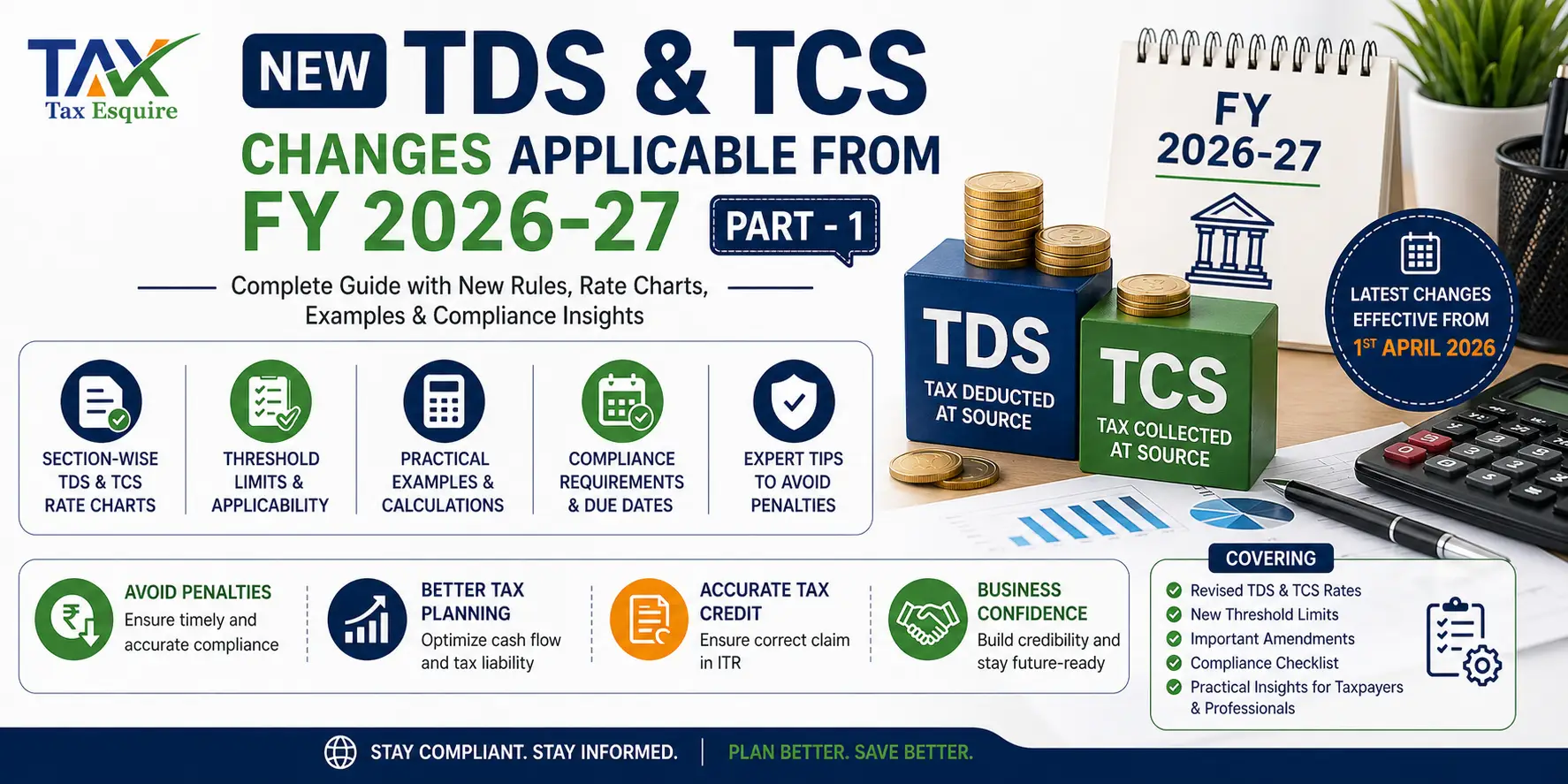
New TDS & TCS Changes Applicable from FY 2026-27 - Part 1
Introduction
Tax Deducted at Source (TDS) and Tax Collected at Source (TCS) are foundational pillars of India’s direct tax system. These mechanisms ensure real-time tax collection, reduce tax evasion, and improve financial transparency across the economy.
With the introduction of revised provisions aligned with the Income Tax Act, 2025, effective from April 1, 2026, there are important updates in rates, thresholds, compliance procedures, and reporting standards.
This comprehensive guide is designed for businesses, professionals, accountants, and taxpayers, offering a complete understanding of TDS & TCS rates for FY 2026–27, along with practical insights and expert guidance.
What is TDS (Tax Deducted at Source)?
TDS is a mechanism where tax is deducted at the time of making specified payments such as salary, interest, rent, commission, or professional fees. The deducted tax is then deposited with the government.
Key Characteristics:
Deducted before payment is made
Applicable on income generation stage
Responsibility lies with the payer (deductor)
Credit is reflected in the recipient’s Form 26AS
Purpose of TDS:
Ensures steady revenue flow for the government
Minimizes tax evasion
Distributes tax burden throughout the year
What is TCS (Tax Collected at Source)?
TCS is the tax collected by the seller from the buyer at the time of sale of specified goods or transactions.
Key Characteristics:
Collected at the time of sale
Applicable on specified goods/services
Responsibility lies with the seller (collector)
Common Transactions Covered:
Sale of scrap, minerals
Sale of goods exceeding threshold
Foreign remittances (LRS)
Overseas tour packages
Purpose of TCS:
Tracks high-value transactions
Expands tax base
Improves transaction transparency
Key Changes in TDS & TCS from April 2026
The financial year 2026–27 introduces structural refinements aimed at simplification and digitization:
Major Updates:
Rationalization of threshold limits
Simplification of rate structures
Integration with AI-based compliance systems
Enhanced reporting & reconciliation requirements
Stricter penalties for defaults and delays
Impact:
Increased compliance for businesses
Improved transparency in transactions
Reduced ambiguity in tax deduction rules
TDS Rate Chart for FY 2026–27 (Section-wise)
Below is a simplified yet comprehensive overview:
Important Notes:
Higher rate applies if PAN is not available (Section 206AA)
Special rates apply for non-residents
Surcharge and cess may apply where relevant
TCS Rate Chart for FY 2026–27
Key Highlights:
Higher rates may apply in non-filing cases (Section 206CCA)
TCS credit can be claimed by the buyer during ITR filing
TDS Threshold Limits for FY 2026–27
Threshold limits determine when TDS becomes applicable.
Key Insights:
No TDS if payment is below prescribed limit
Limits apply per transaction or annually, depending on section
Aggregation rules may apply
Example:
If contractor payment is:
₹25,000 → No TDS
₹35,000 → TDS applicable
TCS Threshold Limits & Applicability
Applicability Rules:
Triggered when sales exceed specified threshold
Seller must collect tax at time of receipt
Example:
If total sales exceed ₹50 lakh:
TCS @0.1% applies on amount exceeding ₹50 lakh
Major Sections Covered (Important Provisions Explained)
Understanding the key sections under TDS and TCS is crucial because each section applies to a specific type of transaction, and incorrect classification can lead to penalties or disallowances.
Section 192 – TDS on Salary
This section governs TDS on salary payments made by an employer to an employee.
Key Features:
TDS is calculated based on applicable income tax slab rates
Employer must consider:
Employee’s total income
Deductions (80C, 80D, HRA, etc.)
Chosen tax regime (old vs new)
Important Points:
No fixed TDS rate — depends on income level
Adjustments allowed during the year
Employer is responsible for accurate computation
Practical Insight: Incorrect estimation may result in short deduction, leading to interest liability.
Read the rest in 'New TDS & TCS Changes Applicable from FY 2026-27 - Part 2'.