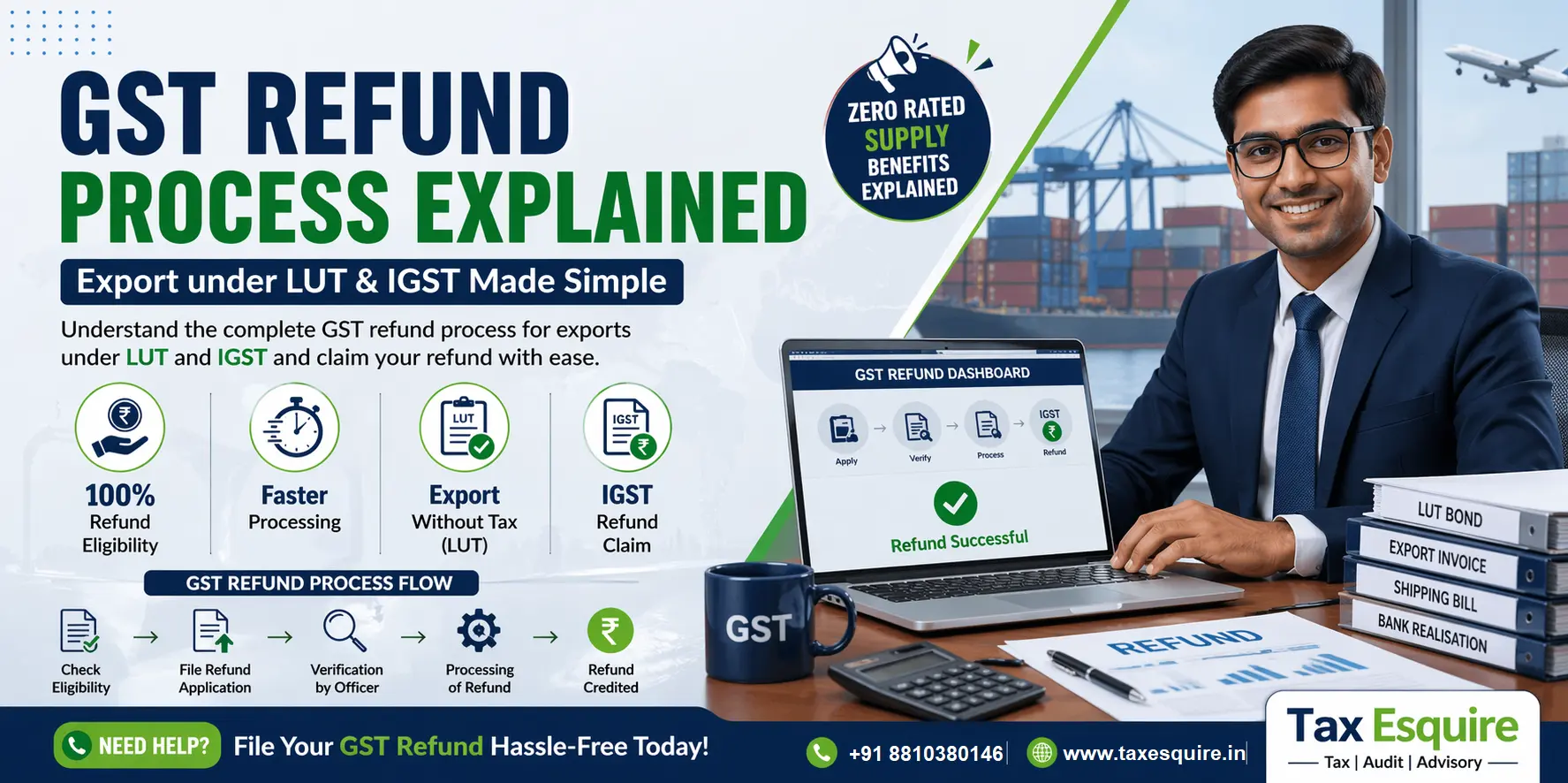
GST Refund Process Explained: Export Under LUT & IGST
Introduction
Exports are the backbone of international trade, and to ensure Indian businesses remain competitive globally, the GST framework provides a tax neutral mechanism for exporters. Under GST, exports are not meant to carry any tax burden. However, taxes are often paid during procurement of goods, services, or even at the time of export , which leads to working capital blockage.
To address this, the government has introduced a structured GST refund mechanism, enabling exporters to claim back taxes paid. This ensures:
Better cash flow
Reduced cost of export’s
Improved global competitiveness
Despite its benefit’s, the refund process involves multiple step’s, documentation’s, and compliance requirements, making it essential for exporters to understand the system in detail.
What Constitutes Export under GST?
Under GST, exports are classified into export of goods and export of services, each subject to specific conditions.
Export of Goods
Export of goods involves the physical movement of goods from India to a location outside India. It is supported by documents such as shipping bills, customs clearance, and export invoices.
Export of Services
A service qualifies as an export only if all the following conditions are met:
Supplier is located in India
Recipient is located outside India
Place of supply is outside India
Payment is received in convertible foreign exchange (or permitted INR)
Supplier and recipient are not merely establishments of the same entity
If any of these conditions are not satisfied, the transaction will not be treated as an export, which may impact GST benefits like refunds and zero-rated status.
Zero-Rated Supply Explained
Exports are treated as zero-rated supplies, which is one of the most important concepts under GST.
What Does Zero-Rated Mean?
GST rate = 0%
Exporter can claim Input Tax Credit (ITC)
Refund of taxes is allowed
Difference Between Zero-Rated and Exempt Supply
Types of GST Refund Available to Exporters
Exporters can claim refunds under multiple categories depending on their business model:
1. Refund of IGST Paid on Exports: Applicable when exports are made after paying IGST.
2. Refund of Unutilized ITC: Applicable when exports are made under LUT without paying tax.
3. Refund for Deemed Exports: Certain domestic transactions are treated as exports (e.g., supplies to EPCG or EOU).
4. Refund of Excess Tax Paid: Due to errors or miscalculations. Each category has specific procedure’s, timeline’s, and documentation requirement’s.
Export Options Under GST
Exporters can choose between two methods:
1 Export with Payment of IGST
Pay IGST at the time of export
Claim refund after export
Refund processed automatically through customs
2 Export under LUT (Without Payment of Tax)
No GST paid at export stage
Refund claimed for accumulated ITC
Comparison
Documents Required for GST Refund
Accurate documentation is critical for successful refund claims.
Export invoices
Shipping bills / bill of export
GSTR-1 and GSTR-3B returns
LUT/Bond copy
BRC/FIRC (proof of payment)
Statement of invoices
ITC ledger details
Pre-requirement for Refund Process
1. For Export with IGST Payment
File GSTR-1 with export details
File GSTR-3B and pay IGST
Generate shipping bill
Data transmitted to customs system (ICEGATE)
Refund processed automatically
Amount credited to bank account
2. For Export under LUT (Without Tax Payment)
File LUT before export
Export goods/services without paying tax
File GSTR-1 and GSTR-3B
Apply for refund using Form RFD-01
Upload documents and declarations
Application verified by GST officer
Refund approved and credited
Online RFD-01 Process Step-by-Step
Login to GST portal
Go to Services → Refunds → Application for Refund
Select refund category
Fill Form RFD-01
Upload supporting documents
Submit using DSC/EVC
Track status under “Refund Status”
GST Refund Timelines
Common Errors & Reasons for Refund Rejection
GST refund claims are often rejected due to errors in documentation, reporting, or compliance gaps. Some of the most common reasons include: Mismatch between GSTR-1 and GSTR-3B leading to inconsistencies in reported turnover and tax liability Incorrect or incomplete invoice details, affecting validation of claims Non-submission of BRC/FIRC, which is essential for export proceeds realization Invalid or improperly filed LUT, impacting eligibility for zero-rated benefits Data mismatch with customs records, especially in export transactions Selection of incorrect refund category, resulting in processing delays or rejection Ensuring accuracy and proper reconciliation before filing can significantly reduce the chances of refund rejection. Delay in processing refunds GST portal technical issues Complex documentation ITC reconciliation problems Dependence on customs data These challenges often affect working capital and operations. File returns accurately and on time Maintain proper documentation’s Reconcile data regularly Avoid last-minute filing Track refund applications actively Export of Services: Requires foreign exchange realization SEZ Supplies: Treated as zero-rated Deemed Export’s: Refund’s can be claimed by supplier or recipient Each case requires specific compliance and documentation. Increased automation in refund processing Faster integration with custom’s system’s Improved tracking system on GST portal Stricter verification to prevent fraudulent claims The GST refund mechanism ensures that exports remain tax free and globally competitive. While exporters can choose between the IGST and LUT routes, the LUT option is generally more beneficial for managing working capital, whereas the IGST route offers faster refunds. A clear understanding of procedure’s, accurate documentation, and timely compliance are the keys to a smooth refund process. With proper planning and execution, exporters can avoid delays and ensure seamless recovery of their funds.Challenges Faced by Exporters
Tips to Ensure Faster GST Refund
Special Cases in GST Refund
Latest Updates & Amendments (2026)
Conclusion
Author: CA POONAM GUPTA & ADV LOKESH GUPTA
© 2026 Tax Esquire | Expert CA Services in Greater Noida, Uttar Pradesh
8810380146 | info.taxesquire@gmail.com | taxesquire.in
This document is for informational purposes only. For personalised tax advice, consult our chartered accountants.