GST Compliance for Indian Startups in 2026: Complete Guide to Registration, Filing, and Penalties
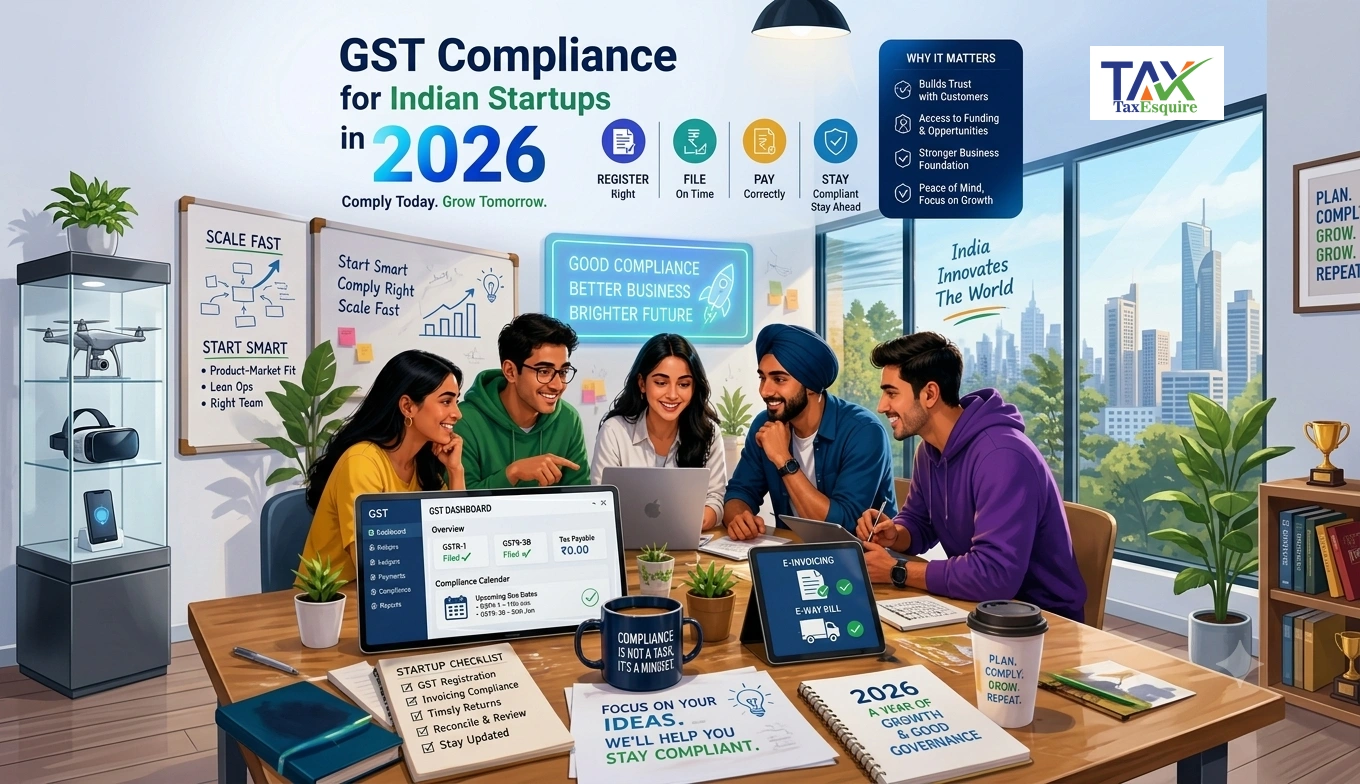
GST Compliance for Indian Startups in 2026
Everything you need to know about getting GST right from day one
Why GST Compliance Matters for Your Startup
Look, I've seen too many founders get blindsided by GST notices. They start their business, make some revenue, and suddenly they're staring at a compliance nightmare they didn't see coming. The thing is, GST isn't optional—it's compulsory once you hit a certain threshold. And ignoring it costs way more than just getting it right from the start.
When you're building a startup, every rupee counts. But what I mean is, the cost of not complying with GST is exponentially higher than the cost of setting it up properly. You're looking at penalties, interest, and worst-case scenarios involving the GST department showing up at your door. So let's make sure that doesn't happen to you.
Getting GST right early protects your business from penalties, builds credibility with customers, and makes scaling easier when you need funding or partnerships.
Understanding GST Registration Thresholds in 2026
Here's the first thing you need to know: not every startup needs to register for GST immediately. The government sets thresholds, and whether you're above or below them determines if registration is compulsory or optional.
In 2026, the basic threshold for GST registration is 40 lakh rupees in annual turnover. But—and this is important—that number changes based on what you do. If you're in certain states or providing specific services, the threshold might be different.
- Standard threshold: 40 lakh rupees annual turnover
- Composition scheme threshold: 1.5 crore rupees annual turnover (for eligible businesses)
- Specific services threshold: Can vary by service type
- E-commerce operators: Can't use composition scheme
- Interstate supplies: Different rules apply
And here's something most founders miss: you can voluntarily register for GST even if you're below the threshold. Why would you do that? Because you can claim input tax credits on your purchases. If your suppliers are charging GST and you're not registered, you're eating that cost.
Exceeding the threshold even by a single rupee makes GST registration compulsory. You can't delay. If you cross 40 lakhs in a financial year, you must register within 30 days.
Step-by-Step GST Registration Process
So what does this mean for you? It means you need to get registered properly. The good news is that the GST registration process is straightforward if you follow the steps.
Step 1: Gather Your Documents
Before you start, collect the paperwork you'll need. This isn't complicated, but missing something means delays.
- PAN card of the business owner or authorized signatory
- Aadhar card for identity verification
- Business registration certificate or incorporation documents
- Proof of business premises (rent agreement, utility bill, or ownership document)
- Bank account details
- Passport-sized photograph
Step 2: Register on the GST Portal
Go to the GST portal (www.gst.gov.in) and fill out Form GST REG-01. You'll enter your PAN, business details, and the state where you're registering. The system will generate a temporary reference number.
Step 3: Upload Documents and Get Verification
Upload your supporting documents. Then you wait. The GST officer might ask for more information or schedule a verification visit to your business premises. This is normal and happens for most new registrations.
Step 4: Get Your GSTIN
Once approved, you get your 15-digit GST Identification Number (GSTIN). This is your unique tax identifier. You'll use it on every invoice, return, and GST document you file.
The whole process typically takes 3 to 7 days if everything is in order. But if there are issues, it can stretch longer.
GST Filing Requirements for Startups
Once you're registered, you're not done. You've got filing obligations. And that's really it—if you don't file, penalties kick in fast.
Regular Returns (GSTR-1 and GSTR-3B)
GSTR-1 is your outward supply return. You file it monthly and list all the invoices you've issued. GSTR-3B is your summary return where you report GST collected and GST paid.
- GSTR-1 filing deadline: 11th of the next month
- GSTR-3B filing deadline: 20th of the next month
- Late filing attracts penalties
- Non-filing can result in suspension of your GSTIN
Annual Return (GSTR-9)
At the end of the financial year, you file GSTR-9. This is a consolidated return showing your entire year's business. It's due by December 31st of the next financial year.
Missing GST return deadlines isn't just about penalties. Your suppliers might not be able to claim input credits if you don't file your GSTR-1 on time. This creates a chain reaction of compliance issues.
Common GST Compliance Mistakes Startups Make
I work with startups every day, and I see the same mistakes over and over. Let me walk you through them so you don't repeat them.
Mistake 1: Wrong Tax Rate Applied
Different products and services have different GST rates. Most items are 18%, but some are 5%, 12%, or even 0%. Applying the wrong rate means your invoices are incorrect and your returns are wrong.
Example: If you're selling software services, it's 18%. But if you're selling certain food items, it might be 5%. Get this wrong, and the GST department will catch it during an audit.
Mistake 2: Not Maintaining Invoice Records
Your invoices are your proof of supply. If you don't maintain them properly, you can't claim input credits. And if you're audited, missing invoices are a red flag.
- Every invoice must have a unique serial number
- Customer GSTIN must be mentioned for B2B supplies
- HSN or SAC code must be included
- Keep digital and physical copies for at least 5 years
Mistake 3: Ignoring E-Way Bill Requirements
If you're moving goods worth more than 50,000 rupees across state lines, you need an e-way bill. Honestly, this trips up a lot of startups because they don't realize the threshold is low.
Not having an e-way bill when you're supposed to? The GST department can impose penalties and confiscate your goods.
Mistake 4: Late GST Payments
You collect GST from customers, but that money isn't yours. You're holding it in trust for the government. If you don't pay it on time, interest and penalties start adding up immediately.
GST Penalties and Interest: What You Need to Know
Let's talk about what happens when things go wrong. Penalties aren't just a slap on the wrist—they can be substantial.
| Violation | Penalty | Additional Details |
|---|---|---|
| Late GST payment | 18% per annum interest | Calculated from due date to payment date |
| Late return filing | Up to 100 rupees per day | Capped at 5,000 rupees per return |
| Incorrect invoice details | 10% of tax amount or 10,000 rupees | Whichever is higher, capped at 1 lakh |
| Non-filing of returns | GSTIN suspension | Can't issue invoices or claim credits |
| Unaccounted supplies | 10-100% of tax amount | Plus interest and possible prosecution |
The thing is, these penalties compound. If you're late on one return and then late on payment, the penalties stack. What starts as a small oversight becomes a real problem.
In 2026, the GST department has been more lenient with first-time offenders. If you file voluntarily and correct errors before being detected, penalties might be reduced or waived entirely.
Best Practices for GST Compliance in 2026
So what can you actually do to stay compliant? Here are the practices that work.
- Maintain a dedicated GST calendar with all filing deadlines marked
- Use accounting software that integrates with GST portals automatically
- Train your team on correct invoicing practices and GST rates
- Reconcile your GST accounts monthly, not just before filing
- Keep all supporting documents organized and easily accessible
- File returns on time, even if you're not sure about a particular entry
And here's something I tell every founder: get professional help. A CA or GST consultant costs money upfront, but it saves you way more in penalties and stress down the line.
GST Composition Scheme: Is It Right for Your Startup?
The composition scheme is a simpler way to comply with GST if you qualify. Instead of filing monthly returns, you file quarterly. And your tax rate is lower—1% for traders, 5% for manufacturers and restaurants.
But—and this matters—you can't claim input credits under the composition scheme. So if you're buying a lot of goods with GST, this scheme might not save you money.
- Turnover limit: Up to 1.5 crore rupees
- Can't do interstate supplies (except e-commerce)
- Can't provide services unless specified
- No input credit allowed
- Quarterly filing instead of monthly
For most startups, the regular scheme makes more sense because you can claim input credits. But if you're a small trader with minimal purchases, the composition scheme might be simpler.
GST Audit and What to Expect
Here's what keeps founders up at night: the possibility of a GST audit. Let me demystify this for you.
If your turnover is above 1 crore rupees, you're liable for a GST audit. The GST department will review your records to make sure everything matches your returns. It's not a witch hunt—it's just verification.
What they're looking for: discrepancies between your GSTR-1 (outward supplies) and your customers' GSTR-2A (inward supplies). If you're claiming input credits that don't match your suppliers' records, that's a red flag.
- Audit notice is usually issued 6 months after the financial year ends
- You get 30 days to respond with documents
- Auditor might visit your premises
- Keep all invoices, bank statements, and ledgers ready
- If discrepancies are found, penalties apply
Don't ignore an audit notice. It's not optional. If you don't respond, the GST department can pass orders based on the information they have, which usually isn't in your favor.
Frequently Asked Questions About GST Compliance
Q1: My startup is below the GST threshold. Do I still need to register?
No, registration isn't compulsory. But you can voluntarily register if you want to claim input credits. Many startups do this because they're buying supplies with GST. If you don't register, you're essentially paying GST on your inputs without recovery.
Q2: What happens if I exceed the threshold mid-year?
You must register within 30 days of exceeding 40 lakhs in turnover. If you don't, penalties apply. The GST department tracks your sales, so they'll know when you cross the threshold.
Q3: Can I file GST returns late if I have a good reason?
Late is late. There's no grace period. You get until the 11th for GSTR-1 and the 20th for GSTR-3B. After that, penalties apply. The GST department doesn't really care about reasons—they care about compliance.
Q4: What's the difference between GSTR-1 and GSTR-3B?
GSTR-1 is detailed—you list every invoice you've issued. GSTR-3B is a summary where you report total sales, GST collected, purchases, and GST paid. GSTR-1 feeds into your customers' GSTR-2A, so if there's an error, they'll see it.
Q5: What should I do if I discover an error in a past return?
File an amended return as soon as possible. The GST system allows amendments through GSTR-1 (for outward supplies) or by issuing a credit/debit note. The sooner you correct it, the better. If the GST department finds it first, penalties are harsher.
Q6: Is GST compliance required for service-based startups?
Absolutely. Services are taxable under GST at 18% unless specifically exempted. If you're providing consulting, software development, design services, or anything else, you're liable for GST registration once you cross the threshold.
Q7: Can I claim input credit on all my business purchases?
Not all. You can claim input credit on purchases that are directly related to your business supplies. But personal expenses, travel, and entertainment don't qualify. And you need proper invoices—without them, you can't claim anything.
Key Takeaways for Startup Founders
Let me wrap this up with what really matters. GST compliance isn't complicated, but it does need attention. Here's what you should remember:
- Register for GST when you hit 40 lakhs in turnover or voluntarily if it helps your business
- File GSTR-1 by the 11th and GSTR-3B by the 20th of every month
- Maintain proper invoices with correct tax rates and customer details
- Pay GST on time to avoid interest and penalties
- Keep records for at least 5 years
- Consider hiring a CA if you're unsure about anything
- Respond to any GST department notices immediately
The reality is this: getting GST right from day one is way easier than fixing it later. And that's really it. Your compliance today determines your peace of mind tomorrow.
" } ```
© 2026 Tax Esquire | Expert CA Services in Greater Noida, Uttar Pradesh
8810380146 | info.taxesquire@gmail.com | taxesquire.in
This document is for informational purposes only. For personalised tax advice, consult our chartered accountants.