Financial Changes From April 2026: STT, SGB Taxation, FASTag and RBI Compliance Guide
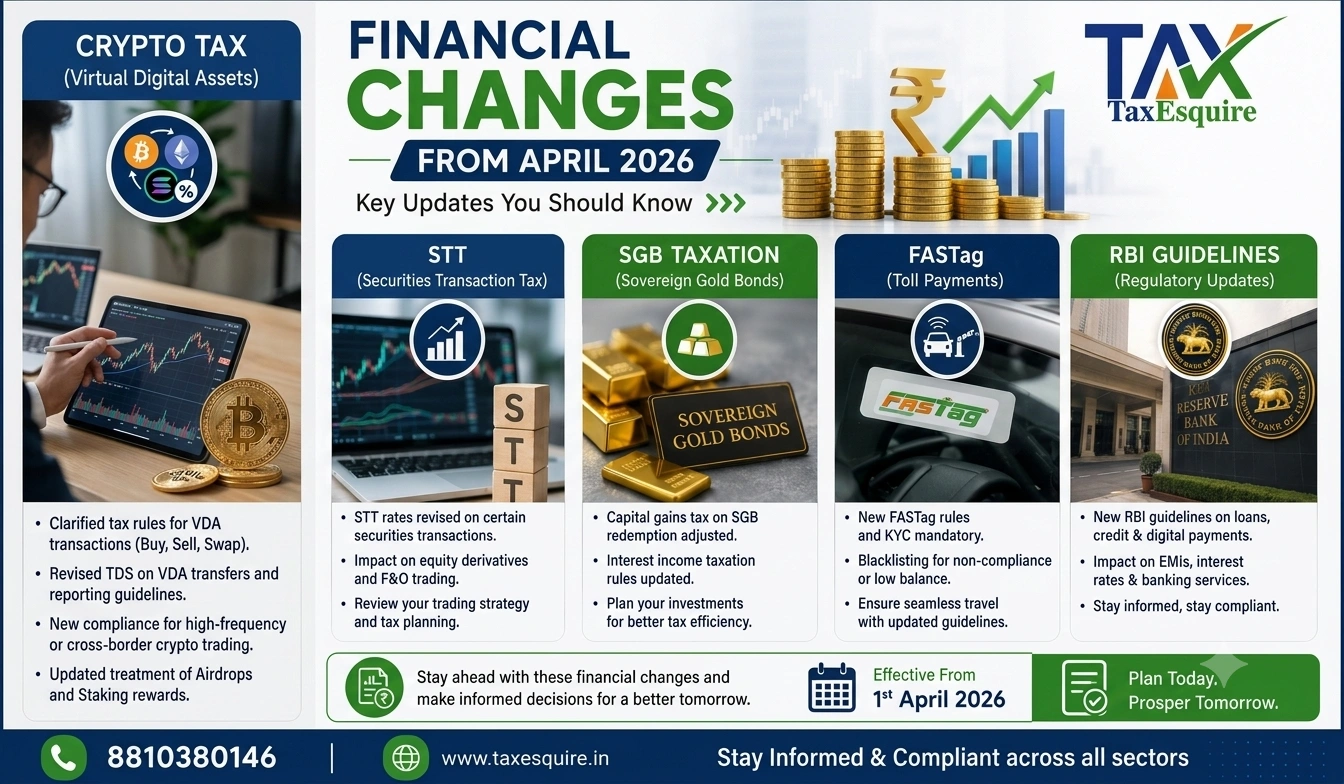
Financial Changes From April 2026
Everything you need to know about the regulatory shifts coming to India's financial landscape in the new fiscal year
What's Changing in April 2026? A Quick Overview
Look, the financial world's about to shift gears. Starting April 2026, India's introducing some pretty significant changes that'll touch everything from how you trade stocks to how you pay highway tolls. And honestly, if you're an investor, business owner, or someone who just wants to stay compliant, you need to know what's coming.
The changes span across four major areas: Securities Transaction Tax (STT), Sovereign Gold Bond (SGB) taxation, FASTag regulations, and RBI compliance frameworks. Each one has real implications for your wallet and your compliance calendar. So let's break this down piece by piece, because what I mean is, these aren't just bureaucratic tweaks—they're going to affect how you invest, trade, and move around the country.
STT Changes: What's New From April 2026
Securities Transaction Tax has always been a bit of a thorn in traders' sides. From April 2026, the government's restructuring how STT works, and the changes are more nuanced than just rate hikes. The new framework aims to encourage long-term investing while discouraging high-frequency trading.
Here's what you're looking at: equity delivery transactions are getting a slight increase, but intraday trading rates are going up more sharply. Why? Because the policy wants to push people toward holding stocks longer instead of day trading. It's a carrot-and-stick approach, really.
- Equity delivery: 0.10% (up from 0.08%) on both buy and sell sides
- Intraday equity: 0.025% (up from 0.015%) on both sides
- Options contracts: 0.05% (up from 0.03%) on sell side only
- Futures contracts: 0.02% (up from 0.01%) on sell side only
- Currency derivatives: Remains at 0.001% on sell side
But here's the thing: these changes don't happen in a vacuum. If you're an active trader, your costs are going up. A person who trades 50 times a month could see their STT expenses jump by 30-40% annually. That's real money.
If you're a high-frequency trader or run an algorithmic trading operation, recalculate your profit margins immediately. The April 2026 changes could turn profitable strategies into money-losers when you factor in the new STT burden.
So what does this mean for you? If you're a long-term investor, the impact's minimal. But if you're trading regularly, you need to revisit your strategy before the new fiscal year kicks in. Consider shifting to longer holding periods or reducing trade frequency.
SGB Taxation: The New Rules Starting April 2026
Sovereign Gold Bonds have been a favorite for people wanting to hold gold without the storage hassle. But from April 2026, the tax treatment's changing in ways that affect your returns significantly.
The government's introducing a tiered taxation approach based on holding periods. And that's really it—the longer you hold, the better the tax treatment. Here's the breakdown:
| Holding Period | Tax Treatment | Effective Rate (for 30% bracket) |
|---|---|---|
| Less than 2 years | Short-term capital gains (STCG) | 30% |
| 2-5 years | Long-term capital gains (LTCG) 15% | 15% |
| Above 5 years | LTCG 10% with indexation benefit | 10% |
Now, let me give you a practical example. Say you buy SGBs for ₹1 lakh in April 2026 and they appreciate to ₹1.20 lakh by December 2027. If you sell, that's a ₹20,000 gain. Under the new rules, you'd pay short-term capital gains tax at your slab rate—basically your income tax rate. But if you hold till April 2031 and the same bond is worth ₹1.40 lakh, you'd pay only 10% tax with indexation, which could bring your effective rate down to 6-7%.
The indexation benefit for SGBs held beyond 5 years is a genuine tax saver. If inflation averages 5% annually, your indexed cost base could increase by 25-30%, potentially wiping out a chunk of your capital gains tax liability.
And here's something most people miss: the interest income from SGBs remains tax-free. So you're getting tax-free interest plus favorable capital gains treatment if you hold long enough. That's a pretty sweet deal.
But don't get too excited. The interest component—usually around 2.5% per annum—is paid semi-annually. You need to report this in your income tax return, even though it's not taxable. It's a compliance thing, and the RBI's getting stricter about tracking this.
FASTag Compliance: What Every Driver and Fleet Owner Needs to Know
FASTag's been around for a few years now, but from April 2026, the compliance requirements are tightening up. The National Highways Authority of India (NHAI) and state toll authorities are implementing stricter rules, and honestly, if you're not paying attention, you could face penalties.
The big change? All commercial vehicles and a growing number of personal vehicles need to maintain active, valid FASTag accounts with minimum balance requirements. And here's what's new starting April 2026:
- Minimum balance requirement: ₹500 for personal vehicles, ₹2,000 for commercial vehicles
- Mandatory auto-recharge: Vehicles must have auto-recharge enabled to avoid toll gate blockages
- Real-time tracking: All toll transactions are now tracked in real-time with SMS alerts
- Penalty structure: Non-compliance penalties increase from ₹100 to ₹500 per violation
- Interoperability: All FASTag providers must ensure seamless operation across all toll plazas nationwide
- Vehicle tracking: RFID data is now integrated with vehicle registration databases for enforcement
Let me be real with you: if you run a fleet of 50 trucks, this is going to change your cash flow management. You'll need to maintain ₹1 lakh in FASTag accounts across your fleet just to meet minimum balance requirements. That's capital tied up that you weren't thinking about before.
From April 2026, if your FASTag account goes below the minimum balance, you won't just face a penalty—you'll be blocked at toll gates. This means your vehicle can't proceed until you recharge. For commercial operations, this could cause significant delays and operational losses.
But there's a silver lining. The system's also getting smarter about fraud detection. If you're a legitimate user, you'll actually benefit from better security. The RBI's working with toll authorities to prevent duplicate charges and toll fraud, which has been a real problem.
For GST purposes, FASTag transactions are now being reported directly to GSTN. This means you need to match your FASTag statements with your GST records. If there's a mismatch, it could trigger an audit notice. So keep your records clean.
RBI Compliance Requirements: The Regulatory Tightening
The Reserve Bank of India's been gradually tightening its grip on financial compliance, and April 2026 marks another significant step. These changes affect everyone with a bank account, investment portfolio, or any kind of financial transaction.
The main areas of focus are KYC (Know Your Customer), AML (Anti-Money Laundering), and transaction monitoring. Basically, the RBI wants to know where your money comes from and where it's going.
- Enhanced KYC: All existing customers need to re-verify their identity with updated documents by June 2026
- Transaction limits: Unverified accounts face stricter daily transaction limits (₹50,000 instead of ₹1 lakh)
- Source of funds declaration: Any deposit above ₹5 lakh requires source declaration
- Beneficial ownership disclosure: If you hold accounts on behalf of others, you need to disclose this
- Digital payment tracking: All digital payments above ₹20,000 are now reported to GSTN automatically
Now, if you're thinking this is just about catching criminals, you're missing the point. The RBI's also trying to formalize India's economy. They want every rupee traced. And for honest people, this is actually good—it reduces fraud risk and improves your financial security.
Enhanced RBI compliance actually protects you. Better transaction monitoring means fraudsters find it harder to steal your money. Banks are investing more in cybersecurity and fraud detection, which directly benefits account holders like you.
But here's where it gets tricky. If you have irregular income—say you're a freelancer or run a small business with cash transactions—you need to document everything properly. The RBI's systems are getting smarter at identifying suspicious patterns. Regular deposits of ₹99,000 to avoid the ₹1 lakh reporting threshold? That's called structuring, and it's illegal. The system flags it automatically.
One more thing: if you're sending money abroad or receiving remittances, the compliance requirements are getting stricter. The FEMA (Foreign Exchange Management Act) rules are being tightened, and you'll need proper documentation for anything over $10,000.
Practical Compliance Checklist for April 2026
So what do you actually need to do before April 2026 kicks in? Here's a practical checklist that'll keep you compliant and stress-free:
- Review your investment portfolio and identify high-frequency trades that'll be affected by STT changes
- If you hold SGBs, map out your holding periods and plan your exit strategy based on new tax rules
- Audit all FASTag accounts (personal and commercial) and ensure minimum balance requirements are met
- Update your KYC details with all banks and financial institutions before June 2026 deadline
- Document all sources of income and maintain clear records of large deposits
- If you're a business owner, ensure your GST records align with your FASTag and digital payment transactions
How These Changes Interact: The Bigger Picture
And here's what most people don't realize: these changes don't work in isolation. They're part of a larger push to formalize India's economy and make financial tracking seamless.
The RBI compliance tightening makes it harder to hide income. The STT changes discourage short-term speculation. The SGB taxation changes encourage long-term wealth building. The FASTag compliance ensures government revenue collection is efficient. It's all connected.
For the average person, this means being transparent is actually easier and cheaper than trying to hide things. The system's getting so sophisticated that workarounds don't work anymore. So the smart move? Get compliant, get organized, and stop worrying.
Frequently Asked Questions
Q1: Will the STT increase affect my long-term investment returns?
Not significantly. If you're buying and holding stocks for years, the STT you pay on purchase and eventual sale is a tiny fraction of your overall returns. For example, on a ₹1 lakh investment that grows to ₹3 lakh over 5 years, the STT cost is about ₹300. That's nothing compared to your ₹2 lakh gain. The new rates mainly hurt traders who buy and sell frequently.
Q2: Can I avoid the new SGB taxation by selling before April 2026?
Technically, yes, but it's not always smart. The new rules apply to SGBs issued from April 2026 onwards. If you already own SGBs, the old tax rules might still apply depending on the issuance date. But here's the thing: if you're planning to hold your SGBs long-term anyway, the new 10% tax rate after 5 years is actually better than what many people get under the old rules. So don't rush to sell just to avoid the new rules.
Q3: What happens if my FASTag account goes below the minimum balance?
Your account becomes inactive, and you won't be able to use it at toll plazas. You'll get blocked at the gate, which is annoying if you're in a hurry. You need to recharge immediately to proceed. For commercial vehicles, this can cause operational delays. The smart move is to enable auto-recharge so your account always stays above the minimum balance.
Q4: Do I need to re-do my KYC even if I did it recently?
It depends on when you last updated it. The RBI's asking for re-verification for all customers, but banks are prioritizing those who haven't updated their KYC in the last 2-3 years. If you updated your KYC in 2024 or 2025, you might not need to do it immediately. But don't wait for a notice—do it proactively. It takes 10 minutes online.
Q5: How do I report FASTag expenses for GST purposes?
FASTag tolls are eligible for GST input credit if you're a registered business. You can claim the GST paid on toll charges under the ITC mechanism. Keep your FASTag statements and toll receipts organized. From April 2026, these are automatically reported to GSTN, so your books need to match. If you're claiming GST credit, make sure your FASTag account is registered under your business name or GST number.
Q6: Will these changes affect NRI accounts differently?
Yes and no. The STT and SGB taxation changes apply to all investors regardless of residency status. But NRI accounts have separate compliance requirements under FEMA rules. The RBI's tightening those too. If you're an NRI with accounts in India, expect more documentation requirements and stricter source of funds declarations. Also, the remittance rules are getting stricter, so plan ahead if you're sending money back to India.
What You Should Do Right Now
Don't wait until April 2026 arrives. Start preparing now. Here's what I'd recommend:
First, audit your investment portfolio. Know exactly which securities you hold and how often you trade. If you're a high-frequency trader, start thinking about whether your strategy makes sense under the new STT structure. You might need to shift to longer holding periods or reduce trade volume.
Second, review your SGB holdings if you have any. Calculate your holding periods and plan your exit strategy. If you're close to a key milestone (like 2 years or 5 years), timing matters now.
Third, sort out your FASTag situation. If you own vehicles, check your account balance and enable auto-recharge. If you run a fleet, audit all accounts and ensure they meet the new minimum balance requirements.
Fourth, get your KYC sorted. Don't wait for your bank to send a notice. Proactively update your documents. It's painless and saves you from hassles later.
Finally, if you're a business owner, start reviewing your record-keeping processes. Make sure your GST records, bank statements, and transaction documentation all align. The RBI's systems are going to be checking for inconsistencies, and you don't want to be caught unprepared.
Final Thoughts
April 2026 isn't a disaster. It's a reset. The government's trying to create a more transparent, formalized financial system. And honestly, for most people, that's good news. Fraudsters and tax evaders face higher risks. Honest people get better security and lower fraud exposure.
The changes might cost you a bit more in STT if you trade actively. Your SGB strategy might need tweaking. Your FASTag account needs attention. Your bank paperwork needs updating. But none of this is insurmountable. With proper planning, you can navigate these changes smoothly.
The key is to start now. Don't wait for April 2026 to arrive. Proactive compliance is always cheaper and less stressful than reactive scrambling. Get your house in order, understand the rules, and you'll be fine.
© 2026 Tax Esquire | Expert CA Services in Greater Noida, Uttar Pradesh
8810380146 | info.taxesquire@gmail.com | taxesquire.in
This document is for informational purposes only. For personalised tax advice, consult our chartered accountants.