TDS Rate Chart FY 2026-27 (AY 2027-28)
Introduced
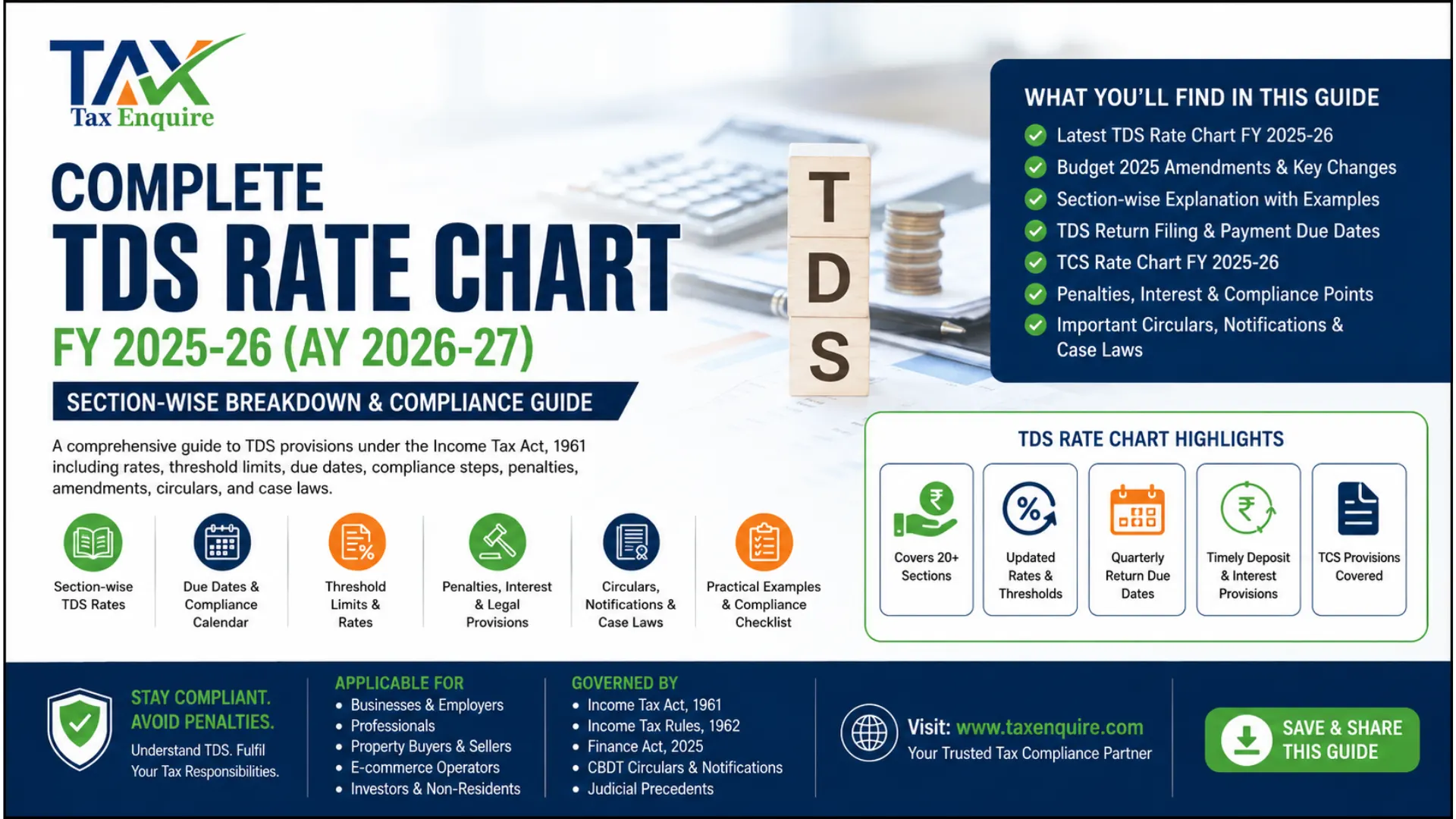
Tax Deducted at Source (TDS) is one of the most important mechanisms under the Income Tax Act, 1961 to ensure timely collection of taxes by the government. Under this system, the payer deducts tax at the prescribed rate before making specified payments such as salary, interest, commission, rent, professional fees, contractor payments, and foreign remittances.
For FY 2026-27 (AY 2027-28), several TDS provisions continue to apply with revised threshold limits and compliance requirements introduced through Budget 2025 and recent CBDT notifications. Taxpayers, businesses, employers, professionals, deductors, and non-residents must understand the updated TDS rates to avoid interest, penalties, and disallowances.
This guide provides a complete section-wise TDS rate chart for FY 2026-27 along with threshold limits, due dates, TCS provisions, and important compliance points.
Recent CBDT Circulars & Notifications
Budget 2025 & Recent Amendments in TDS Provisions
Major Changes Introduced
What is TDS ?
TDS(Tax Deducted at Source) is a tax collection mechanism where the deductor deducts tax while making specified payments to the recipient and deposits it with the Central Government.
The concept ensures:
Regular inflow of revenue to the government
Reduction in tax evasion
Wider tax base
Advance collection of income tax
The person deducting tax is called the “Deductor”, and the recipient is called the “Deductee”.
Common transactions covered under TDS:
Salary
Interest income
Rent
Professional fees
Contractor payments
Commission
Purchase of property
E-commerce transactions
Virtual digital assets (crypto)
Foreign remittances
TDS Rate Chart – FY 2026-27
Section 194LB / 194LC / 194LD
These sections cover specified interest income payable to non-residents and foreign institutional investors.
TDS Return Filing Due Dates
TDS Payment Due Dates
TCS Rate Chart
Tax Collected at Source (TCS) applies when sellers collect tax from buyers on specified transactions.
TCS Rate Chart FY 2026-27 Important Notes and Compliance Points 1. Higher TDS for Non-PAN Cases – Section 206AA If PAN is not furnished: Higher TDS may apply Generally at 20% or prescribed rate, whichever is higher 2. Higher TDS for Non-Filers – Section 206AB Higher TDS applies to specified non-filers of income tax returns. 3. Interest on Late Deduction/Deposit 4. Late Filing Fee – Section 234E ₹200 per day for delay in filing TDS return, subject to TDS amount. 5. Penalty Provisions Penalty may apply under: Section 271C Section 272A Section 276B 6. TDS Certificates Conclusion TDS provisions for FY 2026-27 continue to play a crucial role in India’s tax administration system. Businesses, employers, professionals, property buyers, e-commerce operators, and taxpayers must understand applicable TDS sections, threshold limits, and due dates to remain compliant. Timely deduction, deposit, return filing, and issuance of TDS certificates help avoid: Interest liability Late fees Penalties Disallowance of expenses Since TDS provisions are amended frequently through Finance Acts and CBDT notifications, taxpayers should regularly review updated rules before making payments covered under the Income Tax Act, 1961. Author: CA POONAM GUPTA & ADV LOKESH GUPTA