Form 121 Replaces 15G & 15H: New TDS Rule
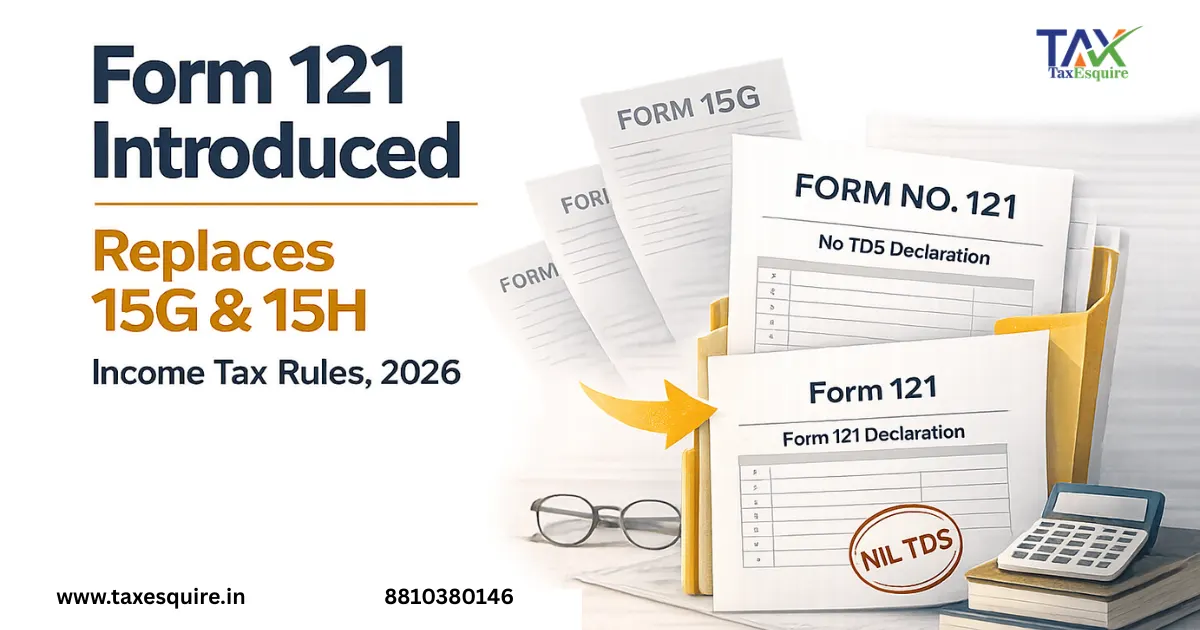
Form 121 is a turning point for the Tax Deduction at Source system in India. Since the introduction of Form 121 instead of 15G and 15H, it has become imperative that one should have knowledge about this system so as to prevent themselves from any deductions of TDS in 2026.They lack information that is vital to the IT Deptt. and verifying that the taxpayer has filled out these forms with proper information is quite difficult.
Such an initiative is part of a larger digital tax structure initiated by agencies such as the Central Board of Direct Taxes.
Some of the firms in the present age allow the tax-payers to fill these forms online and they do not require the taxpayers to fill out these forms on a paper. It makes life easier for tax-payers but not for these firms or IT dept. because processing of these forms is largely paper based. In reality, these firms might be generating these forms based on online submission of details of the tax-payers and printing them on paper later.
Form 121 Key Highlights
● Replacing Forms 15G and 15H for claiming exemptions on TDS
● Uniformity in the declaration process makes things easier for taxpayers
● Digital verification will lead to improved precision
● Senior citizens and ordinary citizens have to use the same form
● More consistent with current tax technologies and reporting procedures
What Is Form 121 and Why it Matters
Form 121 is a newly created form that helps the taxpayer declare that their income falls below the taxable threshold and exempts them from deductions on their taxable income, especially income earned from interest on fixed deposits.
Whereas before, people filed Form 15G if they were under 60 years of age and Form 15H if they were above 60 years, with the new form, everyone uses the same form regardless of age.
This move is in line with India’s tax modernization, which is regulated by various bodies, including the Reserve Bank of India and Securities and Exchange Board of India.
Download Form : Click Hear
Key Differences between Form 121 & Forms 15G and 15H
Unified Format
Whereas Forms 15G & 15H depended on an individual’s age, Form 121 has done away with this factor. It applies regardless of whether you are a senior citizen or not.
Enhanced Digitization Process
In contrast to previous forms, Form 121 will be digitalized completely, allowing for immediate validation.
Enhanced Tracking Abilities
The tracking process has become easier, making it difficult for individuals to exploit this facility.
Who Can Use Form 121?
Form 121 applies to persons who wish to protect themselves from TDS on the following income streams:
● Interest from fixed deposits
● Interest from recurring deposits
● Select dividend incomes
● Take, for instance, when the total income falls within the basic exemption limit, Form 121 shields an individual from being deducted any TDS on interest incomes.
Features of the new Form 121
● The Forms 15G and 15H have been merged together to form a single unified form.
● The information in the form would be auto-filled, and hence filling the form would be simpler.
● The feature of real-time verification is provided by the system.
● Form 121 can easily be matched with AIS (Annual Information Statement) due to its link with it.
● Easy tracking has been achieved by the use of the UIN (Unique Identification Number).
Points to remember while filing Form 121
● One must furnish PAN in the form.
● One should file a separate form for each payer (bank or other financial institution).
● Only a single year would be covered by filing Form 121.
● Even if the form has been filed, then it is essential to mention income in the ITR.
● One might face penalties if false information is furnished in the form.
Form 121 is believed to be a great relieving measure for taxpayers. Not only has this made the process easy, but now only a single form is needed in order to escape the burden of TDS. However, it is very important that one furnishes accurate information.
Real-world example
Suppose a salary earner earning ₹2.5 lakh per annum with ₹40,000 interest from FDs had submitted Form 15G under the old process to claim tax exemption.
In 2026, the same person will use Form 121 instead. The process remains similar but now it is much simpler and easier to verify.
Effects on taxpayers and investors
Simpler process
Firstly, it is much simpler since only one form will be used.
Greater transparency
With the digital approach, discrepancies in declared income and real income become rare.
Improved financial planning
Investors may better plan their income streams knowing that it will be much easier to handle TDS exemptions.
This is very helpful for retail investors who invest in both fixed deposits and equities.

Tan Entry In Case Of TAN’S
Once the tax-payer chooses the financial year and enters the total income estimates for the year, he/she is required to enter the TAN of all banks and institutions who will be paying interests, dividends or any other payment to him/her during the financial year. According to the present practice, if the taxpayer is a Senior citizen then he needs to enter the TAN of all the banks where he has made his investments from where he will earn more than one lakh rupees. Otherwise, if the taxpayer is not a senior citizen then he needs to enter the TAN of all the banks who will give him interest earnings of more than fifty thousand rupees.
Bank’s/Institution’s Databases Updation
Banks and institutions may or may not have registered accounts on the website of the Income Tax Department. If they don’t then they can register their accounts. Once the Bank registers itself on the Income Tax website, it will be provided the details of PAN of all those taxpayers whose TAN entries show they have investments in its account and hence it should not deduct IT at source for these taxpayers.
Entry Of Data By The Banks
The banks will thus make entries in the following two items in the portal maintained by the IT Department:
1. The income payable to the tax payer by the bank
2. Nature of income
This data can also be entered through a computer program that copies the information from the Banks database to the IT Department database. The following details will not need to be provided by the banks as they are available with the IT Department:
- Name
- Address
- PAN
- Email Id
- Contact number
How Tax Esquire Can Help You Adapt to These Changes
Adapting to change is challenging, but using platforms such as Tax Esquire Services makes it much easier.
- Quality research and advice regarding how to invest
- Technology-driven platform which combines financial planning with compliance
- Support services which help investors understand the ever-changing regulations
- Emphasis on investor education to prepare them for changes such as Form 121
Form 121 provides a more straightforward approach for individuals looking not to have any TDS deducted from their investment income if they do not expect to pay any taxes during the year.
Through the knowledge gained about what Form 121 is, how to complete Form 121, who may file Form 121, and the application of Form 121 to fixed income investments, the filing of tax information becomes much easier.
For those investing in bonds, for instance, completing Form 121 in good time ensures that all the money expected is paid out in full without deductions.
Author: CA POONAM GUPTA & ADV LOKESH GUPTA