ITR Filing for Salaried Employees in 2026-27: Complete Compliance Guide
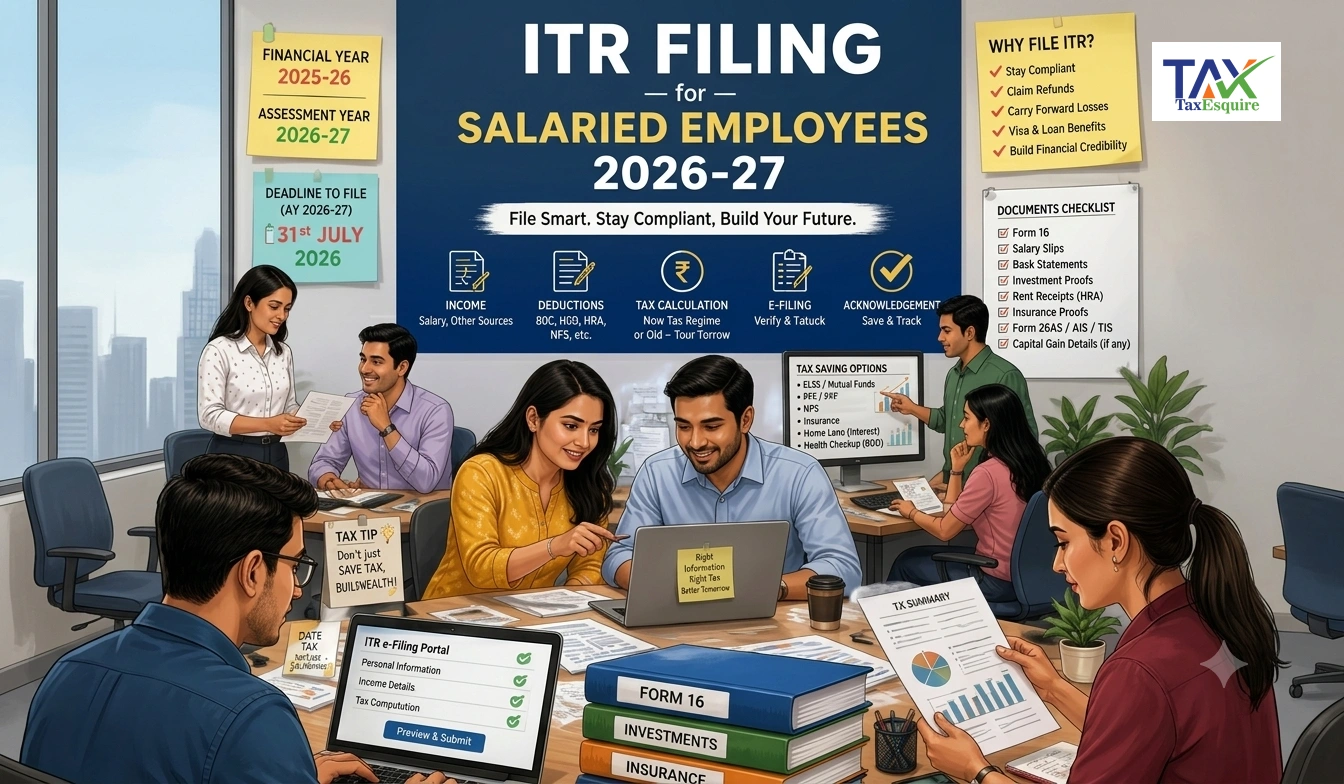
ITR Filing for Salaried Employees in 2026-27
Everything you need to know about filing your income tax return as a salaried professional
Why Salaried Employees Need to File ITR
Look, filing an ITR isn't just about following rules. It's about protecting yourself. Even if your employer deducted tax from your salary, you still need to file if you fall under certain conditions. And here's the thing: filing an ITR gives you legal proof of your income, which matters when you apply for loans, credit cards, or even rent a property.
So what does this mean for you? If you earned more than the basic exemption limit, received income from other sources, or want to claim refunds, you're looking at a mandatory filing. Put simply, an ITR is your formal statement to the income tax department about what you earned and what taxes you paid.
The financial year 2026-27 follows the same pattern as previous years. Your income earned between April 1, 2026 and March 31, 2027 is what you'll report. The deadline to file is usually July 31, 2027, but honest professionals file way earlier to avoid the last-minute rush.
Filing ITR on time helps you claim tax refunds, establish creditworthiness, and maintain a clean compliance record with tax authorities.
Who Needs to File ITR in 2026-27
Not every salaried person needs to file. But if you fall into any of these categories, filing is compulsory. And that's really it—if even one applies to you, you're in.
- Your total income exceeds the basic exemption limit (currently Rs. 2.5 lakhs for individuals below 60 years)
- You earned income from multiple sources like rental income, freelance work, or investments
- You're self-employed or a partner in a firm
- You want to claim a tax refund for excess TDS or advance tax paid
- You have bank deposits exceeding Rs. 10 lakhs in a single financial year
- You made foreign remittances or own foreign assets
Honestly, if you're earning a decent salary and your employer deducted tax, filing is the smart move. You might get a refund, and you'll definitely have proof of income for future needs.
Which ITR Form Should You File
This is where most salaried people get confused. The income tax department has different forms for different situations. Your job is to pick the right one. Filing the wrong form means your return gets rejected, and you'll end up filing again. Not fun.
| ITR Form | Who Should File | Key Features |
|---|---|---|
| ITR-1 (Sahaj) | Salaried individuals with income up to Rs. 50 lakhs | Simplest form, only salary and house property income |
| ITR-2 | Individuals with income from multiple sources | Covers capital gains, rental income, and investments |
| ITR-3 | Self-employed professionals and business owners | Includes business profit and loss statements |
| ITR-4 (Sugam) | Self-employed with presumptive income scheme | Simplified for small business owners |
For most salaried employees, ITR-1 is the way to go. But if you have rental income, earned capital gains from selling stocks or property, or received interest from fixed deposits, you'll need ITR-2. What I mean is, check your income sources first, then pick the form.
Filing the wrong ITR form gets your return rejected. You'll get a notice asking you to resubmit with the correct form. This delays your refund and creates unnecessary compliance headaches.
Key Deductions You Can Claim
Here's the real value of filing ITR: you can reduce your taxable income through legitimate deductions. And that directly reduces the tax you owe. So don't leave money on the table.
- Section 80C: Life insurance premiums, provident fund contributions, and education fees up to Rs. 1.5 lakhs
- Section 80D: Health insurance premiums for you and your family up to Rs. 25,000 (or Rs. 50,000 if you're 60+)
- Section 80E: Interest paid on education loans with no upper limit
- Section 80G: Donations to approved charities and NGOs up to 50% or 100% of income
- Section 80TTA: Interest on savings bank accounts up to Rs. 10,000
- Home loan interest: Up to Rs. 2 lakhs under Section 24 if you own a property
Basically, every rupee you claim as a deduction is a rupee you don't pay tax on. So track your expenses, keep your receipts, and claim what you're legally allowed to. Most salaried people miss out on these deductions simply because they don't track them properly.
Let me give you a real example. Suppose you earn Rs. 8 lakhs annually. You pay Rs. 1.2 lakhs in life insurance premiums and Rs. 15,000 in health insurance. Your total deductions under 80C and 80D come to Rs. 1.35 lakhs. Your taxable income drops from Rs. 8 lakhs to Rs. 6.65 lakhs. That's a tax saving of about Rs. 54,000 at your slab rate. That's not small change.
Step-by-Step Process to File ITR Online
Filing ITR online is straightforward now. The portal is user-friendly, and you can do it from your home. Here's how it works in 2026-27.
Step 1: Gather Your Documents Before you even log in, collect everything. Your Form 16 from your employer, bank statements, investment receipts, insurance premium receipts, and any other income documents. Don't skip this step. Missing documents mean incomplete filing.
Step 2: Visit the Income Tax Department Portal Go to incometaxindiaefiling.gov.in. Register if you haven't already. Create a username and password. Keep these safe—you'll need them every year.
Step 3: Log In and Select Assessment Year Log in with your credentials. Select the assessment year as 2027-28 (which is for financial year 2026-27). Then choose the right ITR form based on your income sources.
Step 4: Fill in Your Personal and Income Details Enter your PAN, Aadhaar, name, and address. Then fill in your salary details from your Form 16. Add income from other sources if any. The portal guides you through each section. And honestly, it's pretty straightforward if you have your documents ready.
Step 5: Claim Deductions and Exemptions This is where you enter all your 80C, 80D, and other deductions. The portal calculates your taxable income automatically. Double-check the numbers before moving forward.
Step 6: Review and Submit Review your entire return. Check for errors. Once you're confident, submit. You'll get an acknowledgment number. Save this.
Step 7: Verify Your Return Within 30 days of submission, you need to verify your return. You can do this through Aadhaar OTP, digital signature, or by sending a signed physical copy to the tax office. Most people use Aadhaar OTP as it's the fastest.
Filing online saves time, reduces errors, and gives you instant confirmation. You can also track your return status and download documents anytime from your account.
Important Deadlines for 2026-27
Missing deadlines costs you. Late filing attracts penalties, and some benefits get forfeited. So mark these dates on your calendar.
- July 31, 2027: Regular deadline for filing ITR for financial year 2026-27
- October 31, 2027: Extended deadline if you have specific conditions like loss carry-forward or are a non-resident
- 30 days from submission: Deadline to verify your return through Aadhaar OTP or digital signature
- Before filing: Ensure your TDS certificates (Form 16) are issued by your employer by June 30, 2027
Pro tip: Don't wait until June to file. The portal gets slow during peak season, and you might face technical issues. File by May-end if you can. That way, you're done and dusted before the rush.
Filing after July 31, 2027 invites a penalty of up to Rs. 5,000 under Section 271F. Plus, you lose the benefit of claiming a refund if any tax was overpaid.
Common Mistakes Salaried Employees Make
I've seen thousands of returns, and certain mistakes show up again and again. Avoid these and you're golden.
Mistake 1: Mismatching Income Figures Your salary in the ITR doesn't match your Form 16. This happens when you get a bonus or arrears late. Always reconcile your Form 16 with your ITR before filing. Ask your HR for a revised Form 16 if needed.
Mistake 2: Not Including All Income Sources You forgot to add that freelance income or interest from your savings account. The tax department has data from banks and other institutions. They'll catch this mismatch and issue a notice. Include every rupee.
Mistake 3: Claiming Deductions Without Proof You claim Rs. 1.5 lakhs under 80C but don't have receipts. If the tax department asks, you can't substantiate it. Keep all original receipts for at least 5 years. Digital copies are fine, but you need to show originals if demanded.
Mistake 4: Filing the Wrong ITR Form You have rental income but filed ITR-1. Your return gets rejected. Then you file again with ITR-2. This creates delays and confusion. Pick the right form from the start.
Mistake 5: Not Verifying Your Return You submitted but forgot to verify within 30 days. Your return stays unverified, and it's as good as not filed. Always verify before the deadline.
The thing is, most of these mistakes are preventable. Take 20 minutes to double-check before hitting submit. It's worth it.
What Happens After You File
Filing isn't the end. Here's what happens next and what you should expect.
Automatic Refund Processing If your tax withheld (shown in Form 16) is more than your actual tax liability, you get a refund. The department processes this within 90 days of your verified filing. You'll get the money in your bank account. No need to follow up.
Scrutiny Assessment Sometimes the tax department picks your return for scrutiny. They'll send you a notice asking for specific documents or clarifications. This doesn't mean you did something wrong. It's just their way of verifying information. Respond promptly and honestly. Most scrutiny cases are resolved within 6 months.
Tax Notices If the department finds discrepancies, you'll get a notice. Don't panic. Most notices are resolved by simply providing clarification or additional documents. Respond within the specified time frame. Ignoring notices invites penalties.
Assessment Completion Once the department is satisfied, they issue an assessment order. This is your formal tax assessment. Keep a copy for your records. You'll need it for loan applications and other purposes.
ITR Filing for Different Salary Scenarios
Your salary situation affects how you file. Let me break down different scenarios.
Scenario 1: Single Employer, Straightforward Salary You work for one company, get a fixed salary, and no other income. This is the simplest case. Use ITR-1. Enter your salary from Form 16, claim standard deduction of Rs. 50,000, add your 80C and 80D deductions, and you're done. Takes about 15 minutes.
Scenario 2: Changed Jobs Mid-Year You switched jobs in the financial year. You'll get two Form 16s from two employers. Add the income from both. File ITR-1 if total income is under Rs. 50 lakhs with no other sources. The tax department reconciles both Form 16s automatically.
Scenario 3: Salary Plus Rental Income You earn salary and also rent out a property. You need ITR-2. Include your salary and rental income. You can claim deductions for property maintenance, property tax, and interest on home loan. This gets slightly complex, so consider getting professional help.
Scenario 4: Salary Plus Investment Income You earn salary and also have income from stocks, mutual funds, or fixed deposits. Use ITR-2. Report all capital gains and interest income separately. Different income types have different tax rates, so accurate reporting matters.
Scenario 5: Salary Plus Freelance Income You work full-time but also do freelance projects. If freelance income is occasional and small, you might still use ITR-1. But if it's substantial and regular, use ITR-2 or ITR-3 depending on whether you're registered as self-employed.
FAQs on ITR Filing for Salaried Employees
Q1: Do I need to file ITR if my employer deducted tax and I don't owe anything?
Honestly, yes. Even if you don't owe tax, you should file if your income exceeds the exemption limit. Why? Because you might get a refund if excess tax was deducted. Plus, an ITR gives you proof of income for loans and other purposes. It's a smart move.
Q2: What if I didn't get my Form 16 from my employer?
Your employer is legally required to issue Form 16 by June 30. If they haven't, ask them immediately. If they're being difficult, file a complaint with the income tax department. Don't wait. You can't file your ITR without Form 16 details. In extreme cases, you can file based on your salary slip, but this creates issues later.
Q3: Can I file ITR after the July 31 deadline?
You can, but you'll face penalties. Filing between August 1 and October 31 invites a penalty of Rs. 5,000. Plus, you lose the right to claim a refund if you overpaid tax. So file on time. Set a reminder in May itself.
Q4: What if I made a mistake in my filed ITR?
You can file a revised ITR within 2 years of the original filing deadline. So for 2026-27, you can file a revised ITR up to July 31, 2029. The process is simple: log in, select "revised return," make corrections, and resubmit. Just make sure the mistake is genuine and not a strategic change to reduce tax.
Q5: Do I need a CA to file my ITR?
Not if your situation is straightforward. If you have only salary income and standard deductions, you can do it yourself in 20 minutes. But if you have multiple income sources, complex deductions, or past notices from the tax department, get a CA. It costs about Rs. 2,000 to 5,000, and it's worth the peace of mind.
Tax Saving Tips for Salaried Employees
Beyond filing, here's how you can actually save tax throughout the year.
- Maximize 80C contributions: Invest in life insurance, PPF, or ELSS mutual funds up to Rs. 1.5 lakhs yearly
- Buy health insurance: Cover yourself and family. It's a deduction and essential protection
- Take home loan benefit: If you own a property, claim both principal repayment under 80C and interest under Section 24
- Claim education loan interest: If you're paying education loan interest, claim the full amount with no cap
- Donate strategically: If you donate to approved charities, you can claim 50% or 100% of your income as deduction
- Track all expenses: Keep receipts for everything. Medical bills, education fees, insurance premiums. Everything counts
The key is planning. Don't wait until March to think about tax saving. Start from April. Invest in 80C instruments gradually. Spread your purchases across the year. This way, you're not scrambling at the end.
Compliance Checklist for 2026-27
Before you file, go through this checklist. It ensures you don't miss anything.
- Collect Form 16 from your employer by June 30, 2027
- Gather all investment receipts, insurance premium receipts, and donation certificates
- Reconcile your salary with Form 16 and salary slips
- Identify all income sources: salary, rental, interest, capital gains, freelance income
- Calculate your total deductions under various sections
- Choose the right ITR form based on your income profile
- File your ITR before July 31, 2027
- Verify your return within 30 days through Aadhaar OTP
- Download your acknowledgment and keep it safe
- Monitor your return status on the portal for any notices
Key Takeaways
Filing ITR as a salaried employee is straightforward if you're organized. Start early, gather your documents, pick the right form, claim all legitimate deductions, and submit before the deadline. Verify your return within 30 days. That's really it.
And honestly, filing on time gives you peace of mind. You're compliant with the law, you get proof of income, and you might even get a refund. It's a win-win.
For financial year 2026-27, the process remains the same. The portal is user-friendly. The forms are straightforward. So don't delay. Start preparing from now. Maintain records. And file well before July 31, 2027.
" } ```
© 2026 Tax Esquire | Expert CA Services in Greater Noida, Uttar Pradesh
8810380146 | info.taxesquire@gmail.com | taxesquire.in
This document is for informational purposes only. For personalised tax advice, consult our chartered accountants.