
ITR Filing Due Date FY 2025-26 (AY 2026-27): Updated Guide
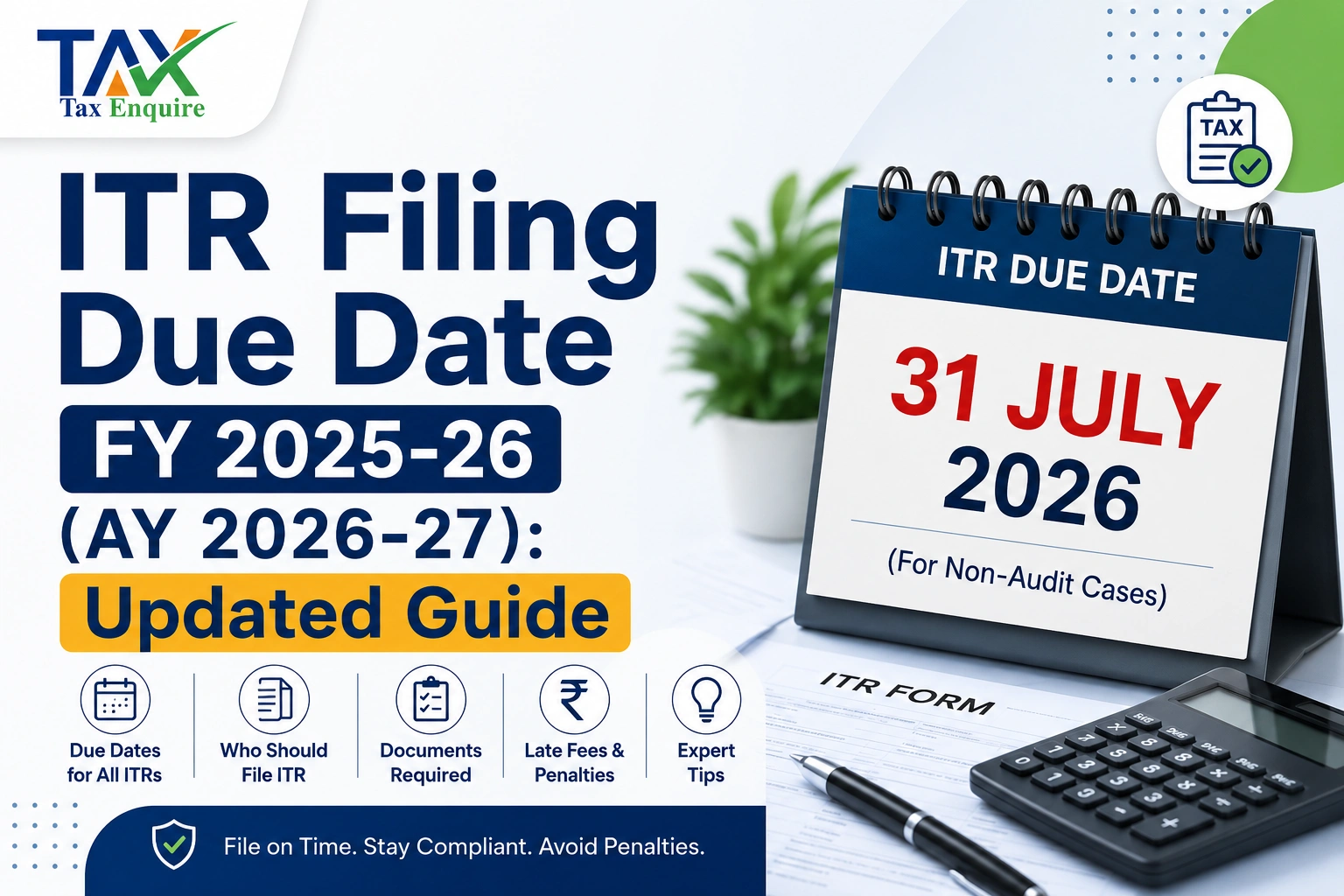
Filing Income Tax Return (ITR) within the prescribed due date is essential to avoid penalties, interest, notices, and loss of tax benefits. For Financial Year (FY) 2025-26 relevant to Assessment Year (AY) 2026-27, taxpayers must carefully understand the latest due dates, interest provisions, revised return timelines, and compliance updates.
The Income Tax Department has prescribed different due dates depending upon the category of taxpayer and audit applicability.
Important Update: Income Tax Act 1961 vs Income Tax Act 2025
Though the new Income Tax Act, 2025 is proposed to come into effect from 1 April 2026, the provisions of the Income Tax Act, 1961 will continue to apply for AY 2026-27 since the income pertains to FY 2025-26 ending on 31 March 2026.
Therefore, all provisions relating to:
Section 139
Section 234A/B/C
Section 234F
Section 44AB
Deductions under Chapter VI-A
will continue to govern ITR filing for AY 2026-27.
1. Major Updates in ITR Filing for AY 2026-27
1. Separate Due Dates for Different Non-Audit Taxpayers
One of the key compliance changes for AY 2026-27 is the distinction between
ITR-1 & ITR-2 taxpayers
ITR-3 & ITR-4 taxpayers
Now:
Salaried and simple non-audit taxpayers generally have due date of 31 July 2026
Business/profession non-audit taxpayers filing ITR-3 or ITR-4 may file up to 31 August 2026.
This change aims to reduce portal congestion and improve filing efficiency.
2. Revised ITR Forms Notified
CBDT has notified revised ITR Forms 1 to 7 for AY 2026-27 with additional disclosure requirements and compliance reporting.
Important updates include:
Reporting of long-term capital gains
Buyback loss disclosures
F&O and intraday trading details
Additional address reporting
Expanded prefilled information
Improved AIS/TIS reconciliation
3. Higher Focus on AIS & Compliance Matching
Taxpayers must now carefully reconcile the following:
Form 26AS
AIS (Annual Information Statement)
TIS (Taxpayer Information Summary)
TDS certificates
Mutual fund transactions
Stock market transactions
Foreign remittances
Mismatch may result in:
Defective return notices
Refund delays
Scrutiny notices
Demand notices
Who Should File ITR Even if Income is Below Taxable Limit?
Many taxpayers believe ITR filing is mandatory only when tax liability arises. However, return filing may still be compulsory in several cases.
You should file ITR if:
Total income exceeds basic exemption limit
TDS has been deducted
Foreign assets are held
High-value transactions are undertaken
Bank deposits exceed prescribed limits
Electricity expenses exceed specified threshold
Foreign travel expenses incurred
Business losses need carry forward
Refund claim is pending
Loan or visa documentation required
IF you missed filing the ITR on the due date, what should you do?
Then you have 2 options; they are
Belated Return and Updated Return
Revised Return under Section 139(5)
If any mistake is noticed after filing original ITR, taxpayer can revise return.
Common mistakes include:
Wrong bank account
Missed income disclosure
Incorrect deduction claim
Wrong ITR form selection
TDS mismatch
Omitted capital gains
Last date to revise return for AY 2026-27:
31 December 2026
Interest for Late Filing of ITR
Section 234A – Delay in Filing Return: Interest at 1% per month or part thereof is payable on outstanding tax liability if ITR is filed after due date.
Section 234B – Default in Advance Tax: Interest at 1% per month applies if advance tax paid is less than 90% of total tax liability.
Section 234C – Delay in Advance Tax Installments: Interest at 1% per month applies for deferment of quarterly advance tax installments.
Late Filing Fee under Section 234F
If return is filed after due date, late fees under Section 234F may apply.
Which ITR Form is Applicable for AY 2026-27?
Consequences of Missing ITR Due Date
Failure to file ITR within due date may lead to:
Interest under Sections 234A/B/C
Late filing fee under Section 234F
Delay in income tax refund
Loss of carry forward of business and capital losses
Higher chances of notices and scrutiny
Difficulty in loan or visa approval
Income Tax Act 1961 vs Income Tax Act 2025 – Section Comparison
Note: Proposed section mapping under Income Tax Act 2025 is subject to final implementation and notification.
Documents Required for ITR Filing
Salaried Individuals
PAN & Aadhaar
Form 16
AIS & Form 26AS
Investment proofs
Bank statements
Business & Professionals
Financial statements
GST returns
Audit reports
TDS certificates
Investors
Capital gain statements
Mutual fund reports
Dividend details
Benefits of Timely ITR Filing
Timely filing offers several financial and legal benefits:
Faster Refund Processing:Early filed returns generally receive quicker refund processing.
Easy Loan Approval: Banks and NBFCs frequently ask for:
2-3 years ITR copies
Computation of income
Acknowledgement receipts
Visa Processing:Many embassies require ITRs as proof of financial stability.
Carry Forward of Losses:Business and capital losses can generally be carried forward only if ITR is filed within due date.
Avoid Notices & Penalties: Timely and accurate filing reduces litigation and compliance risk.
Conclusion
For AY 2026-27, taxpayers should ensure timely filing of Income Tax Returns under the provisions of the Income Tax Act, 1961. With increased AIS-based monitoring and enhanced disclosure requirements, proper reconciliation and timely compliance have become extremely important.
Taxpayers should avoid last-minute filing and ensure accurate reporting of income, deductions, capital gains, and tax credits to prevent penalties, notices, and refund delays.
Frequently Asked Questions (FAQs)
What is the due date for salaried taxpayers for AY 2026-27?
31 July 2026.
What is the due date for tax audit cases?
31 October 2026.
Can I file belated return after due date?
Yes, up to 31 December 2026.
What is the late filing fee under Section 234F?
Up to ₹5,000.
What is the interest rate for late filing?
Generally 1% per month under Sections 234A/B/C.
Is Income Tax Act 2025 applicable for AY 2026-27?
No, AY 2026-27 continues under Income Tax Act, 1961.
Can I revise my ITR after filing?
Yes, revised return can be filed up to 31 December 2026.
Author: CA POONAM GUPTA & ADV LOKESH GUPTA
© 2026 Tax Esquire | Expert CA Services in Greater Noida, Uttar Pradesh
8810380146 | info.taxesquire@gmail.com | taxesquire.in
This document is for informational purposes only. For personalised tax advice, consult our chartered accountants.