ELSS Funds: How to Save Tax Under Section 80C via Mutual Funds
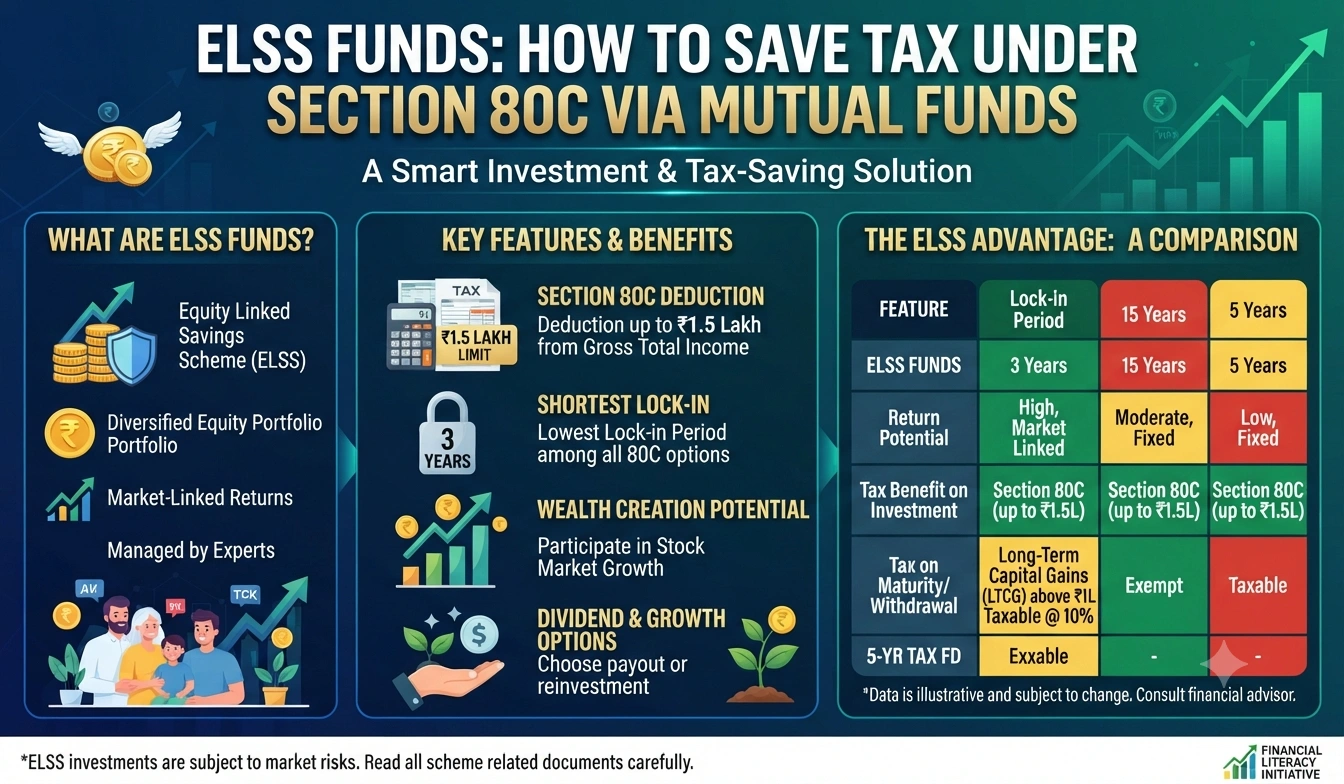
ELSS Funds
Your complete guide to equity linked savings schemes and tax-efficient wealth building
What Exactly Is an ELSS Fund?
ELSS stands for Equity Linked Savings Scheme. Think of it as a mutual fund that lets you invest in stocks while getting a tax break at the same time. It's basically a win-win if you want to save taxes and grow your money.
The way it works is simple. You put money into an ELSS fund, and that investment qualifies for a tax deduction under Section 80C of the Income Tax Act. You can deduct up to ₹1.5 lakhs in a financial year. And here's the thing—your money is actually invested in the stock market, so it has the potential to grow much faster than traditional fixed deposits or savings accounts.
But there's a catch. Your money stays locked for 3 years. You can't touch it before that. So what does this mean for you? It means ELSS is perfect if you're looking for a long-term investment that also saves you taxes right now.
How Section 80C Works With ELSS Investments
Section 80C is one of the most powerful tax-saving tools in India. It lets you reduce your taxable income by the amount you invest in certain instruments. ELSS is one of them.
Here's a practical example. Say you earn ₹10 lakhs a year and you invest ₹1.5 lakhs in an ELSS fund. Your taxable income now becomes ₹8.5 lakhs instead of ₹10 lakhs. If you're in the 30% tax bracket, you save ₹45,000 in taxes right away. That's real money in your pocket.
And that's really it—the deduction is straightforward. You invest, you get the deduction, and you reduce your tax bill. No complicated paperwork or conditions beyond the lock-in period.
You can invest in ELSS through your employer's salary deduction (if available) or directly through a mutual fund platform. Both routes give you the same tax benefit.
The 3-Year Lock-In Period Explained
The lock-in period is the one thing that stops many people from investing in ELSS. But honestly, it's not as bad as it sounds.
When you invest in an ELSS fund, your money is locked for exactly 3 years. You can't withdraw it, you can't transfer it, you can't do anything with it. After 3 years, it's completely free. You can withdraw whenever you want, and you don't pay any exit load.
Why is this a good thing, not a bad thing? Because it forces you to stay invested. The stock market rewards long-term investors. By locking your money for 3 years, you're avoiding the temptation to panic-sell during market downturns. And trust me, that's a big deal.
Let me give you a real scenario. In 2026, you invest ₹1.5 lakhs in an ELSS fund. The market drops 20% in 2027. You can't sell. But by 2029, the market recovers and your investment grows to ₹2.1 lakhs. If you could have sold in 2027, you'd have lost money. The lock-in protected you.
ELSS Returns: What Can You Really Expect?
This is the question everyone asks. How much money will you actually make?
ELSS funds invest in Indian stocks, so their returns depend on stock market performance. Historically, over a 3-year period, ELSS funds have delivered returns ranging from 8% to 15% per year. But past performance doesn't guarantee future results.
Here's a practical calculation. If you invest ₹1.5 lakhs and get an average return of 12% per year, here's what happens: Year 1: ₹1.68 lakhs, Year 2: ₹1.88 lakhs, Year 3: ₹2.10 lakhs. You made ₹60,000 in gains. Plus, you saved ₹45,000 in taxes (assuming 30% tax bracket). Total benefit: ₹1,05,000.
But here's the honest part. Some years you'll make more. Some years you'll make less. You might even have negative returns in a given year. Stock markets are unpredictable.
ELSS returns are not guaranteed. You could get 20% returns one year and -5% the next. Only invest money you don't need for at least 3 years.
Tax Treatment of ELSS Returns and Withdrawals
Here's where ELSS gets really interesting from a tax perspective. The gains you make are taxed as capital gains, not as regular income. That's a huge advantage.
If you hold the ELSS fund for more than 1 year (which you will, since it's locked for 3 years anyway), your gains are treated as long-term capital gains. And long-term capital gains on equity are taxed at just 10% if they exceed ₹1 lakh in a year. That's way lower than your regular income tax rate.
Put simply, you get a double benefit: a tax deduction when you invest, and a low tax rate when you withdraw. That's the real power of ELSS.
| Scenario | Tax Rate | How It Works |
|---|---|---|
| Long-term capital gains (1+ year) | 10% above ₹1 lakh | Gains above ₹1 lakh taxed at 10% |
| Gains up to ₹1 lakh | 0% | Completely tax-free |
| Dividends from ELSS | Dividend distribution tax + your slab | Depends on fund structure |
How to Choose the Right ELSS Fund
There are about 40-50 ELSS funds available in India. So how do you pick the right one?
And here's the thing—there's no single "best" ELSS fund. What works for you depends on your risk appetite and investment horizon. But there are some solid criteria you can use.
- Look at 3-year returns. Check how the fund performed over the last 3 years. Consistency matters more than one great year.
- Check the expense ratio. Lower is better. Anything below 0.75% is decent. High expense ratios eat into your returns.
- See the fund manager's track record. Has the same person been managing the fund for at least 3 years? Stability is good.
- Look at the fund size. Very small funds (below ₹100 crore) can be risky. Very large funds (above ₹5,000 crore) sometimes underperform. Sweet spot is ₹500 crore to ₹3,000 crore.
- Compare with the benchmark. The fund should beat the Nifty 500 or Sensex over 3 years. If it doesn't, why invest in it?
- Check the fund's holdings. Does it invest in quality companies you recognize? Or is it loaded with penny stocks?
Some popular ELSS funds (as of 2026) include Axis ELSS Tax Saver, Aditya Birla Sun Life Tax Relief 96, and HDFC Tax Saver. But don't just pick based on popularity. Do your own research.
ELSS vs. Other Section 80C Options
Section 80C isn't just about ELSS. You can also save taxes through Life Insurance, PPF, NSC, and fixed deposits. So why choose ELSS?
| Investment Option | Lock-In Period | Expected Returns | Tax on Returns |
|---|---|---|---|
| ELSS Funds | 3 years | 10-15% per year | 10% LTCG (above ₹1L) |
| PPF | 15 years | 6-7% per year | Tax-free |
| Life Insurance | Depends on policy | 4-6% per year | Tax-free (mostly) |
| NSC | 5 years | 7-8% per year | Taxable as per slab |
| Fixed Deposit | Flexible | 5-7% per year | Taxable as per slab |
The comparison shows that ELSS offers the best combination of growth potential and tax efficiency. The 3-year lock-in is shorter than PPF's 15 years, and the returns are much higher than fixed deposits.
But here's what matters: ELSS isn't right for everyone. If you're very risk-averse, PPF is safer. If you need complete liquidity, a fixed deposit is better. Choose based on your situation.
Practical Steps to Invest in ELSS
Ready to invest? Here's exactly how to do it.
- Open an account on a mutual fund platform (like Groww, CAMS, or your bank's mutual fund portal)
- Complete KYC (Know Your Customer) verification with your PAN and Aadhaar
- Search for ELSS funds and compare 3-year returns
- Choose a fund and decide on your investment amount (minimum is usually ₹500 to ₹1,000)
- Set up a lump sum investment or a systematic investment plan (SIP)
- Complete the investment and keep your confirmation receipt for tax filing
Many people use SIP (Systematic Investment Plan) instead of lump sum. With SIP, you invest a fixed amount every month. This reduces the risk of investing everything at the wrong time. For example, invest ₹12,500 every month for 12 months to reach ₹1.5 lakhs.
How to Claim Tax Deduction for ELSS
Investing is one thing. Claiming the deduction is another.
When you file your income tax return, you need to report your ELSS investment in Schedule CYC (for direct tax purposes). You'll need the following documents: Investment statement from the mutual fund, Bank statement showing the payment, PAN of the fund, and your investment confirmation receipt.
The deduction is claimed in the year you invest, not when you withdraw. So if you invest in March 2026, you claim the deduction in your 2026 tax return (filed in 2027).
Most mutual fund platforms automatically generate a consolidated statement showing your investments. This makes tax filing much easier. Just download it and attach it to your return.
Common Mistakes to Avoid
I've seen people make the same mistakes repeatedly with ELSS. Here are the big ones to avoid.
- Investing just before the tax deadline. Many people rush to invest in March to save taxes. This often means buying at the wrong price. Start investing early in the financial year instead.
- Picking a fund based solely on last year's performance. One great year doesn't mean the fund is good. Look at 3-year and 5-year returns.
- Panicking and trying to withdraw before the lock-in ends. You can't do it anyway, so don't stress. Let it sit and grow.
- Ignoring the expense ratio. A 1.5% expense ratio vs. 0.5% might not sound like much, but it compounds over time and eats into your returns significantly.
- Not diversifying within Section 80C. If you have ₹3 lakhs to invest, don't put it all in one ELSS fund. Split it across 2-3 good funds.
Real-Life Example: Complete Scenario
Let me walk you through a realistic example to tie everything together.
Suppose you're a 35-year-old earning ₹15 lakhs per year. Your tax bracket is 30%. You decide to invest ₹1.5 lakhs in an ELSS fund in January 2026 via SIP (₹12,500 per month). Here's what happens:
Immediate benefit (2026): You save ₹45,000 in taxes (30% of ₹1.5 lakhs). Your take-home pay increases by ₹45,000.
By January 2027: Your ELSS investment grows to ₹1.68 lakhs (assuming 12% annual return). You can't withdraw yet. The lock-in is still active.
By January 2029: Your investment grows to ₹2.10 lakhs. The lock-in ends. You now have a choice: withdraw or stay invested.
If you withdraw in January 2029: Your capital gain is ₹60,000 (₹2.10 lakhs - ₹1.5 lakhs). Since it's more than ₹1 lakh, you pay 10% tax on the excess (₹6,000). Your net gain is ₹54,000. Combined with the ₹45,000 tax saved in 2026, your total benefit is ₹99,000.
That's a pretty solid outcome for simply choosing to invest wisely.
FAQs About ELSS and Section 80C
Q1: Can I invest more than ₹1.5 lakhs in ELSS?
Yes, you can invest as much as you want. But the tax deduction is capped at ₹1.5 lakhs per financial year under Section 80C. Any amount above that won't give you a tax benefit. So investing ₹2 lakhs means only ₹1.5 lakhs gets the deduction.
Q2: What happens if the market crashes after I invest?
Your investment value will drop temporarily. But you can't withdraw until 3 years are over. The good news? Markets historically recover. If you stay invested, you'll likely see growth by the time the lock-in ends. This is why ELSS is better for people with a 3+ year investment horizon.
Q3: Do I need to file ITR to claim ELSS deduction?
Only if your income exceeds the taxable limit. If you earn below ₹5 lakhs (or ₹7.5 lakhs if you're over 60), you might not need to file ITR. But if you file voluntarily, you can still claim the deduction. Check with a CA to be sure.
Q4: Can I withdraw before 3 years in case of emergency?
No. The 3-year lock-in is compulsory. There's no way around it, even for emergencies. That's why you should only invest money you won't need for 3 years.
Q5: Is SIP better than lump sum for ELSS?
Both work. SIP is better if you want to reduce the risk of buying at the wrong time (rupee cost averaging). Lump sum is better if you have a large amount and want to invest it immediately. Honestly, the difference over 3 years isn't huge. Pick whichever fits your cash flow.
Q6: What if I change jobs? Does my ELSS investment get affected?
Not at all. Your ELSS investment is personal and independent of your job. You can change jobs, move cities, or even change careers. Your ELSS fund keeps growing without any interruption.
Q7: Can my spouse invest in ELSS and claim the deduction?
Yes. Each person has their own ₹1.5 lakh limit under Section 80C. So if you and your spouse both invest ₹1.5 lakhs, you both get the deduction separately. Total tax benefit: ₹90,000 (if both are in 30% bracket).
Final Thoughts: Is ELSS Right for You?
ELSS isn't just a tax-saving tool. It's a wealth-building tool that happens to save taxes. The combination of growth potential and tax efficiency makes it one of the smartest investments you can make.
But it's not for everyone. You need to be comfortable with stock market volatility. You need to have money you won't need for 3 years. And you need to pick the right fund, not just any fund.
If you tick all those boxes, ELSS deserves a serious look. Start small if you're unsure. Invest ₹10,000 or ₹20,000 and see how it feels. Once you're comfortable, increase your investment. The earlier you start, the more time your money has to grow.
So what are you waiting for? The financial year 2026-2027 is your chance to save taxes while building wealth. Make it count.
" } ```
© 2026 Tax Esquire | Expert CA Services in Greater Noida, Uttar Pradesh
8810380146 | info.taxesquire@gmail.com | taxesquire.in
This document is for informational purposes only. For personalised tax advice, consult our chartered accountants.