Customs Duty & Anti-Dumping Duty Basics for Importers: A Complete 2026 Guide
Customs Duty & Anti-Dumping Duty Basics for Importers
Everything you need to know about import duties, tariff classifications, and anti-dumping measures in India
What's the Deal With Customs Duty?
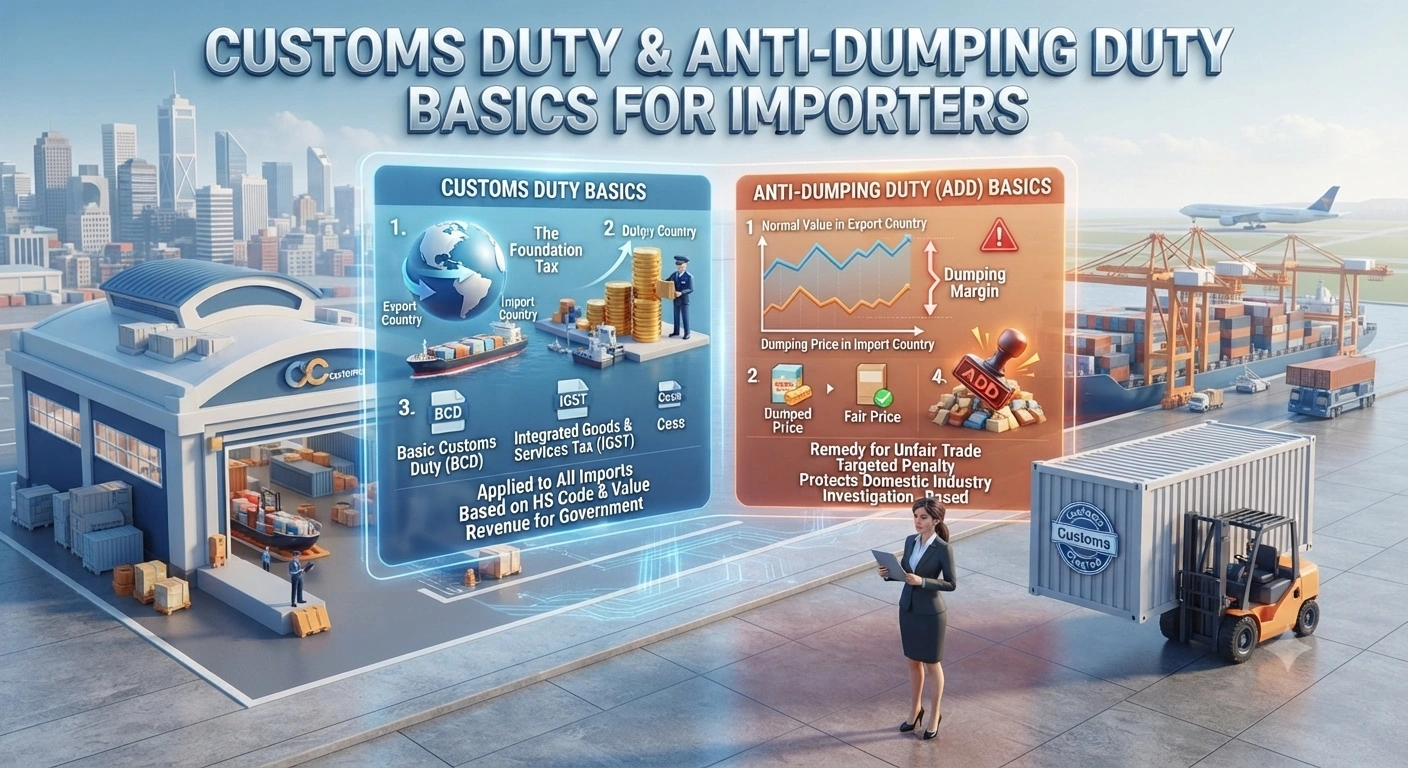
Customs duty is basically a tax that you pay when you bring goods into India. The government charges this to protect local industries and raise revenue. Think of it as the price of entry for your products into the Indian market.
The thing is, the duty rate changes depending on what you're importing. A smartphone might have a different rate than industrial machinery. So what does this mean for you? You need to know exactly what you're importing and which category it falls into.
And here's what gets tricky: you also need to think about anti-dumping duties. These are extra charges that kick in when foreign companies try to sell goods at unfairly low prices. Put simply, the government doesn't want imports to undercut local manufacturers by dumping cheap products.
Understanding duty structures helps you plan your import costs accurately, avoid surprise bills at customs, and stay competitive in pricing.
How Customs Duty Actually Works
The basic customs duty in India is calculated on the assessable value of goods. The Central Board of Indirect Taxes and Customs (CBIC) sets the rates, and they change regularly. In 2026, the rates vary from zero percent on some items to over 100 percent on others.
Here's how the math works: you take the CIF value (cost, insurance, and freight) of your goods, add any applicable surcharges, and then apply the duty rate. The result is what you owe to customs.
But wait—there's more. You might also pay additional duties like countervailing duty (CVD) or integrated goods and services tax (IGST). These stack on top of basic customs duty. So your final bill can be much bigger than you initially thought.
- Basic Customs Duty: The primary tax on imported goods
- Additional Customs Duty: Roughly equals the IGST rate on domestic goods
- Countervailing Duty: Compensates for subsidies in the exporting country
- Anti-Dumping Duty: Protects against unfairly priced imports
- Agriculture Infrastructure Development Cess: Applied on select items
- Health Cess: Charged on specific products like tobacco
Understanding Tariff Classification
Tariff classification is where most importers get confused. You need to classify your goods under the Harmonized System (HS) code. This is an eight-digit code that tells customs exactly what you're importing.
The wrong classification can cost you dearly. If you classify a product incorrectly to pay lower duty, customs can slap penalties on you. Basically, you're looking at extra charges, interest, and sometimes even legal action.
So how do you get it right? You can file an advance ruling application with the customs authority. They'll give you a binding decision on the classification before you import. This takes about 90 days, but it saves you from guessing wrong.
Wrong tariff classification isn't just a mistake—it's treated as fraud. Customs can demand back duty, penalties up to 100% of duty value, and confiscate your goods. Don't guess on this.
What Is Anti-Dumping Duty and When Does It Apply?
Anti-dumping duty is a special protective measure. It kicks in when the government decides that foreign companies are selling goods below their normal value. The goal? To stop unfair competition and protect Indian manufacturers.
And here's what I mean by dumping: imagine a Chinese steel company sells steel at $300 per ton in its home market but offers it at $200 per ton in India. That's dumping. The Indian government then adds an anti-dumping duty to bring the price back to fair levels.
The Directorate General of Trade Remedies (DGTR) investigates these cases. They look at whether dumping is happening, whether it's hurting Indian industry, and what duty level is fair. This process takes months, sometimes years.
In 2026, India has anti-dumping duties on products like steel, chemicals, pharmaceuticals, and electronics. The rates vary widely depending on the product and the country of origin.
| Product Category | Common Duty Range | Status in 2026 |
|---|---|---|
| Steel Products | 5-25% | Active |
| Chemicals | 8-40% | Active |
| Electronics | 10-35% | Active |
| Textiles | 3-20% | Active |
| Pharmaceuticals | 2-15% | Active |
Practical Example: Importing Electronics
Let's say you're importing 1,000 mobile phone chargers from China. The CIF value is $10,000. Here's how the duty calculation works:
- CIF Value: $10,000 (about ₹835,000)
- Basic Customs Duty at 20%: ₹167,000
- Additional Customs Duty (IGST equivalent) at 5%: ₹41,750
- Anti-Dumping Duty at 15% (if applicable): ₹125,250
- IGST on duty: ₹50,895
- Total Duty Burden: ₹384,895
So your effective cost jumps from $10,000 to about $15,500. That's a 55% increase just from duties. This is why importers need to factor duty costs into their pricing strategy from day one.
Knowing duty costs upfront helps you decide whether to import, source locally, or negotiate better prices with suppliers. You can also explore duty exemption schemes or concessional rates.
Duty Exemptions and Concessions Available to Importers
The good news? You don't always pay full duty. India has several exemption schemes that can help you save money.
The Advance Authorisation scheme lets you import raw materials or components duty-free if you're exporting finished goods. You need to prove that you'll export goods made from these imports. It's a bit of paperwork, but the savings are real.
Then there's the Export Promotion Capital Goods (EPCG) scheme. If you're importing machinery to manufacture goods for export, you can get concessional duty rates. The duty is typically 5% instead of the full rate.
- Advance Authorisation: Zero duty on imports if you export finished goods
- EPCG Scheme: 5% duty on capital goods for export manufacturers
- Duty Drawback: Refund of duty paid if you export the goods later
- SEZ Imports: Zero duty on imports into Special Economic Zones
- Baggage Rules: Personal imports up to certain limits are duty-free
- Samples: Temporary imports for testing may get exemptions
But here's the catch: you need to follow the rules strictly. If you claim Advance Authorisation but don't export the goods within the stipulated time, you'll have to pay back all the duty plus interest and penalties.
How to Determine If Anti-Dumping Duty Applies to Your Import
Checking whether anti-dumping duty applies to your goods is crucial. You can't just assume it doesn't apply and then get hit with a surprise bill at customs.
Start by visiting the DGTR website. They maintain a list of all products under anti-dumping investigation or already covered by anti-dumping duty. Search for your HS code and product description.
The list shows the duty rate, the country of origin, and the period for which the duty applies. Some duties are temporary and expire after 5 years unless renewed. Others have been in place for years.
Also check the notification issued by the Ministry of Commerce. It specifies the exact duty rate applicable. This is legally binding, so you can't argue about it at customs.
Anti-dumping duty is charged in addition to basic customs duty. If you miss it in your calculation, your goods will be held at the port until you pay. This can delay your shipment by weeks and cost you money in storage charges.
Customs Clearance Process and Compliance
Once your goods arrive at the port, they don't automatically come in. You need to go through customs clearance. This involves filing documents, paying duties, and getting approval from customs officials.
The process starts with filing an import bill of entry. Your customs broker does this on your behalf. The bill of entry contains details like the invoice, packing list, and certificates of origin.
Customs then assesses the goods. They check the documents, sometimes physically inspect the cargo, and determine the duty payable. They use their own valuation methods, so the duty might be higher than what you calculated.
Once you pay the duty, you get the bill of entry stamped. Then you can collect your goods from the port. The whole process typically takes 3-5 days if everything is in order. But if there are issues—missing documents, classification disputes, or physical inspection—it can stretch to weeks.
- File Bill of Entry with customs broker
- Customs assesses value and duty
- Physical inspection may happen (random or risk-based)
- Pay duty and other charges
- Get bill of entry stamped
- Take delivery of goods
Common Mistakes Importers Make
I've seen importers mess up in predictable ways. Learning from their mistakes can save you thousands of rupees.
First mistake: undervaluing goods to pay lower duty. Customs has access to international price databases. They catch this. When they do, they reassess the value, demand back duty, and slap penalties on you. The penalty can be 100% of the duty amount.
Second mistake: not checking for anti-dumping duty before importing. You assume it doesn't apply, then get hit at the port. Your goods sit there while you scramble to arrange money for the duty.
Third mistake: poor documentation. Missing invoices, unclear packing lists, or incomplete certificates of origin slow down clearance. Customs holds your goods until you provide complete paperwork.
Fourth mistake: using the wrong HS code. This is serious. Wrong classification can lead to assessment at a higher rate, penalties, and even criminal charges if it's intentional.
Fifth mistake: not keeping records. Customs can audit you for 5 years after import. If you can't produce documents, they can demand duty again.
Staying Compliant in 2026 and Beyond
Compliance isn't optional. It's the foundation of sustainable importing. Here's what you need to do.
Keep all import documents for at least 6 years. This includes invoices, packing lists, bills of entry, duty payment receipts, and inspection reports. Organize them by shipment and date.
Maintain a register of all imports. Note the HS code, quantity, CIF value, duty paid, and anti-dumping duty (if applicable). This helps you track patterns and spot errors.
Work with a reliable customs broker. They know the rules, have relationships with customs officials, and can help you navigate disputes. A good broker saves you more than their fees.
Get advance rulings for new products. If you're importing something for the first time, file an advance ruling application. The small cost and time investment pay off by eliminating classification disputes later.
Monitor duty changes. The government updates tariff rates regularly. What's 20% duty this year might become 25% next year. Stay informed so you can adjust your pricing strategy.
Staying compliant builds trust with customs, speeds up clearance, and protects you from penalties. It also makes audits less stressful because your records are clean.
Frequently Asked Questions
1. Can I appeal a customs duty assessment?
Yes, you can. If you disagree with the duty assessment, you can file an appeal with the Commissioner of Customs within 6 months. You'll need to present evidence supporting your claim. If the Commissioner doesn't help, you can go to the Customs, Excise & Service Tax Appellate Authority (CESTAT). This process takes time, but it's worth it if the duty amount is large.
2. What's the difference between countervailing duty and anti-dumping duty?
Countervailing duty protects against subsidies. If a foreign government subsidizes exports, India charges countervailing duty to level the playing field. Anti-dumping duty, on the other hand, protects against unfairly low prices. So countervailing duty is about subsidies, and anti-dumping duty is about pricing. Sometimes both apply to the same product.
3. How long does it take to clear goods through customs?
If everything is in order—documents are complete, no inspection is needed, and you've paid duty—it takes about 1-2 days. But if customs wants to inspect your goods or if there are document issues, it can take a week or more. In rare cases where there's a dispute about classification or valuation, it can take months.
4. Can I import goods without paying anti-dumping duty?
No, you can't avoid it if it applies to your product. But you can check if your product is covered. Also, some countries are exempted from anti-dumping duty on specific products. For example, if anti-dumping duty applies to steel from China but not from Japan, you can import from Japan without the duty. Check the DGTR notification for exemptions.
5. What happens if I declare a lower invoice value to pay less duty?
Don't do it. Customs has sophisticated valuation methods and access to international price data. They'll catch undervaluation. The penalty is 100% of the duty amount, plus interest at 15% per year, plus potential criminal charges. It's not worth the risk. Declare the true value and explore legitimate duty exemption schemes instead.
6. Is there a way to reduce customs duty on my imports?
Yes, several ways. If you're exporting goods made from your imports, use the Advance Authorisation scheme to import duty-free. If you're importing capital goods for manufacturing exports, use the EPCG scheme for 5% duty. If you import and later export the same goods, claim duty drawback. Also check if your product qualifies for concessional rates under trade agreements like CEPA or CECA.
Key Takeaways for Smart Importing
- Know your HS code before importing. Wrong classification costs money and time.
- Always check for anti-dumping duty. It adds significantly to your import cost.
- Factor duty costs into your pricing from day one. Don't treat it as an afterthought.
- Work with a good customs broker. They're worth their fees.
- Keep complete documentation for 6 years. Customs audits are real.
- Explore duty exemption schemes if you're exporting goods. The savings are substantial.
- Declare true values. Undervaluation penalties are harsh.
- Stay updated on duty changes. Rates change regularly.
Conclusion
Customs duty and anti-dumping duty aren't just technical details. They're real costs that impact your profitability. Understanding how they work, what they apply to, and how to manage them is essential for successful importing.
The good news? You're not powerless. By getting the HS code right, checking for anti-dumping duty upfront, and exploring exemption schemes, you can optimize your duty costs. And by maintaining good compliance practices, you avoid penalties and delays.
In 2026 and 2027, the import landscape will continue to evolve. Duty rates will change, new anti-dumping cases will come up, and trade agreements will shift. But the fundamentals stay the same: know your product, know the rules, and keep good records.
If you're serious about importing, invest in understanding these concepts. Talk to experienced customs brokers, file advance rulings for new products, and stay updated on policy changes. The time and money you invest now will pay off many times over.
" } ```
© 2026 Tax Esquire | Expert CA Services in Greater Noida, Uttar Pradesh
8810380146 | info.taxesquire@gmail.com | taxesquire.in
This document is for informational purposes only. For personalised tax advice, consult our chartered accountants.