Top 10 Income Tax Filing Mistakes to Avoid in 2026-2027
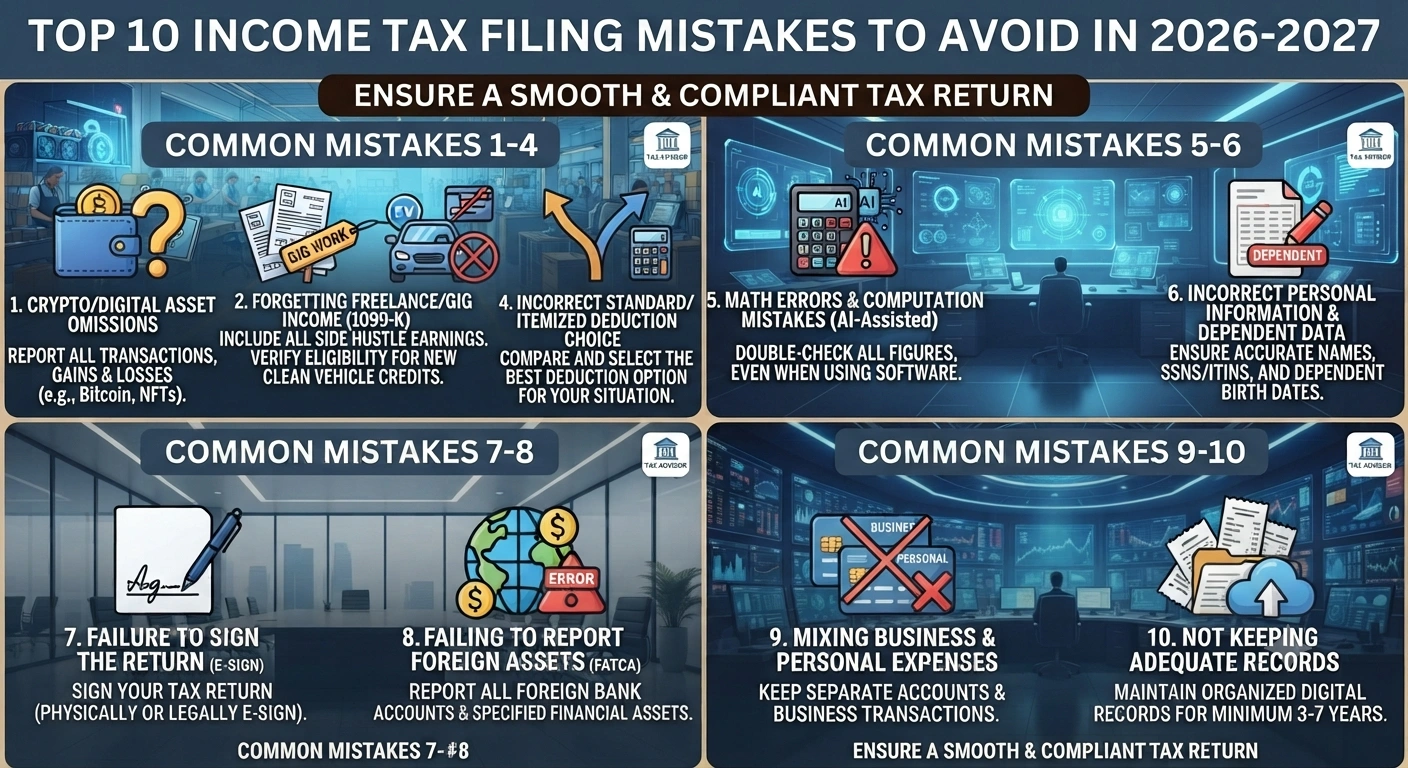
Top 10 Income Tax Filing Mistakes to Avoid
A practical guide to staying compliant and keeping your money safe during the 2026-2027 tax season
I've been filing tax returns for over a decade now, and I can tell you something honestly—most people make the same mistakes year after year. And that's really it. They're not trying to cheat anyone. They just don't know what they don't know.
The problem? These mistakes can cost you. Sometimes it's just a small penalty. Sometimes it's an audit that keeps you up at night. So I'm going to walk you through the 10 biggest errors I see, and more importantly, how to avoid them.
Mistake #1: Not Reporting All Your Income Sources
This is the number one reason the Income Tax Department comes knocking. You've got your salary, sure. But what about that freelance project you did? The rental income from your apartment? Interest from your savings account?
And here's the thing—the tax department gets copies of these too. Your bank sends them 1099-equivalent forms. Your employer files your salary details. Your property records are public. So when you don't report it, they notice.
Put simply, you need to list every rupee that came in. Income from salary, business, capital gains, rental property, interest, dividends—everything.
Missing income sources is one of the fastest ways to trigger a tax notice. The penalty can be 50% of the tax amount, plus interest.
Mistake #2: Claiming Deductions You Can't Prove
Everyone wants to reduce their tax bill. I get it. But the deduction only works if you can back it up with paperwork. No receipt? No deduction. Simple as that.
I see people claim home office expenses without any documentation. Or medical deductions where they've lost the bills. Or donations where they don't have the charity's registration number. It doesn't fly.
- Keep all invoices and bills for at least 5 years
- For donations, get the 80G certificate from the NGO
- Medical expenses need hospital receipts and doctor prescriptions
- Business expenses need GST invoices or receipts
- Home office claims need proper documentation of space and costs
What I mean is, if you can't show it, don't claim it. The tax officer doesn't care about your memory.
Digital record-keeping systems like GST invoices and bank statements create automatic proof. They're actually your best friends during an audit.
Mistake #3: Filing Late or Missing the Deadline Completely
The income tax deadline for 2026-2027 is July 31st. Not August. Not "sometime in August." July 31st. And yet, I still see people scrambling on August 1st.
Late filing brings penalties. If you miss the deadline, you pay 5% of the tax due if you file within a month, and 10% if you file later. But that's not even the worst part. You also lose the right to carry forward losses and claim certain deductions.
So what does this mean for you? Mark the date now. Set a reminder. Don't wait until the last week.
Mistake #4: Wrong PAN or Aadhaar Linking
Your PAN is your tax ID. Your Aadhaar is your identity proof. They need to match perfectly with what's on file at the tax department. A typo here can invalidate your entire return.
I've seen returns get rejected because someone wrote their PAN as "ABCDE1234F" instead of "ABCDE1234E." One letter. That's all it takes. And your Aadhaar needs to be linked with your PAN before you file—not after.
Before you hit submit, double-check both. Then check again. Honestly, I do it three times.
If your PAN-Aadhaar linking is incomplete, your return gets rejected automatically. You'll need to fix it and refile, which wastes time and creates compliance issues.
Mistake #5: Ignoring TDS and Tax Collected at Source
TDS is tax that's already been taken from your income. Your employer takes it from your salary. Banks take it from your interest. Contractors take it from their payments to you. And here's the thing—you need to report it in your return, or you won't get credit for it.
I had a client who didn't report the TDS from his interest income. He ended up paying tax twice on the same money. Once as TDS, once again in his return. That's not how it's supposed to work.
Your employer and banks send TDS certificates. Collect them all. Match them with your return. If there's a mismatch, correct it before filing.
Mistake #6: Mixing Personal and Business Expenses
If you run a business or are self-employed, you can deduct business expenses. But only business expenses. Your personal groceries aren't a deduction. Your car fuel is only deductible if it's purely for business.
The problem is, people get creative. They claim their entire home as a business office. They deduct their personal phone as a business expense. They claim their car completely, even though they use it for personal trips too.
The tax officer can smell this from a mile away. If your profit margin suddenly jumps because of huge deductions, they'll ask questions. And they'll dig deep.
- Keep separate bank accounts for business and personal
- Only deduct the business-use percentage of shared expenses
- Document everything with invoices from vendors
- Don't claim personal travel as business travel
- For home office, deduct only the room's proportionate cost
- Keep a mileage log if you claim vehicle expenses
Mistake #7: Not Keeping Proper Books of Accounts
If your income exceeds certain limits, you're supposed to keep books of accounts. That means a proper record of all income and expenses. Not a notebook. Not a folder of random receipts. Actual books—whether digital or physical.
Many small business owners skip this. They think, "I'll just keep my receipts and figure it out later." Then when the tax officer asks for books, they scramble. And they look suspicious.
But here's what I know—when you keep proper books, audits become simple. You show your records. They match. You move on. No drama.
Good bookkeeping also helps you understand your business better. You'll see where money's going, where it's coming from, and where you can improve.
Mistake #8: Wrong ITR Form Selection
There are different ITR forms for different types of income. ITR-1 for salary and simple income. ITR-2 for capital gains. ITR-3 for business income. ITR-4 for business with turnover under 2 crores using presumptive taxation.
I see people file ITR-1 when they should file ITR-3. Or they file ITR-2 when ITR-1 works. This creates inconsistencies that flag your return for review. And then you're explaining something that shouldn't have been complicated in the first place.
The rule is simple: pick the form that matches your income sources. If you're not sure, ask a CA. Don't guess.
Mistake #9: Not Reporting Foreign Income or Assets
If you have income from abroad, you need to report it. If you have assets overseas, you need to declare them. The tax department now has information-sharing agreements with many countries. They know about your foreign bank accounts, your rental property in Dubai, your investments in the US.
People think, "Nobody will know." But they will. And the penalties for hiding foreign income are strict. We're talking 10 times the tax amount in some cases.
So what does this mean? If you have any foreign income or assets, report it. Full stop.
Non-disclosure of foreign assets can trigger prosecution, not just penalties. This is serious stuff. Don't mess with it.
Mistake #10: Not Verifying Your Return Before Submission
Here's the thing about the income tax system—once you file, you're stuck with it. If you find a mistake after filing, you can file a revised return, but that comes with complications and sometimes penalties.
So before you click submit, read through your entire return. Check that your income figures match your salary slips and 1099s. Check that your deductions are reasonable. Check that your tax calculation is correct. Check that your bank account details are right for refunds.
I spend about 30 minutes just reviewing before I file. It's boring. But it saves headaches later.
Summary Table of Common Mistakes and Fixes
| Mistake | Impact | How to Fix It |
|---|---|---|
| Missing income sources | Tax notice, penalties | Report all income including freelance, rental, interest |
| Unproven deductions | Disallowed claims, audit | Keep 5 years of receipts and documentation |
| Late filing | 5-10% penalty, loss of deductions | File by July 31st for 2026-2027 tax year |
| PAN-Aadhaar mismatch | Return rejection | Link Aadhaar with PAN before filing, verify details |
| TDS not reported | Double taxation | Get TDS certificates, match with return |
| Personal vs business mixing | Deduction disallowance, audit | Keep separate accounts, document business use percentage |
Frequently Asked Questions
Q1: What happens if I file my return late?
A: You'll face a penalty of 5% of your tax if you file within one month of the deadline, and 10% if you file later. You'll also lose the right to carry forward losses and claim certain deductions. For the 2026-2027 tax year, the deadline is July 31st, 2027. Don't miss it.
Q2: Do I need to keep physical receipts or are digital copies okay?
A: Digital copies are fine, and honestly, they're better. GST invoices, email confirmations, and bank statements are all acceptable. But keep them organized and accessible. The tax officer might ask to see them, and you should be able to pull them up quickly.
Q3: What's the difference between ITR-1 and ITR-3?
A: ITR-1 is for people with salary income and simple sources like savings interest and rental income. ITR-3 is for people who run a business or are self-employed. If you have business income, you must file ITR-3, not ITR-1. Filing the wrong form can cause your return to be rejected.
Q4: Can I claim my home office as a deduction if I work from home?
A: Yes, but only the portion of your home that's used exclusively for business. If you have a dedicated room that's 10% of your home's total area, you can deduct 10% of your rent, utilities, and maintenance. But you need to show this calculation and have documentation. Don't claim your entire home—that's a red flag.
Q5: What should I do if I find a mistake after I've already filed my return?
A: You can file a revised return, but it comes with some complications. You can only revise within one year of filing the original return. And if you've already been issued a notice, you can't revise. It's better to get it right the first time. That's why verification before submission is so important.
Q6: Do I need to report interest from my savings account?
A: Yes, absolutely. Any interest you earn needs to be reported as income. Your bank sends this information to the tax department, so they know about it anyway. If you don't report it, you're asking for trouble. The amount might be small, but the principle is the same—all income counts.
Key Takeaways for the 2026-2027 Tax Season
Look, filing your income tax doesn't have to be complicated. But it does need to be done right. Here's what you need to remember:
- Report every source of income—salary, business, rental, interest, everything
- Keep proper documentation for all deductions going back 5 years
- File by July 31st, 2027 to avoid penalties and loss of benefits
- Make sure your PAN and Aadhaar are linked and correct before filing
- Report TDS received so you don't pay tax twice
- Keep business and personal expenses separate with proper documentation
- Maintain proper books of accounts if required by law
- Choose the right ITR form based on your income type
- Declare all foreign income and assets
- Review your entire return before hitting submit
And that's really it. Follow these rules, and you'll stay compliant. You'll sleep better. And you won't get surprise notices from the tax department.
When Should You Seek Professional Help?
Honestly, if you have a simple salary and basic deductions, you might be fine filing on your own. But if you have multiple income sources, a business, rental property, or foreign income, get a CA. The cost is worth it. A good CA will save you money through better tax planning and help you avoid costly mistakes.
And if you've already received a tax notice or are being audited, definitely get professional help. Don't try to handle it alone.
" } ```
© 2026 Tax Esquire | Expert CA Services in Greater Noida, Uttar Pradesh
8810380146 | info.taxesquire@gmail.com | taxesquire.in
This document is for informational purposes only. For personalised tax advice, consult our chartered accountants.