How to Become an Accountant in India: Complete Career Guide for 2026-2027
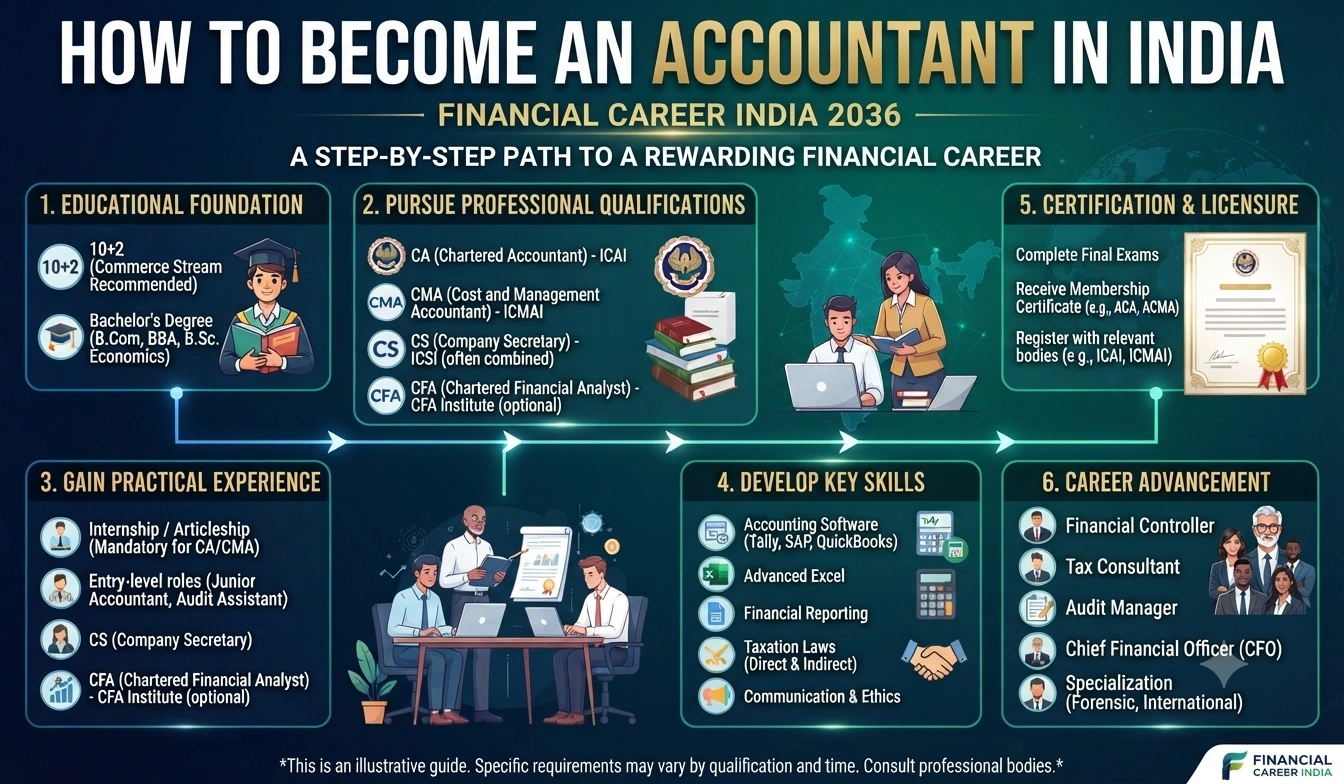
How to Become an Accountant in India
Your complete roadmap to a rewarding accounting career in 2026-2027
Why Become an Accountant in India?
Look, accounting isn't just about crunching numbers. It's a career that opens doors across every industry—startups, multinational companies, government, NGOs, you name it. And the demand keeps growing. In 2026-2027, India's economy is expanding rapidly, which means businesses everywhere need skilled accountants to manage their finances, ensure compliance, and drive growth.
The thing is, accountants aren't just number-keepers anymore. You'll be a business advisor, a problem-solver, and someone companies rely on for critical financial decisions. Job security is solid, salaries are competitive, and there's always room to grow into senior roles like CFO or audit partner.
So what does this mean for you? If you're detail-oriented, good with numbers, and want a stable career with real impact, accounting is worth exploring seriously.
High earning potential: Entry-level accountants in India earn ₹3-5 lakhs annually, while experienced professionals and CAs earn ₹15-50+ lakhs depending on specialization and location.
Educational Pathways to Become an Accountant
There are three main routes to become an accountant in India, and honestly, they're all legitimate. Your choice depends on your goals, time commitment, and career ambitions. Let me walk you through each one.
Path 1: Chartered Accountant (CA) - The Gold Standard
The CA qualification is the most recognized and prestigious accounting credential in India. It's regulated by the Institute of Chartered Accountants of India (ICAI). But here's the reality—it's also the toughest path, and that's exactly why it carries so much weight in the job market.
CA Eligibility Requirements
- You must pass 12th standard from any recognized board
- No age limit, but you should be at least 18 years old to register
- No specific subject requirements in 12th—science, commerce, or arts students can all apply
- You don't need to complete your bachelor's degree before starting the CA course
- Criminal background shouldn't prevent you from registering
The CA course has three stages, and this is important to understand before you commit. Each stage has its own exams, and you can't skip ahead.
CA Course Structure (As of 2026-2027)
| Stage | Duration | What You Do |
|---|---|---|
| CA Foundation | 4 months minimum | Basic accounting, law, and economics concepts |
| CA Intermediate | 8 months minimum | Advanced accounting, auditing, taxation, and finance |
| CA Final + Articleship | 3 years (concurrent) | Real-world experience while studying for final exams |
Here's what I mean: you register for CA Foundation, study for about 4 months, then sit for the exam. Once you pass, you move to Intermediate. You can't skip Foundation and jump straight to Intermediate. And after Intermediate, you need to find an articleship (apprenticeship) with a practicing CA for 3 years while preparing for your final exams.
The CA course is demanding. Foundation to Final typically takes 5-6 years if you pass exams on your first attempt. Many students take longer. You'll need consistent effort, strong discipline, and genuine interest in accounting to complete this successfully.
But here's the payoff: once you're a CA, doors open everywhere. You can work in audit firms, tax consulting, corporate finance, startup advisory, or start your own practice. CAs earn significantly more than other accounting professionals, and they're always in demand.
Path 2: Cost Management Accountant (CMA) - The Specialist Route
The CMA qualification is issued by the Institute of Cost Accountants of India (ICAI). It's different from CA in that it focuses on cost accounting, management accounting, and financial planning. If you're interested in internal auditing, cost analysis, and business management, CMA might be your sweet spot.
CMA Eligibility and Structure
- Pass 12th standard from any recognized board
- CMA Foundation: 4 months of study, then exam
- CMA Intermediate: 8 months of study, then exam
- CMA Final: 12 months of study plus 3 years of practical experience
- Total timeline: 4-5 years to complete
- Less expensive than CA but also less recognized internationally
CMAs work in manufacturing companies, financial institutions, and corporate finance departments. They're experts in budgeting, cost control, and strategic financial planning. The salary range is slightly lower than CAs but still competitive—typically ₹4-8 lakhs starting, growing to ₹12-30 lakhs with experience.
Path 3: Bachelor of Commerce (B.Com) + Professional Certifications
This is the quickest entry into accounting work. You do a 3-year bachelor's degree in Commerce, and you're ready for accounting jobs immediately. But here's the thing: without a professional certification like CA or CMA, your growth is limited.
Many accountants take this route, work for a few years, and then pursue CA or CMA part-time. It's a practical approach if you need income quickly.
B.Com Specializations to Consider
- Financial Accounting
- Cost Accounting
- Taxation
- Auditing
- Corporate Accounting
- International Accounting Standards
After B.Com, you can also pursue international certifications like ACCA (Association of Chartered Certified Accountants) or CPA (Certified Public Accountant), which are respected globally. These take 2-3 years alongside work experience.
B.Com graduates start earning immediately. Entry-level accounting jobs pay ₹2-3.5 lakhs annually, and with experience plus a professional certification, you can reach ₹8-15 lakhs within 5 years.
Step-by-Step Guide to Becoming a CA (The Most Popular Path)
Since most people ask about CA, let me break down exactly what you need to do, month by month.
Step 1: Register for CA Foundation (After 12th Pass)
Visit the ICAI website and register for CA Foundation. You'll fill out a form, pay the registration fee (about ₹12,000), and get your registration number. That's it—you're officially a CA student now.
- Registration fee: ₹12,000 (one-time)
- Study period: 4 months minimum
- You can start studying immediately after 12th pass
- Exam conducted twice yearly (May and November)
Step 2: Study and Pass CA Foundation Exam
The Foundation exam has 4 papers covering accounting fundamentals, business law, economics, and quantitative techniques. And honestly, it's not too difficult if you focus. Most students pass on their first or second attempt.
Study options: You can join coaching classes (₹30,000-80,000), study online through ICAI's portal (cheaper), or self-study with books. Many successful CAs used a mix of all three.
Step 3: Register for CA Intermediate
Once you pass Foundation, you're eligible for Intermediate. Registration fee is about ₹18,000. The Intermediate course is where things get serious. You'll study advanced topics like auditing, taxation, financial reporting, and corporate law.
The Intermediate exam has 8 papers (4 in each group), and you can sit for one group or both groups together. Most students take both groups together, but if you're struggling, you can do one group at a time.
- Study period: 8 months minimum
- Group 1: Accounting, Law, Costing, Taxation
- Group 2: Auditing, Financial Management, Information Systems, Advanced Accounting
- Success rate: About 40-50% pass on first attempt
Step 4: Find an Articleship Position
This is the part that surprises many students. After passing Intermediate (or sometimes before), you need to find a practicing CA who'll take you on as an article clerk (apprentice) for 3 years. This isn't paid highly—you might get ₹5,000-15,000 monthly—but it's valuable hands-on experience.
How to find articleship? Network with CAs, check ICAI's portal, contact audit firms, or ask your coaching institute. The earlier you start looking, the better. Competition is tough, so make sure your Intermediate marks are decent and you have good communication skills.
Not finding articleship is a real problem for many students. Without it, you can't complete your CA qualification, no matter how well you do in exams. Start networking and applying for articleship positions as soon as you pass Intermediate. Don't wait.
Step 5: Study and Pass CA Final While on Articleship
During your 3 years of articleship, you'll also prepare for and sit the CA Final exam. You can sit for Final only after completing 2 years and 6 months of articleship. The Final exam has 8 papers across 2 groups, similar to Intermediate.
This is the toughest part because you're working full-time (6 days a week typically) and studying for a difficult exam. Time management becomes critical. Many students study late nights and weekends. It's exhausting but doable.
Step 6: Complete Articleship and Get Your CA Certificate
Once you've completed 3 years of articleship and passed all CA Final exams, you're done. ICAI issues your CA certificate, and you're a fully qualified Chartered Accountant. From this point, you can practice independently, work in any organization, or start your own firm.
Career Opportunities After Becoming an Accountant
Once you're qualified, the job market opens up significantly. Here's where accountants work in India and what they earn:
| Sector | Job Role | Salary Range (2026-2027) |
|---|---|---|
| Audit Firms | Junior Auditor, Senior Auditor, Manager | ₹6-12 lakhs (junior) to ₹20-40 lakhs (manager) |
| Corporate Finance | Accountant, Finance Manager, CFO | ₹5-10 lakhs (accountant) to ₹30-60 lakhs (CFO) |
| Taxation | Tax Consultant, Tax Manager | ₹7-15 lakhs (consultant) to ₹25-50 lakhs (senior) |
| Government | Income Tax Officer, Accounts Officer | ₹8-12 lakhs + benefits |
| Startups | Finance Lead, CFO | ₹8-20 lakhs + equity |
| Private Practice | CA Practitioner, Partner | ₹10-25 lakhs (practitioner) to ₹50+ lakhs (partner) |
The best part? Accounting skills are always in demand. Whether the economy is booming or struggling, companies need accountants to manage their books, pay taxes, and stay compliant. And in 2026-2027, with India's focus on digitalization and GST compliance, accountants who understand technology are especially valuable.
Skills You'll Need as an Accountant
Beyond the technical knowledge from your course, certain skills will make you stand out in the job market. And honestly, these are things you should start developing now, not after you finish your qualification.
- Proficiency with accounting software: Tally, SAP, QuickBooks, XBRL
- Advanced Excel skills: Pivot tables, VLOOKUP, macros, data analysis
- Tax knowledge: GST, Income Tax, TDS compliance
- Communication skills: You'll explain complex financial data to non-finance people
- Attention to detail: One wrong figure can cause major problems
- Time management: Handling multiple deadlines during audit and tax seasons
In 2026-2027, automation is changing accounting. Many routine tasks are being handled by AI and software. But that doesn't mean accountants are disappearing—it means they're shifting toward advisory roles and strategic analysis. Learning these new tools early gives you a huge advantage.
Common Mistakes Students Make
I've seen hundreds of accounting students, and certain patterns repeat. Learning from others' mistakes can save you years of frustration.
- Starting without a clear plan: Drifting through the course without understanding why they're studying each topic
- Ignoring practical work: Focusing only on exams and neglecting real-world accounting practices
- Weak fundamentals: Rushing through Foundation and Intermediate without truly understanding concepts
- Poor articleship selection: Joining a firm just because they offered a position, not considering learning opportunities
- No networking: Not building relationships with seniors, peers, or potential employers
- Skipping updates: Not staying current with tax law changes and accounting standards
Students who start internships or part-time work during their studies finish faster, get better jobs, and earn more. Real experience makes exam preparation easier because you understand why you're learning each topic.
Costs Involved in Becoming an Accountant
Let's be honest about money. The CA course isn't cheap, and you should know exactly what you're investing before you start.
| Expense | Amount (₹) |
|---|---|
| CA Foundation Registration | 12,000 |
| Coaching Classes (optional but recommended) | 40,000-80,000 |
| CA Intermediate Registration | 18,000 |
| Study Materials & Books | 30,000-50,000 |
| CA Final Registration | 20,000 |
| Articleship (living expenses for 3 years) | 3,60,000-6,00,000 |
| Total Estimated Cost | 5,00,000-8,50,000 |
But put simply, this investment pays back within 2-3 years of working as a CA. The earning potential is high enough that most people recover their costs quickly.
Frequently Asked Questions
Q1: Can I become a CA if I'm not a commerce student?
Yes, absolutely. You don't need to be a commerce student. Science, arts, or commerce—doesn't matter. You just need to pass 12th. That said, commerce students find the course easier because they're already familiar with accounting basics. But many successful CAs come from non-commerce backgrounds, so don't let that stop you.
Q2: How long does it take to become a CA in total?
If you pass all exams on your first attempt and find articleship immediately, it's about 5-5.5 years from 12th pass to CA qualification. But in reality, most people take 6-8 years because they don't pass exams on first attempt or face delays in finding articleship. Don't rush—quality matters more than speed.
Q3: What if I fail an exam? Can I retake it?
Yes. You can retake any exam as many times as you need. There's no limit on attempts. Exams are conducted twice yearly (May and November), so you get two chances per year. Many successful CAs took 3-4 attempts at some papers. It's normal, not a failure.
Q4: Is it better to do CA or CMA?
If you want maximum career options and earning potential, CA is the better choice. It's more recognized and opens more doors. But if you specifically love cost accounting and internal management, CMA is great. The honest answer? CA is harder but more rewarding. CMA is easier but slightly less prestigious. Choose based on your interests, not just difficulty.
Q5: Can I work while studying for CA?
Yes, and it's actually recommended. Many students work part-time or do internships while studying. During Foundation and Intermediate, it's manageable. During articleship, you're working full-time anyway, so you're combining work and study. The key is finding the right balance and not overcommitting yourself.
Q6: What's the job market like for accountants in 2026-2027?
Strong. India's economy is growing, GST compliance is becoming more complex, and digital transformation is creating new opportunities. Startups are hiring accountants, corporations need finance professionals, and tax consulting is booming. The demand for skilled accountants is high, and it's expected to grow through 2026-2027. You won't struggle to find jobs—you'll have choices.
Q7: Can I practice as a CA without doing articleship?
No. Articleship is compulsory. You can't get your CA certificate without it. You can work as an accountant in a company without articleship, but you can't practice independently or use the CA title. The 3 years of articleship is part of the qualification, not optional.
Final Thoughts: Is Accounting the Right Career for You?
Becoming an accountant in India is a solid choice if you're detail-oriented, enjoy problem-solving, and want job security with good earning potential. The path is long—5-6 years minimum—and it requires consistent effort. But the payoff is real.
The thing is, accounting isn't just about numbers anymore. Modern accountants are business advisors, strategists, and technology experts. If you're interested in how businesses work, how to manage money responsibly, and how to help organizations grow, accounting is genuinely rewarding.
In 2026-2027, the accounting profession is evolving. AI is handling routine tasks, but human accountants are becoming more valuable for advisory work. If you're ready to learn, adapt, and grow, this career will serve you well for decades.
So what's your next step? If you're serious, register for CA Foundation this month. If you want to explore first, take some online accounting courses or do a summer internship. Either way, start moving. The sooner you begin, the sooner you'll be earning as a qualified accountant.
" } ```
© 2026 Tax Esquire | Expert CA Services in Greater Noida, Uttar Pradesh
8810380146 | info.taxesquire@gmail.com | taxesquire.in
This document is for informational purposes only. For personalised tax advice, consult our chartered accountants.