GST Notice Under Section 74: Complete Compliance Guide for Indian Businesses in 2026
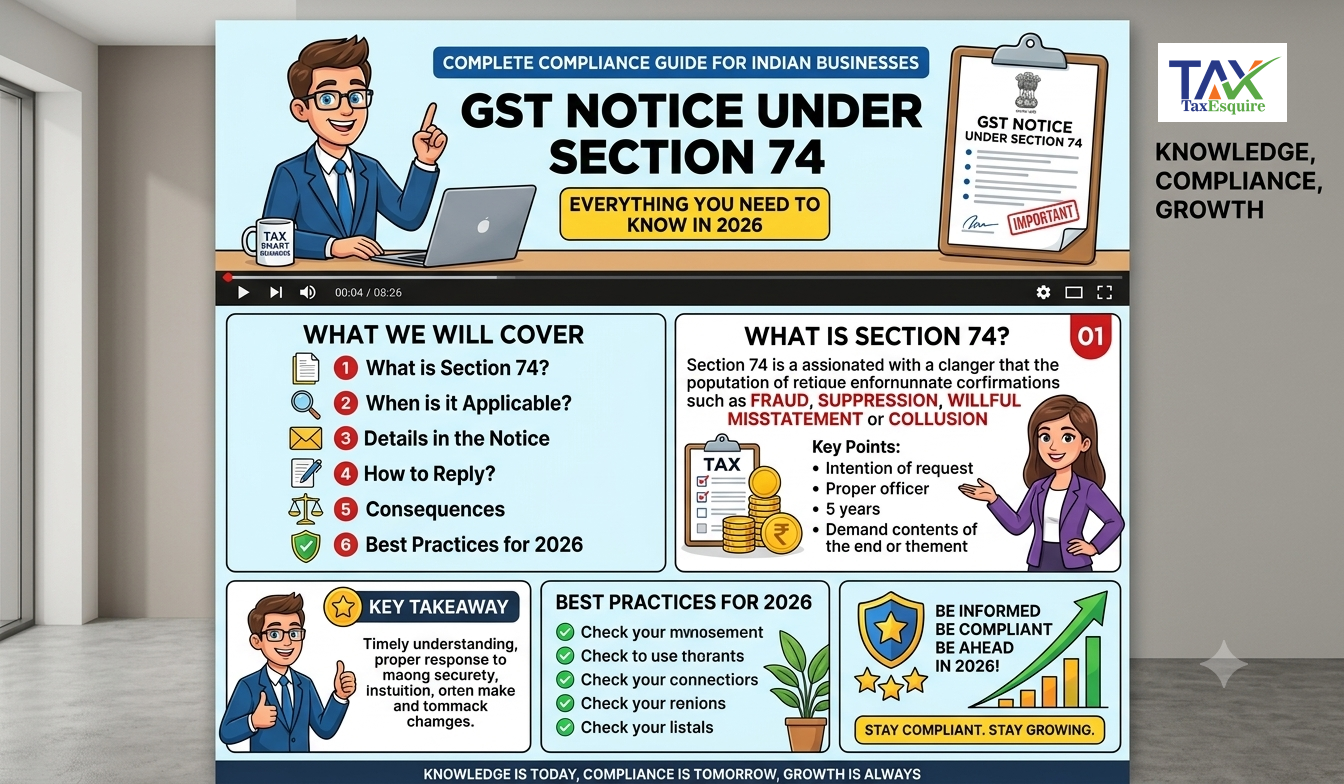
GST Notice Under Section 74
Everything you need to know about responding to GST notices and protecting your business
What Is a GST Notice Under Section 74?
A GST notice under Section 74 is basically an official demand from the GST authorities asking you to explain a discrepancy or issue in your tax filing. When the tax officer finds something that doesn't add up—maybe your input tax credit doesn't match your supplier's output, or there's a mismatch in your returns—they send you this notice.
And here's the thing: this isn't necessarily a penalty notice. It's a show-cause notice. The officer is giving you a chance to explain yourself before they take action. That's actually good news because you get to make your case.
The notice asks you to show why they shouldn't demand payment of the tax amount they think you owe. So what does this mean for you? It means you have time to gather documents, check your records, and respond properly.
When Do You Get a Section 74 Notice?
The tax officer issues this notice when they spot issues during their review of your returns. This could happen for many reasons.
- Your input tax credit doesn't match your supplier's filed returns
- You've claimed ITC on invoices that don't exist or are fake
- There's a mismatch between your purchase and sales records
- You've claimed tax credit on blocked items (like personal consumption goods)
- Your turnover or tax liability looks suspicious based on industry standards
- You've missed reporting certain supplies or claimed wrong tax rates
Basically, any discrepancy that the system or the officer catches can trigger this notice. The good news? You get 7 days to respond (or sometimes 15 days depending on the notice). That's your window to act.
Ignoring a Section 74 notice is a serious mistake. If you don't respond within the given timeline, the officer can demand payment of the full amount without hearing your side. This can lead to penalties up to 50% of the tax due, plus interest.
Key Differences: Section 74 vs. Section 73 Notices
People often mix up Section 73 and Section 74 notices. Let me clear this up because it matters.
| Feature | Section 73 | Section 74 |
|---|---|---|
| What it is | Self-assessment notice (you report the error) | Show-cause notice (officer found the error) |
| Who initiates | You (voluntary) | Tax officer |
| Penalty | Lower (25% of tax) | Higher (50% of tax) |
| Your chance to respond | Not applicable | Yes, you must respond |
| Timeline to respond | N/A | 7 to 15 days |
The key difference? With Section 73, you're coming clean yourself and the penalty is lighter. With Section 74, the officer caught you and you need to explain. To be fair, Section 74 is still better than a full audit because you get a chance to respond before they assess.
Step-by-Step: How to Respond to a Section 74 Notice
Let's walk through exactly what you need to do when you get this notice. This is where most businesses go wrong.
Step 1: Read the Notice Carefully
Don't panic. Read it twice. The notice will clearly state what discrepancy they found and what they want you to explain. Highlight the specific issue. Is it about ITC? Is it about a mismatch with a supplier? Is it about a specific invoice?
Mark the deadline clearly. This is crucial. If you miss it, you're in trouble.
Step 2: Gather All Relevant Documents
Now comes the hard work. You need to collect every document that supports your position. This includes:
- Original invoices and purchase orders
- Payment proofs (bank statements, cheques, NEFT records)
- Goods receipt notes and delivery challan copies
- Supplier's GST registration certificate and GSTIN
- Your GST returns (GSTR-1, GSTR-2A, GSTR-3B) for the relevant period
- Email correspondence with the supplier
And honestly, if you don't have some of these documents, that's a problem you need to address head-on in your response.
Step 3: Analyze the Issue
Look at what the officer is questioning. Are they right? Is there actually an error in your filing? Be honest with yourself here. If you made a mistake, you're better off correcting it voluntarily than having the officer catch more issues later.
If you think the officer is wrong, identify exactly why. Maybe the supplier didn't file their return yet. Maybe the invoice was later canceled. Maybe you rejected the goods. Document your reasoning.
Step 4: Prepare Your Written Response
Your response should be clear, professional, and point-by-point. Address each issue the officer raised. Don't ramble. Keep it factual.
Here's a basic structure:
- Acknowledge the notice and the specific discrepancy
- Explain your position clearly
- Provide documentary evidence
- If you made an error, explain how you'll correct it
- Request that the notice be dropped or modified
Put simply, be straightforward. The officer wants to see that you're serious about compliance.
Step 5: Submit Your Response on Time
Submit it through the GST portal if possible, or hand-deliver it to the office. Get a receipt. Don't email it unless the notice specifically says email is acceptable. Keep a copy for your records.
Submit it well before the deadline—don't wait until the last day. If you need more time, request an extension in writing before the deadline expires.
If you respond promptly with proper documentation, the officer may close the notice without demanding any payment. Even if they find an error, your cooperation can result in a lower penalty.
Common Reasons for Section 74 Notices in 2026
Based on what we're seeing in 2026, here are the most common triggers for these notices.
ITC Mismatches: This is the number one reason. Your GSTR-2A shows invoices from suppliers, but your GSTR-3B claims different ITC amounts. The system flags this automatically now.
Fake or Blocked Invoices: You've claimed ITC on invoices that the supplier never filed, or on goods that aren't eligible for ITC (like personal items or banned supplies).
Supplier Issues: Your supplier has been marked as fake or deregistered, and you claimed ITC on their invoices. The system catches this automatically.
Missing Documentation: You claimed ITC but don't have the invoice or supporting documents. The officer is asking you to prove the transaction happened.
Turnover Mismatches: Your sales don't match your purchases by a wide margin, or your GST liability looks wrong compared to similar businesses in your industry.
And that's really it. Most notices fall into these categories. If you stay on top of your ITC reconciliation and keep good records, you'll avoid most of these issues.
What Happens If You Don't Respond?
This is important. If you ignore the notice, here's what happens:
- The officer assumes you have no defense and issues an assessment order
- You're liable for the full tax amount the officer thinks you owe
- You pay a penalty of 50% of the tax due (this is steep)
- You pay interest at 18% per annum on the unpaid amount
- Your GST registration can be canceled for non-compliance
- You lose your right to appeal at the commissioner level
So basically, non-response turns a manageable issue into a financial and legal nightmare. Don't do it.
Penalties Under Section 74
Let's talk about the money side. What penalties might you face?
| Scenario | Tax Due | Penalty | Interest |
|---|---|---|---|
| You respond with proof and are correct | ₹0 | ₹0 | ₹0 |
| You respond but have a minor error | ₹50,000 | ₹25,000 (50%) | 18% p.a. |
| You don't respond at all | ₹50,000 | ₹25,000 (50%) | 18% p.a. |
| You respond but with fake documents | ₹50,000 | ₹25,000 + criminal charges | 18% p.a. |
The penalty is 50% of the tax amount. So if the officer says you owe ₹1 lakh in tax, you'll pay ₹50,000 in penalty. That's on top of the tax itself and interest.
But here's the good news: if you respond properly and the officer sees you were trying to comply, they sometimes reduce or waive the penalty. It depends on how genuine your mistake was.
Don't ever submit fake documents or try to mislead the officer. If they catch you, you're looking at criminal prosecution, not just financial penalties. This can lead to imprisonment.
Real Example: How a Business Handled a Section 74 Notice
Let me walk you through a real scenario that happened in 2026.
A trading company in Delhi received a notice claiming they'd claimed ₹3 lakhs in ITC on invoices from a supplier who'd been deregistered for non-filing. The officer wanted to know why they'd claimed ITC on a blocked supplier's invoices.
Here's what they did right:
- They immediately gathered all invoices and payment proof
- They checked the supplier's status and saw he'd been deregistered later (after they'd bought the goods)
- They submitted a detailed response showing the transaction was genuine and the goods were received
- They provided bank statements proving payment
- They explained that they weren't aware of the supplier's deregistration at the time of purchase
The officer reviewed their response and closed the notice without demanding any payment. Why? Because they'd shown they acted in good faith and had proper documentation.
The lesson here: proper documentation and quick response can save you thousands.
How to Prevent Section 74 Notices
Prevention is better than cure. Here's what you should be doing now in 2026.
Keep Your ITC Records Clean
Match your GSTR-2A with your GSTR-3B every month. If there's a mismatch, investigate it immediately. Don't just claim ITC and hope nobody notices.
Verify Your Suppliers
Check your supplier's GST registration status before you buy from them. Use the GST portal to verify their GSTIN. If they're already flagged as fake or deregistered, don't buy from them.
Maintain Proper Documentation
Keep invoices, delivery notes, payment proof, and communication with suppliers. File everything systematically. If the officer asks for something, you should be able to produce it within 48 hours.
Review Your Returns Before Filing
Don't file your returns in a rush. Check the numbers. Make sure your sales match your invoices. Make sure your ITC is legitimate.
Get Professional Help
Hire a CA to review your GST compliance. They can spot issues before the officer does. This investment usually pays for itself by helping you avoid notices and penalties.
Frequently Asked Questions
Q1: How much time do I have to respond to a Section 74 notice?
You typically have 7 days from the date of the notice. In some cases, it can be extended to 15 days. The notice will clearly state the deadline. If you need more time, send a written request to the officer before the deadline asking for an extension. Don't miss the deadline—there's no grace period.
Q2: Can I respond to the notice verbally or do I need to write it?
You must respond in writing. A verbal response won't be accepted. Your written response should be clear, factual, and supported by documents. Send it through the GST portal if possible, or hand-deliver it to the tax office with a receipt.
Q3: What if I don't have all the documents the officer is asking for?
Be honest about it. Explain in your response which documents you don't have and why. If the goods were received but you've lost the delivery note, explain that. If the supplier didn't give you an invoice, explain that too. The officer will consider your explanation. But if you're missing critical documents like invoices, you'll likely lose the ITC claim.
Q4: Can I appeal if the officer rejects my response?
Yes, absolutely. If the officer issues an assessment order after rejecting your response, you can appeal to the Appellate Authority. You'll need to file the appeal within 30 days of receiving the order. But appeals take time and money. It's better to get it right the first time with a solid response.
Q5: What's the difference between a notice and an assessment order?
A notice is the officer asking you to explain. An assessment order is the officer's final decision after considering (or ignoring) your response. The notice gives you a chance. The assessment order is binding unless you appeal. So respond to the notice seriously—it's your only chance to avoid an unfavorable assessment.
When to Hire a CA or Tax Professional
You should get professional help if:
- The notice involves large amounts of money (above ₹5 lakhs)
- You're not sure whether you're right or wrong
- The issue is complex (multiple invoices, multiple suppliers)
- You've already had dealings with this officer before
- You don't have all the documents and need to explain why
- You want to file an appeal if the notice becomes an assessment order
A good CA can help you craft a response that the officer will take seriously. They know how officers think and what kind of explanations work. It's worth the investment.
Final Thoughts
A Section 74 notice isn't the end of the world. It's actually a chance to explain yourself before things get worse. Many businesses get these notices and come out fine.
The key is to respond promptly, honestly, and with proper documentation. Don't panic. Don't ignore it. Don't try to mislead the officer.
And going forward, keep your GST records clean. Match your ITC monthly. Verify your suppliers. File your returns carefully. These simple steps will help you avoid most notices.
If you're facing a notice right now, take action today. Gather your documents, prepare your response, and get professional help if you need it. Time is your friend only if you use it wisely.
" } ```
© 2026 Tax Esquire | Expert CA Services in Greater Noida, Uttar Pradesh
8810380146 | info.taxesquire@gmail.com | taxesquire.in
This document is for informational purposes only. For personalised tax advice, consult our chartered accountants.